IFS ERP System: Scalable, Industry-Focused ERP for Modern Enterprises
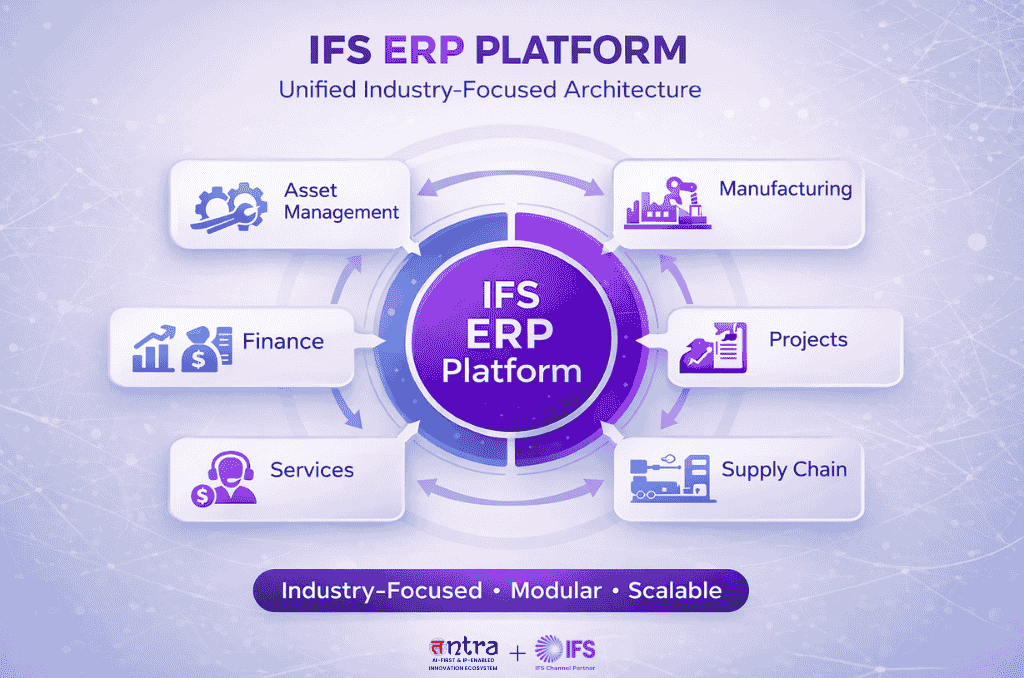
The IFS ERP system is an IFS enterprise ERP platform purpose-built for organizations managing complex operations and asset-intensive environments. Unlike generic ERP systems, IFS ERP software integrates asset management, manufacturing, projects, services, and finance into a unified, modular, and cloud-based ERP system.
This article explains what is IFS ERP and how it works, who it’s best suited for, why enterprises choose it over traditional ERP platforms, and how IFS ERP implementation delivers long-term operational value across industries.
When Growth Creates Complexity, ERP Becomes Strategic
There comes a point in every growing enterprise where momentum is no longer the biggest challenge.
Coordination is.
Teams are capable. Decisions slow down. Information fragments. Leaders feel the organization working hard—but not always together.
Growth introduces layers of assets, regulations, processes, systems, and expectations. This is the moment when ERP stops being background infrastructure and becomes a strategic conversation.
The IFS ERP system was built precisely for this phase—supporting enterprises where operations are physical, regulated, interconnected, and constantly evolving.
Unlike transactional platforms, IFS ERP software understands that enterprise work is rarely linear. Assets age. Projects shift. Supply chains fluctuate. Reliability matters more than promises.
What distinguishes IFS enterprise ERP is not its ambition to cover everything—but its clarity around what matters most in complex industries.
Why Industry Focus Changes the ERP Conversation Entirely
For years, ERP evaluations focused on feature checklists.
Today, relevance matters more than breadth.
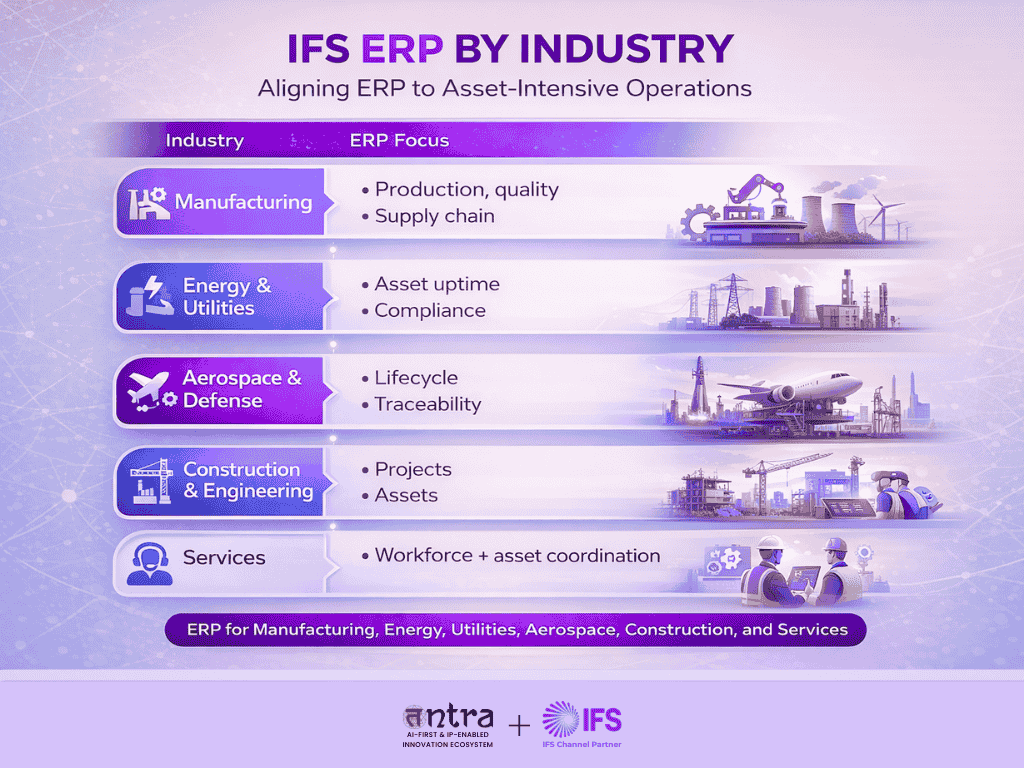
Manufacturing adapts daily. Engineering evolves continuously. Energy and utilities operate infrastructure that cannot fail. Aerospace and defense programs span decades.
This is where industry-focused ERP software changes everything.
The IFS ERP solution for enterprises embeds industry logic directly into its core:
- Asset management is foundational—not an add-on
- Project execution is native—not a workaround
- Service operations connect seamlessly with finance
Supported by a modular ERP platform, enterprises adopt capabilities incrementally while maintaining a single source of truth. This makes IFS ERP a dependable ERP modernization platform and a truly scalable ERP system.
Asset-Centric ERP Built for Real-World Operations
In asset-intensive environments, assets represent value, risk, and continuity.
As an ERP with asset management at its core, the IFS ERP platform treats assets as living operational entities. Maintenance, inventory, workforce planning, compliance, and finance all draw from shared asset intelligence.
For organizations using ERP for asset-intensive industries, the benefits appear quietly:
- Fewer emergency failures
- Clearer investment priorities
- Improved lifecycle cost visibility
This is how IFS ERP supports ERP for complex operations—by connecting decisions across departments instead of isolating them.
Manufacturing and Engineering: Built for Constant Change
Manufacturing and engineering environments evolve daily.
The IFS ERP solution supports ERP for manufacturing and engineering by connecting planning, execution, quality, and supply chain data into one continuous operational flow.
Engineering changes cascade naturally into production. Inventory planning reflects reality. Quality data supports learning—not blame.
For enterprises evaluating IFS ERP for manufacturing and energy companies, this integration delivers resilience rather than rigidity.
Energy, Utilities, Aerospace & Defense: Zero Margin for Failure
Some industries operate without room for error.
The IFS ERP system enables:
- ERP for energy and utilities with real-time asset visibility, workforce coordination, and regulatory alignment
- ERP for aerospace and defense with long-lifecycle tracking, compliance, and secure program management
This makes IFS ERP a trusted ERP system for global enterprises where uptime, traceability, and governance are non-negotiable.
Seeing IFS ERP in action matters—especially in asset-heavy environments.
Explore how utilities and energy companies are using IFS services to reduce operational costs, improve asset uptime, and gain real-time visibility across infrastructure.
Read how IFS helps utilities and energy companies optimize costs: https://www.tntra.io/blog/ifs-services-utilities-energy-companies-cost-optimization/
Cloud Flexibility Without Losing Enterprise Control
Enterprises now approach cloud strategically.
The IFS cloud ERP offering supports multiple deployment models, making IFS ERP cloud vs on-premise a business decision—not a limitation.
As a cloud-based ERP system, IFS ERP delivers scalability, availability, and continuous innovation while maintaining enterprise-grade security and compliance.
Cloud adoption is not just a deployment decision—it’s an operating model shift.
If you’re evaluating how cloud ERP impacts scalability, security, and continuous innovation, this perspective explains why IFS Cloud matters for modern enterprises.
Is IFS ERP Suitable for Large Enterprises?
When leaders ask is IFS ERP suitable for large enterprises, adoption patterns provide the answer.
The IFS ERP system supports multinational complexity, high transaction volumes, and diverse operational models—making it a strong ERP system for global enterprises.
Legacy ERP systems often limit agility long before leaders realize it.
If your organization is navigating modernization decisions, this article explores why global enterprises are moving from legacy ERP to IFS—and what they gain in the process.
Discover why global enterprises choose IFS ERP over legacy systems
Read more: https://www.tntra.io/blog/why-global-enterprises-choose-ifs-erp-over-legacy-erp/
IFS ERP Implementation: A Moment of Organizational Alignment
An IFS ERP implementation is not just a technology project—it’s an organizational inflection point.
Successful implementations focus on intent, not urgency. Leadership clarifies outcomes beyond go-live and treats ERP as a long-term foundation.
Because IFS ERP mirrors real workflows, teams often recognize their own processes in the system. Resistance turns into refinement.
This is where IFS ERP implementation challenges and best practices matter most—not in technology, but in human adoption.
Understanding IFS ERP Implementation Challenges
Common challenges include:
- Aligning global and local processes
- Preparing accurate, reality-based data
- Helping teams see enterprise-wide impact
- Managing expectations during transition
Enterprises succeed when they emphasize communication, phased rollouts, and continuous feedback.
Experienced IFS ERP consultants play a critical role—acting as translators between system capability and operational reality.
The Strategic Role of IFS ERP Consulting
ERP success depends on partnership.
Through IFS ERP consulting and IFS consulting services, enterprises align system capabilities with business outcomes—not just features.
A trusted IFS ERP consulting partner supports:
- Change management
- Governance design
- Scalable architecture decisions
This transforms ERP from a project into a long-term enterprise capability.
Enterprise IFS ERP Implementation Services at Scale
Large organizations require enterprise IFS ERP implementation services designed for complexity.
These services balance:
- Global consistency
- Local flexibility
- Governance without rigidity
This is where the IFS ERP platform demonstrates its strength as a scalable ERP system.
Embedded Intelligence That Supports Human Judgment
The IFS ERP platform includes ERP with embedded AI—supporting predictive maintenance, forecasting, and analytics within daily workflows.
Rather than replacing decision-makers, intelligence enhances context and clarity.
This balance reflects why IFS ERP excels at ERP for digital transformation without disrupting operational maturity.
Continuous ERP Modernization
Through IFS ERP modernization services, enterprises evolve gradually—adopting analytics, AI, and cloud capabilities when ready.
Modernization becomes a continuous conversation, not a disruptive event.
Final Reflection: ERP That Respects How Work Actually Happens
At its best, enterprise software fades into the background. It supports conversations rather than dominating them. It enables decisions rather than complicating them.
The IFS ERP system embodies this philosophy. It brings together people, processes, and assets in a way that feels intuitive, grounded, and human.
For modern enterprises navigating complexity with ambition and care, IFS enterprise ERP offers more than functionality. It offers a foundation for clarity, resilience, and thoughtful growth.
At Tntra, we help organizations evaluate, implement, and modernize IFS ERP with a deep understanding of industry realities, asset-intensive operations, and large-scale transformation.
Talk to our experts about making IFS ERP work for your enterprise.
Schedule a call now.
FAQs
What is IFS ERP?
IFS ERP is an industry-focused ERP software designed for asset-intensive and complex enterprises, combining finance, manufacturing, asset management, projects, and services into a single scalable ERP system.
Who should use it?
Mid-to-large enterprises in manufacturing, engineering, energy & utilities, aerospace & defense, construction, and service-centric industries.
Why choose IFS ERP over traditional ERP?
Because it aligns ERP functionality with real operational workflows—especially assets, projects, and services—rather than generic transactional processes.
When is IFS ERP the right choice vs SAP or Oracle?
When industry depth, asset lifecycle management, and operational clarity matter more than broad but generic functionality. This distinction becomes clearer when leaders evaluate IFS ERP vs SAP for manufacturing enterprises, particularly where asset lifecycle management and operational depth matter more than generic ERP breadth.
What industries is IFS ERP best suited for?
Manufacturing, engineering, energy & utilities, aerospace & defense, construction, and service-centric enterprises.
Does IFS ERP support cloud deployment?
Yes. IFS cloud ERP supports cloud, on-premise, and hybrid deployments.
How scalable is the IFS ERP system?
Highly scalable—designed as an ERP system for global enterprises.
Is IFS ERP a good alternative to SAP or Oracle?
Yes, especially when industry depth and asset-centric operations matter more than generic ERP breadth.
| Top Questions to Ask Before Choosing an IFS Consulting Partner. Read more: https://www.tntra.io/blog/ifs-consulting-partner-top-questions-to-ask/ |