IFS Enterprise Service Management Architecture: Extending ITSM Across the Enterprise
IFS ESM architecture extends the structured, ticket-driven service management discipline that IT departments have relied on for decades into HR, facilities, finance, and legal, giving the entire enterprise one consistent service delivery model. IFS enterprise service management architecture built on IFS Cloud succeeds specifically because it does not force non-IT departments into an IT-shaped workflow, it adapts the underlying service model to fit each department’s actual operational reality.
Key Takeaways
- Extends ITSM beyond IT.
- Uses one shared platform with department-specific workflows.
- Automates HR, Finance, Facilities and Legal services.
- Integrates natively with IFS Cloud ERP.
- Improves SLA compliance and employee experience.
- Provides enterprise-wide reporting with secure access controls.
IFS ESM architecture and IFS enterprise service management solutions address a problem that most large organizations have lived with for so long they have stopped noticing it as a problem at all.
IT departments have run on structured service management discipline for decades. Tickets get logged, categorized, assigned, tracked against service level agreements, and closed with an audit trail. Meanwhile, just a few floors away, an employee requesting a new laptop gets that disciplined experience, while the same employee requesting a facilities repair, a benefits clarification from HR, or an expense approval from finance gets routed through an email chain, a shared inbox, or a phone call that nobody tracks and nobody measures against any defined standard.
Here is the angle that most ESM conversations miss entirely. The natural instinct when extending service management beyond IT is to take the existing ITSM tool and simply open it up to other departments, asking HR and facilities to use the same ticket categories, the same workflow templates, and the same service catalog structure that IT built for itself.
This consistently fails, not because the other departments resist change, but because IT service requests and HR service requests are structurally different kinds of work. An IT ticket is almost always about restoring or changing a technical state.
An HR case is frequently about a sensitive, confidential, multi-step human process that legitimately needs different data handling, different approval chains, and different visibility rules.
IFS ESM framework design succeeds precisely because it treats this as an architecture problem, building one common service management foundation that can be configured differently for each department’s genuine operational reality, rather than forcing every department into IT’s specific mold.
This distinction, common foundation with department-specific configuration rather than department-specific tools or a single rigid template, is the critical architectural insight that determines whether an enterprise service management rollout actually succeeds.
- Foundation versus template: The right way to extend ITSM is to build a shared IFS service management platform foundation, not to force every department to adopt IT’s specific workflow templates
- Visibility with appropriate boundaries: IFS Cloud Enterprise Service Management needs to give leadership cross-department visibility into service performance while still respecting the legitimate confidentiality requirements that HR and legal cases carry.
- Workflow automation as the real value driver: IFS workflow automation delivers most of its value not from ticket tracking itself but from automating the multi-step approval and routing logic that currently happens manually across departments.
- Single platform, multiple service catalogs: IFS ITSM and ESM solution architecture allows IT, HR, facilities, and finance to each maintain their own service catalog and workflow rules while running on the same underlying platform and reporting infrastructure.
What is IFS Enterprise Service Management?
What is IFS Enterprise Service Management is the foundational question worth answering precisely, because the term Enterprise Service Management gets used loosely across the industry to describe everything from a simple rebranded help desk to a genuinely integrated cross-departmental service platform.
IFS ESM framework is the application of structured IT service management discipline, including ticket logging, categorization, workflow routing, service level agreement tracking, and knowledge base management, extended deliberately to non-IT business functions including HR, facilities, finance, and legal.
Built within IFS Cloud Enterprise Service Management, this framework gives every department the same disciplined service delivery experience that IT has used for years, while allowing each department to configure the specific categories, approval chains, and data handling rules that its work actually requires.
How does IFS ESM extend traditional ITSM comes down to recognizing that the core service management discipline, structured intake, defined ownership, tracked resolution, and measured performance, is universally valuable across departments, even though the specific content of what gets requested and how it gets resolved varies enormously between an IT password reset and an HR leave-of-absence case.
The Architecture Behind IFS ESM
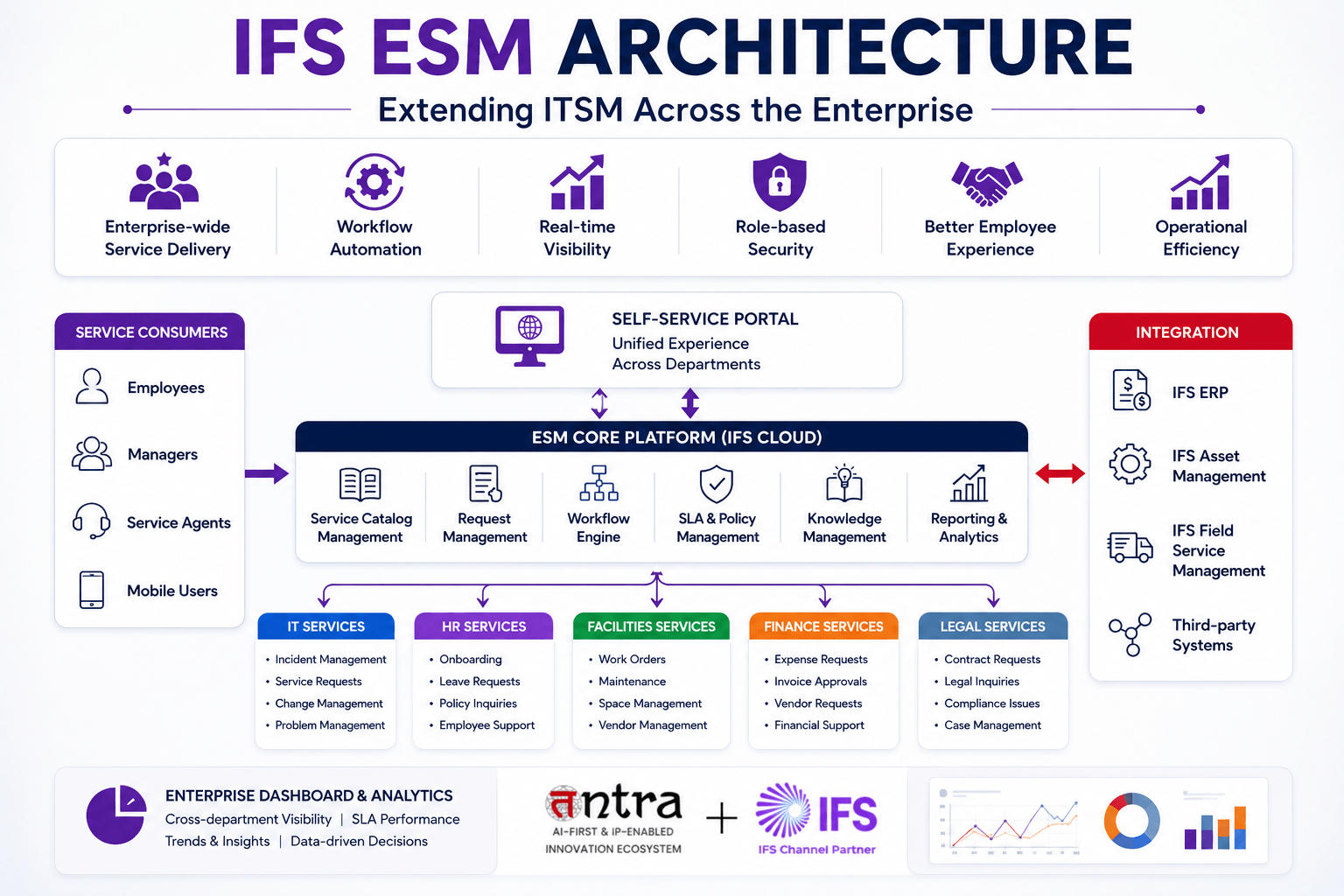
IFS ESM architecture is built around several interconnected layers that together make the shared-foundation, department-specific-configuration approach actually work in practice.
The Common Service Management Core
At the foundation sits a common service management engine that handles the universal mechanics every department needs regardless of its specific domain: request intake, categorization, assignment routing, status tracking, escalation rules, and resolution closure with full audit history.
- Unified intake layer: Every department-specific portal, whether for IT, HR, facilities, or finance, feeds into the same underlying intake and ticketing engine, which is what enables consistent enterprise-wide reporting without requiring separate reporting infrastructure for each department.
- Configurable workflow engine: The same workflow automation engine that routes an IT incident to the correct technician can be configured to route an HR onboarding request through a completely different sequence of approvers, without requiring separate software.
- Shared knowledge base infrastructure: A common knowledge base platform allows each department to publish its own self-service articles and FAQs, reducing ticket volume across IT, HR, and facilities using the same underlying content management capability.
Department-Specific Service Catalogs
This is where IFS ESM best practices diverge most sharply from the simplistic approach of just opening up the IT tool to other departments.
- IT service catalog: Remains structured around technical asset categories, incident severity levels, and change management processes that IT departments have refined over years of ITIL-aligned practice.
- IFS ESM for HR and facilities management: HR service catalogs are structured around employee lifecycle events, including onboarding, benefits changes, leave requests, and performance management cases, each with appropriate confidentiality controls that restrict visibility to authorized HR personnel rather than the general service desk team.
- Facilities service catalog: Facilities catalogs are organized around physical asset and space management, covering maintenance requests, space reservations, and safety incident reporting, often requiring integration with building management systems that IT service catalogs never need to touch.
- Finance and legal catalogs: Finance service requests, including expense approvals and procurement requests, and legal service requests, including contract review and compliance queries, each carry their own approval hierarchies and documentation requirements distinct from both IT and HR.
Cross-Department Visibility With Appropriate Boundaries
IFS digital service management architecture has to solve a genuine tension: leadership wants visibility into service performance across the whole enterprise, while individual departments, particularly HR and legal, have legitimate reasons to restrict who can see the details of specific cases.
- Role-based access control: Granular permission structures ensure that a facilities manager cannot see the contents of an HR leave request, even though both tickets exist within the same underlying platform and contribute to the same enterprise-wide performance dashboards.
- Aggregate reporting without case-level exposure: Leadership dashboards can show volume, resolution time, and satisfaction metrics aggregated across HR, facilities, and IT, without exposing the confidential content of any individual case, satisfying the executive need for visibility without compromising departmental confidentiality requirements.
- Audit trail consistency: Every department benefits from the same rigorous audit trail discipline that IT service management has long required for compliance purposes, which becomes particularly valuable when HR or legal cases face later scrutiny.
IFS Cloud as the Implementation Foundation
IFS Cloud ESM matters specifically because it is delivered as part of the broader IFS Cloud platform rather than as a standalone point solution, which has real architectural consequences for how well enterprise-wide service management actually performs.
Because enterprise service management with IFS Cloud sits on the same platform as IFS’s ERP, asset management, and field service capabilities, service requests that originate in one functional area can trigger automated actions in another without requiring custom integration work.
A facilities maintenance request logged through ESM can automatically check asset maintenance history within IFS’s asset management module. An HR onboarding case can automatically trigger provisioning workflows that touch IT asset assignment and finance payroll setup, all coordinated through the same underlying platform rather than through brittle point-to-point integrations between separate systems.
This integration depth is the unique architectural advantage that distinguishes IFS enterprise service management implementation from generic ESM tools that were built purely as service desk software with no native connection to the broader enterprise systems that most service requests actually need to interact with.
- Native ERP connectivity: Service requests that touch finance, procurement, or asset management can pull and push data directly from IFS Cloud’s ERP modules without custom middleware.
- Single data model: Because IFS Cloud uses a consistent underlying data model across modules, employee records, asset records, and organizational hierarchy used in ESM workflows are the same records used elsewhere in the platform, eliminating data synchronization issues that plague organizations running separate ESM and ERP systems.
- Unified upgrade path: Organizations running IFS Cloud Enterprise Service Management benefit from the platform’s unified update cycle, avoiding the version compatibility issues that arise when a standalone ESM tool and a separate ERP system need to be upgraded independently.
IFS Service Request Management in Practice
IFS service request management is the operational layer that employees and customers actually interact with day to day, and its design quality determines whether the broader architecture investment translates into genuine adoption.
- Self-service portal: A unified portal gives employees a single starting point for any service request, whether it is IT-related, HR-related, or facilities-related, with intelligent routing that directs the request to the correct department’s configured workflow behind the scenes.
- Mobile accessibility: Field-based employees and facilities staff need mobile access to log and update service requests from wherever they are working, particularly relevant for facilities management cases that originate from physical locations rather than desk-based work.
- Automated status updates: Requesters receive automated status notifications as their request moves through the configured workflow, reducing the volume of status-check follow-up communications that consume significant time across all departments without a structured system.
- SLA-driven prioritization: Each department’s service catalog can define its own service level agreement targets, and the platform automatically prioritizes and escalates requests that are approaching or breaching those targets, regardless of which department owns the request.
The Benefits of IFS ESM Architecture for Large Enterprises
What are the benefits of IFS ESM architecture extend well beyond the obvious efficiency gains of replacing email-based request handling with structured ticketing.
- Consistent employee experience: Employees get the same predictable, trackable service experience regardless of which department they are requesting support from, which measurably improves internal satisfaction scores compared to the inconsistent experience that siloed departmental processes produce.
- Cross-department process visibility: Leadership gains genuine visibility into where service delivery bottlenecks exist across the entire enterprise, rather than only within IT, enabling more informed resource allocation decisions across HR, facilities, and finance.
- Reduced shadow IT and shadow processes: When HR, facilities, and finance have a properly designed service management option available to them, they are far less likely to build informal workarounds, spreadsheets, or unsanctioned tools to manage their own request volume.
- Compliance and audit readiness: The consistent audit trail discipline that ESM architecture brings to every department significantly improves an organization’s readiness for compliance audits that touch HR processes, financial approvals, or facilities safety incidents.
How IFS ESM Improves Service Delivery?
How does IFS ESM improve service delivery is ultimately a question about reducing the friction and ambiguity that characterizes most non-IT service requests in organizations that have never extended structured service management beyond the help desk.
When a facilities request, an HR case, or a finance approval enters a structured workflow with defined ownership, tracked status, and measured resolution time, the entire organization benefits from the same discipline that IT departments learned to value decades ago: nothing falls through the cracks silently, everyone involved knows what stage a request is at, and the data generated by the process itself becomes a valuable input for identifying where the organization needs to invest in better processes, more staffing, or improved self-service options.
Implementing IFS ESM: What Enterprises Should Plan For
IFS ESM architecture for enterprise service delivery implementation succeeds when organizations resist the temptation to roll out every department simultaneously. The most successful implementations typically extend from IT, where service management discipline already exists, into one additional department at a time, starting with whichever non-IT function has the most acute pain around its current informal process.
This phased approach allows the organization to refine its configurable workflow templates, role-based access rules, and reporting structure with a single new department before expanding further, rather than attempting to design HR, facilities, and finance workflows simultaneously without the benefit of lessons learned from an initial rollout.
Benefits of implementing IFS ESM compound with each additional department onboarded, because the shared platform investment, the common reporting infrastructure, and the organizational change management experience gained from the first department’s rollout all reduce the cost and risk of extending to subsequent departments.
Conclusion
IFS enterprise service management architecture succeeds where generic attempts to extend ITSM fail because it is built around a foundation-plus-configuration model rather than a one-size-fits-all template. IT keeps its technical service catalog. HR gets confidential, lifecycle-appropriate case management.
Facilities get physical assets and space-aware workflows. Finance gets approval-chain-appropriate request handling. All of it runs on the same underlying platform, contributes to the same enterprise-wide visibility, and benefits from the native integration that IFS Cloud’s unified data model provides.
Organizations that understand this architectural distinction before they begin implementation consistently achieve far better adoption and far more durable value than those that simply hand other departments the IT team’s existing tool and hope it fits.
How Tntra Supports IFS ESM Implementation?
At Tntra, our work as an IFS consulting partner and IFS digital transformation partner helps enterprises design and implement IFS cloud enterprise service management architecture that genuinely fits each department’s operational reality rather than forcing a single IT-shaped template across the organization.
Our IFS implementation services and IFS Cloud consulting practice covers the full ESM rollout lifecycle, from department-specific service catalog design through workflow automation configuration through IFS ERP Integration that connects service requests directly to the broader IFS Cloud platform.
Our enterprise service management consulting and IFS managed services capability ensures that ESM architecture continues to perform and evolve well beyond initial go-live.
Our Digital Transformation Services and IFS Cloud migration services help organizations modernizing their broader technology estate extend that same transformation discipline into Enterprise Service Management and IFS Cloud Services more broadly.
If your organization is ready to extend structured service management beyond IT, Connect with the Tntra team today.
Ready to modernize Service delivery across your Enterprise?
Tntra helps organizations design, implement, and optimize IFS ESM solutions that improve operational efficiency, automate workflows, and accelerate digital transformation. Speak with our IFS experts to plan your ESM roadmap.
FAQs
What is IFS Enterprise Service Management Architecture?
IFS Enterprise Service Management (ESM) architecture extends traditional IT Service Management (ITSM) principles across HR, finance, facilities, legal, and other business functions. Built on IFS Cloud, it provides a unified service management platform with configurable workflows, role-based access, automation, and enterprise-wide visibility while allowing each department to maintain its own processes.
What is IFS ESM?
IFS Enterprise Service Management extends structured IT service management discipline, including ticketing, workflow routing, and SLA tracking, into HR, facilities, finance, and legal departments, built natively on the IFS Cloud platform.
How is IFS ESM different from ITSM?
IFS ESM applies the same structured service delivery discipline that ITSM uses for IT requests to non-IT departments, with department-specific service catalogs, workflows, and access controls configured for each function rather than a single IT-shaped template.
Which business functions can use IFS ESM?
IT, HR, facilities, finance, and legal departments can all use IFS ESM, each with its own configured service catalog, approval workflows, and confidentiality controls running on the same shared underlying platform.
Does IFS Cloud include Enterprise Service Management?
Yes, Enterprise Service Management is delivered as part of the broader IFS Cloud platform, giving it native integration with IFS’s ERP, asset management, and field service modules rather than functioning as a disconnected standalone tool.
What are the benefits of IFS ESM for large enterprises?
Large enterprises benefit from consistent employee service experience, cross-department visibility into service performance, reduced reliance on informal shadow processes, and improved compliance and audit readiness across HR, facilities, and finance functions.
How does IFS ESM improve service delivery?
IFS ESM improves service delivery by replacing ad hoc email and phone-based requests with structured workflows that track ownership, status, and resolution time, ensuring requests are visible and measurable rather than falling through the cracks silently.
Can IFS ESM automate HR and finance workflows?
Yes, IFS ESM can automate HR workflows such as onboarding and leave requests, and finance workflows such as expense and procurement approvals, using the same configurable workflow engine that powers IT incident and request management.