Commercial IP Strategy for Software: When to Patent and When to Keep Innovation Confidential
Choosing between patenting an innovation or keeping it confidential is a strategic business decision—not just a legal one. A commercial IP strategy for software ensures that IP innovation efforts translate into real enterprise value, protecting what matters most while avoiding unnecessary disclosure. By aligning ip strategy decisions with growth, funding, and exit goals, organizations can leverage the right mix of patents, confidentiality, and governance. This article explains when to patent software, when confidentiality works better, and how modern intellectual property services support long-term competitive advantage.
Why IP Strategy Must Start with Business and Innovation Goals
An effective software IP strategy begins with understanding how innovation creates commercial value. IP strategy should never operate in isolation from product vision, revenue models, or platform evolution.
A mature ip practice ensures that:
- Core IP innovation assets are identified early
- Protection aligns with product and go-to-market strategy
- Resources are focused on high-impact IP
- Confidential capabilities remain shielded
When organizations rely on experienced intellectual property consulting services, IP becomes a strategic business lever—not just a legal safeguard.
Patents are Only One Component of a Broader IP Practice
While patents are important, a modern intellectual property strategy for software relies on multiple protection mechanisms managed through a structured ip practice, including:
- Trade secrets
- Copyright and documentation controls
- Confidential technical know-how
- Licensing and contractual enforcement
- Enterprise-grade intellectual property management services
An experienced intellectual property specialist or ip consultant helps organizations decide when to patent software versus when confidentiality creates stronger commercial defensibility.
When Does Patenting Software Support IP Innovation?
A well-executed software patent strategy supports IP innovation when it enables clear business outcomes such as:
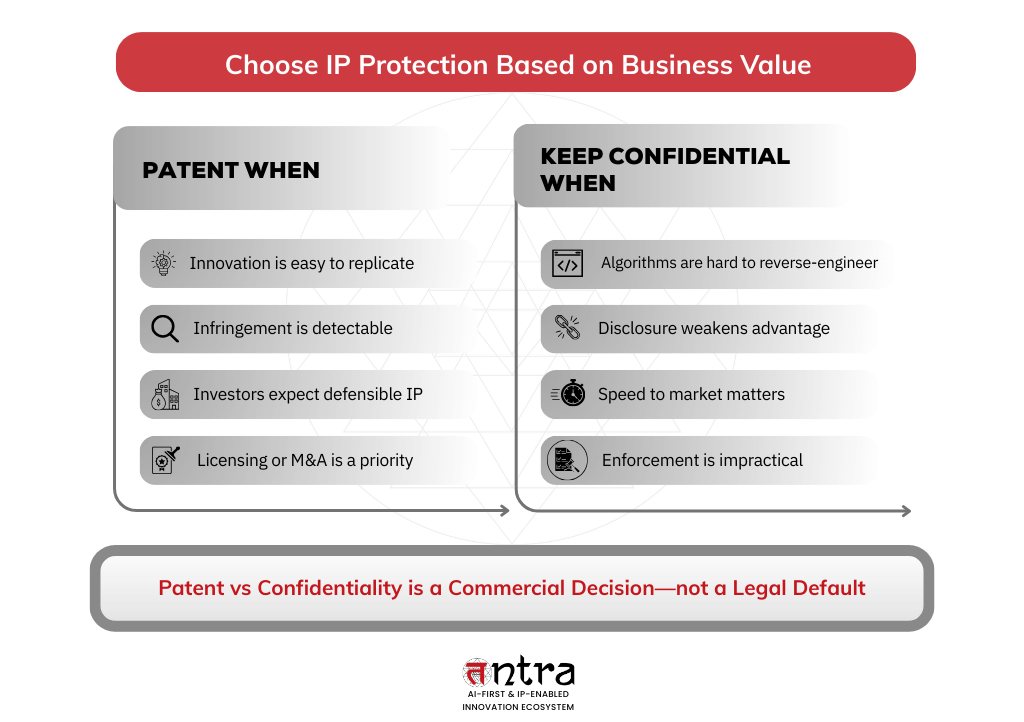
- Investment and Capital Readiness: Investors often expect evidence of formal intellectual property services supporting defensible technology—especially in SaaS, AI, and platform businesses.
- M&A and Strategic Exits: Strong software intellectual property rights, backed by intellectual property legal services, reduce diligence risk and increase transaction value.
- Market Control and Licensing: Patents may enable software IP monetization strategy through licensing, joint ventures, or controlled ecosystem access—especially when infringement is detectable.
However, patenting also introduces cost, time, enforcement challenges, and irreversible disclosure.
When Confidentiality and Trade Secrets Offer Stronger IP Protection
A software patent vs trade secret analysis often favors confidentiality—particularly when supported by robust intellectual property management services.
Confidentiality works best when:
- Innovation is difficult to reverse-engineer
- Public disclosure would weaken IP innovation advantage
- Speed to market outweighs exclusivity
- Enforcement would be costly or impractical
For many businesses, especially those protecting algorithms, workflows, and data models, trade secrets supported by an experienced intellectual property consultant deliver longer-lasting value than patents.
The Risk of Treating IP as a Checkbox Exercise
One of the most damaging mistakes organizations make is reducing ip strategy to a filing decision:
“Should we patent this?”
Without structured intellectual property consulting services, this approach often leads to:
- Misaligned filings
- Unprotected high-value innovation
- Premature disclosure of sensitive IP
- Weak support for funding and exits
A commercially aligned ip practice ensures protecting software ideas supports real business outcomes.
Interconnected software increases IP exposure.
Design an IP Strategy for Software that protects interconnected systems, platforms, and integrations. Our intellectual property services help enterprises manage complexity without exposing core innovation.
Key Questions Every IP Consultant Asks Before Patenting Software
Before committing to patent filings, experienced ip consultants and intellectual property specialists assess:
- Will this IP materially improve valuation or investor confidence?
- Does it qualify under evolving patent eligibility rules?
- Can infringement be detected and enforced?
- Would confidentiality preserve more value long-term?
- Does this align with our software product IP roadmap?
These insights determine when should software be patented and when hybrid protection models make more commercial sense.
Why IP Strategy Matters More for SaaS, AI, and Enterprise Platforms
As software becomes the backbone of enterprise value, IP strategy for SaaS startups, IP protection for AI software, and IP strategy for enterprise platforms have become board-level priorities.
Organizations that invest early in structured intellectual property services gain:
- Faster access to capital
- Reduced software IP risk management exposure
- Clear software IP monetization strategy pathways
- Stronger control over protecting machine learning models
- Scalable generative AI IP strategy frameworks
Protect Innovation Before It Reaches the Market
Build a commercially aligned IP Strategy for Software that safeguards new products from early-stage risk. Work with our intellectual property consulting services team to define the right protection approach. 👉 Plan Your IP Strategy.
Conclusion: Build IP Strategy Around Value Creation
The strongest commercial IP strategy for software is not defined by patents alone. It is shaped by how innovation is built, deployed, protected, and monetized.
When IP strategy, IP practice, and business goals move together, innovation becomes a durable commercial asset—not just protected, but positioned for scale.
At Tntra, our intellectual property consulting services help organizations align IP innovation with product engineering and enterprise growth—ensuring intellectual property supports funding, expansion, and long-term value creation.
Turn Innovation into a Commercial Asset
Build a commercially aligned IP strategy that protects what truly matters. Speak with our intellectual property consulting services team to design an IP roadmap that supports growth, funding, and long-term value creation.