IFS Enterprise Asset Management (EAM): Cloud-First Asset Intelligence for Asset-Intensive Industries
IFS Enterprise Asset Management is a cloud-first EAM platform designed for organizations where assets define performance. It supports the complete asset lifecycle, connecting maintenance, operations, and strategic decision-making in one system.
By centralizing asset data and enabling predictive maintenance using IFS EAM, the platform improves reliability, safety, and cost control. Built for enterprise scale, IFS EAM software helps asset-intensive industries manage complexity with clarity, resilience, and long-term confidence. Continue reading to learn more.
In asset-intensive industries, performance is shaped quietly and continuously. It is shaped in how maintenance teams plan work, how engineers respond to early warning signs, how leaders decide whether to repair or replace, and how effectively information flows between systems and people.
When assets are central to value creation, managing them becomes a strategic capability rather than an operational task.
IFS Enterprise Asset Management sits exactly at this intersection. It unifies asset data, maintenance intelligence, operational workflows, and cloud-based enterprise asset management into a single cohesive platform. For enterprises managing complex equipment, infrastructure, and fleets, IFS EAM for enterprises provides clarity where fragmentation once existed.
This article explores what is IFS enterprise asset management, how a cloud-first EAM platform reshapes asset strategy, and why enterprises choose IFS EAM to improve asset performance at scale.
Understanding What IFS Enterprise Asset Management Really Is
At its core, IFS Enterprise Asset Management is an enterprise-grade enterprise asset management system designed to manage assets across their entire lifecycle—from planning and acquisition to maintenance, optimization, and retirement.
What distinguishes IFS EAM software is its ability to reflect how assets behave in real-world conditions. Assets operate across locations, under regulatory pressure, and through constant human interaction. IFS EAM solution provider implementations are designed to support this operational reality rather than force rigid workflows.
As an enterprise asset management system, it supports daily operational decisions while informing long-term strategy. Maintenance teams gain clarity, operations gain reliability, and leadership gains insight grounded in accurate, connected data.
Why Cloud-First EAM Has Become Essential
Traditional EAM platforms were often site-bound, slow to evolve, and difficult to scale. Today’s operating environment demands resilience, speed, and adaptability—making cloud-based enterprise asset management essential.
IFS cloud EAM is built as a true cloud-first EAM platform, not a legacy system adapted for the cloud. Enterprises benefit from continuous updates, secure global access, and performance that scales as asset portfolios grow.
For asset-intensive organizations, this model enables real-time collaboration between field teams, planners, engineers, and leadership—without data silos or delays. It also supports faster responses to regulatory change and operational disruption, answering the question of cloud EAM vs on-premise EAM clearly.
Choosing an IFS partner? Ask the right questions—before you commit.
Read more: https://www.tntra.io/blog/ifs-consulting-partner-top-questions-to-ask/
How IFS EAM Improves Asset Performance in Practice
Asset performance depends on anticipation rather than reaction. How IFS EAM improves asset performance lies in its ability to connect operational signals with intelligent action.
Through asset performance management IFS, organizations gain visibility into asset condition, failure patterns, and maintenance effectiveness. Maintenance strategies evolve from calendar-based routines to predictive maintenance using IFS EAM and condition-based approaches aligned with actual asset behavior.
By managing complex asset lifecycles through a unified system, organizations reduce downtime, prevent cascading failures, and achieve sustained performance improvements across the asset lifecycle.
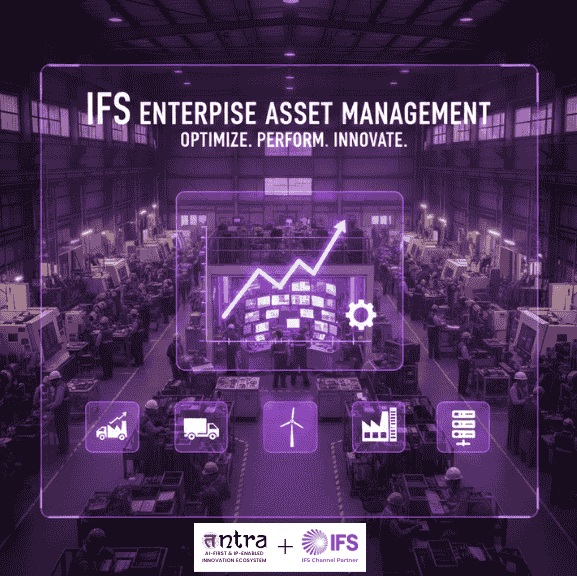
IFS Cloud EAM as a Modern Enterprise Asset Management System
A modern enterprise asset management system must integrate naturally with the broader enterprise. Assets influence production schedules, supply chains, financial planning, and customer commitments.
IFS EAM software connects asset data with work management, inventory, procurement, and financial modules. Decisions become contextual rather than isolated—enabling leaders to link asset risk directly to cost and operational impact.
Core Capabilities Supporting Enterprise-scale Asset Management
- Centralized asset registry with complete lifecycle history
- Intelligent work order and maintenance planning
- Mobile enablement for distributed field teams
- Inventory and spare-parts optimization
- Advanced analytics and reporting
Together, these capabilities create intelligent asset management software that supports operations without overwhelming teams.
Benefits of IFS Cloud EAM for Large Organizations
For large enterprises, asset management extends beyond maintenance into governance, compliance, and long-term resilience. The benefits of IFS cloud EAM include improved visibility into asset utilization, clearer lifecycle cost tracking, and stronger regulatory compliance.
Leadership teams gain standardized processes across regions while retaining local operational flexibility—an essential balance for global organizations adopting IFS enterprise asset management services.
IFS EAM Implementation and the Role of Consulting Services
Technology alone does not transform asset management. Successful IFS EAM implementation depends on aligning systems, processes, and people.
Experienced IFS EAM consulting services and an capable IFS EAM partner help translate operational realities into effective system configuration. This includes asset hierarchies, maintenance strategies, regulatory requirements, and workforce adoption.
A strong IFS EAM solution provider prioritizes data quality, scalability, and long-term value—rather than short-term deployment speed.
Cloud-First EAM for Asset-Intensive Industries
Downtime, safety incidents, and compliance failures carry serious consequences. Cloud-first EAM for asset-intensive industries addresses these challenges with resilience, adaptability, and intelligence.
IFS EAM for heavy asset industries is designed for environments where reliability defines success.
IFS EAM for Utilities
IFS EAM for utilities supports generation, transmission, and distribution assets with deep lifecycle visibility. Utilities use the platform to plan preventive maintenance, manage compliance, and optimize capital investments—while ensuring uninterrupted service.
IFS EAM for Energy and Oil & Gas
IFS EAM for energy and oil & gas supports assets operating under extreme conditions and strict safety standards. The platform enables predictive maintenance, safety compliance, and performance monitoring across upstream, midstream, and downstream operations.
IFS EAM for Manufacturing
IFS EAM for manufacturing aligns maintenance planning with production schedules and quality goals. Manufacturers benefit from reduced downtime, improved equipment effectiveness, and better coordination between maintenance and operations.
IFS EAM for Aerospace and Defense
IFS EAM for aerospace and defense supports serialized asset tracking, fleet readiness, and regulatory traceability. The platform balances mission readiness with rigorous governance—essential in high-risk environments.
Asset Intelligence as a Strategic Advantage
Asset intelligence goes beyond monitoring. IFS asset management solution capabilities connect operational data with analytics to support proactive decision-making.
Organizations move from reactive maintenance to informed anticipation—reducing risk, improving availability, and strengthening long-term resilience.
Choosing the Right IFS EAM Solution Provider
Selecting the right IFS EAM partner directly impacts long-term success. The ideal provider combines industry expertise, technical depth, and pragmatic change management to ensure the platform supports daily operations rather than complicating them.
The Strategic Role of IFS EAM for Enterprises
Growth introduces complexity. IFS EAM for enterprises supports expansion through standardized frameworks that adapt to local requirements. As asset portfolios grow, leadership maintains visibility and control across regions and business units.
Looking Ahead: The Future of Enterprise Asset Management
Enterprise asset management continues to evolve toward automation, AI-driven insights, and predictive intelligence. IFS Enterprise Asset Management aligns naturally with this future—embedding intelligence into everyday workflows without disrupting operations.
Final Thoughts
Asset-intensive industries depend on reliability, insight, and adaptability. IFS Enterprise Asset Management delivers a cloud-first EAM platform that combines operational depth with strategic clarity.
From IFS EAM for utilities to IFS EAM for aerospace and defense, the platform supports organizations where assets define performance. For enterprises seeking asset lifecycle management software that scales with growth, IFS cloud EAM provides a future-ready foundation built for real-world complexity.
For organizations seeking asset lifecycle management software that supports both daily operations and long-term strategy, IFS EAM provides a grounded, future-ready foundation built for real-world conditions.
Transform Asset Performance with Tntra.
Partner with our IFS EAM consulting services experts to migrate to IFS cloud EAM, modernize asset operations, and scale confidently with a cloud-first strategy.
Schedule a Call Now!
FAQs
What is IFS Enterprise Asset Management?
IFS Enterprise Asset Management is a cloud-first platform that helps organizations manage assets across their entire lifecycle—improving reliability, cost control, and performance through centralized data and intelligent maintenance.
What is Enterprise Asset Management EAM Software?
Enterprise asset management software enables organizations to track, maintain, and optimize physical assets throughout their lifecycle, supporting maintenance, compliance, and strategic planning.
What is EAM in IFS?
EAM in IFS refers to IFS Enterprise Asset Management, a unified system combining asset data, maintenance execution, analytics, and enterprise integration.
Is IFS a Tier 1 ERP?
Yes. IFS is considered a Tier 1 ERP, serving large, complex, global enterprises with mission-critical operational requirements.
What is the difference between cloud EAM and on-premise EAM?
Cloud EAM offers faster updates, scalability, and remote access, while on-premise EAM typically requires higher maintenance effort and slower innovation cycles.
Why is Cloud-first EAM important for Asset-intensive Industries?
Cloud-first EAM enables real-time visibility, predictive maintenance, and collaboration across distributed teams—critical for reducing downtime and improving asset performance.