Enterprise AI Platforms: Architecture, Governance, and the Future of Intelligent Systems
Enterprise AI platforms are the integrated technology infrastructure that enables organizations to build, deploy, govern, and scale AI capabilities across the entire enterprise rather than in isolated departmental experiments. The difference between an enterprise AI platform architecture and a collection of AI tools is the difference between a system that compounds intelligence over time and a set of capabilities that never add up to anything greater than their individual parts.
Modern enterprise AI platforms are rapidly becoming the foundation of digital transformation initiatives. Organizations adopting a strong enterprise AI strategy and a robust enterprise AI platform architecture are better positioned to scale automation, decision intelligence, and innovation across business units.
Most organizations that say they are doing AI are actually doing something more modest and more fragmented than that description suggests.
They have a machine learning model running in one business unit. A large language model integration in another. A computer vision pilot in a third. Each of these enterprise AI platforms initiatives has its own data pipeline, its own deployment infrastructure, its own governance approach (or lack of one), and its own definition of what success looks like. They were built by different teams, at different times, for different purposes, and they share almost nothing with each other except the label “AI.”
This is the organizational reality that enterprise AI platform architecture is designed to solve. And the gap between running AI experiments and operating a scalable enterprise AI platform is one of the most consequential technology decisions large organizations are navigating right now.
Enterprise intelligent systems that actually deliver the productivity, decision quality, and competitive advantage that AI promises are built on integrated platform foundations, not on collections of disconnected tools. Understanding what that platform foundation looks like, how it governs AI responsibly, and where enterprise AI is headed is what this article is about.
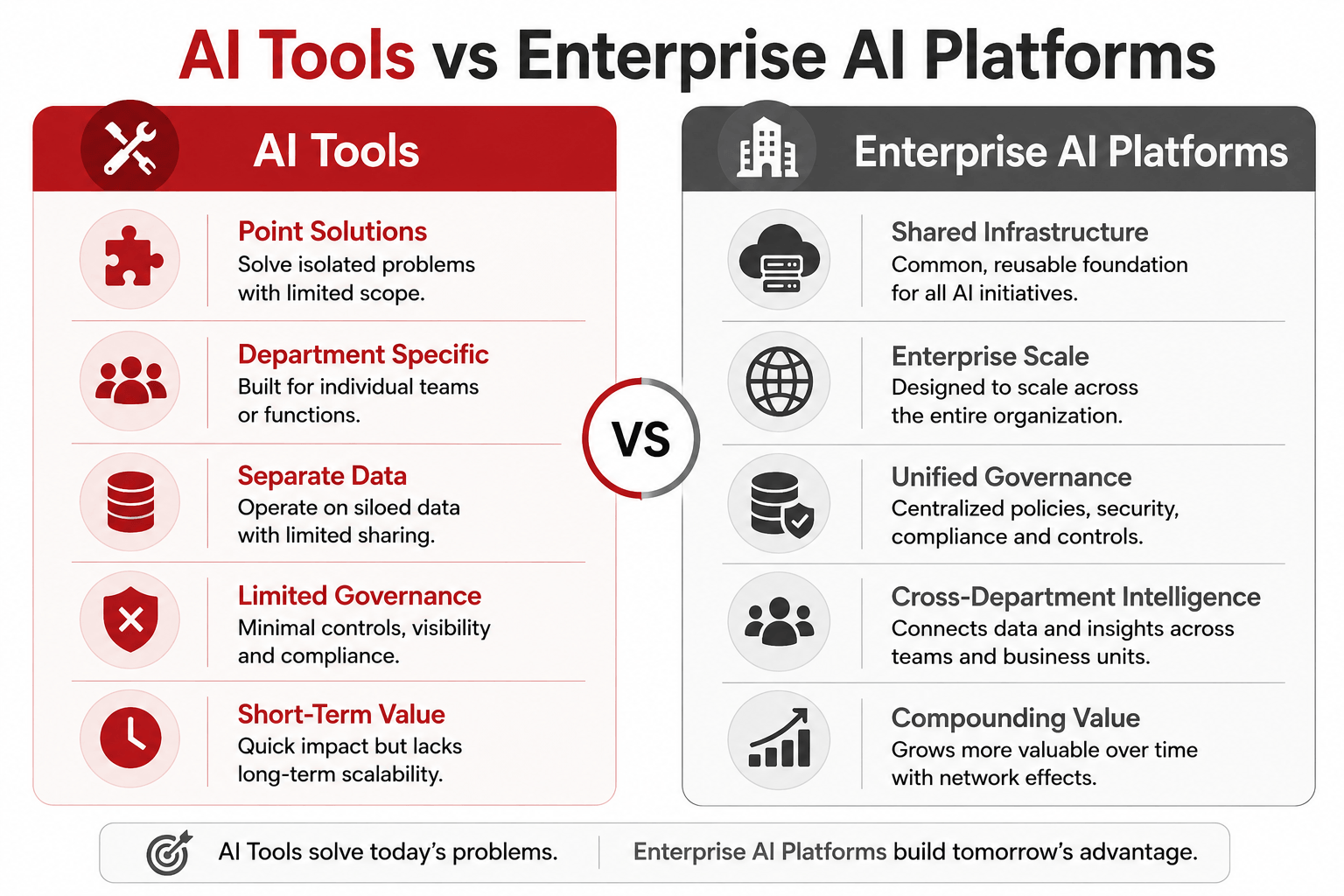
- Platform versus tools: What is the difference between AI tools and enterprise AI platforms comes down to integration, governance, and compounding value. Tools solve specific problems. Platforms build organizational intelligence that improves with every additional use case deployed on top of the same foundation.
- Scale requirement: How enterprise AI platforms scale across departments depends entirely on the architectural decisions made when the platform foundation is established, which is why those foundational decisions deserve significantly more strategic attention than most organizations give them.
- Governance urgency: AI governance in enterprise platforms has moved from a theoretical concern to a practical operational requirement as AI systems take on more consequential decision-making roles across finance, operations, customer experience, and risk management.
- Competitive stakes: The organizations building genuine enterprise AI strategy around integrated platform infrastructure are pulling ahead of those running disconnected pilots in ways that will be very difficult to close once the platform advantage compounds over two to three years of operation.
What is an Enterprise AI Platform and Why It Matters?
What is an enterprise AI platform is a question that gets answered differently by every vendor selling into this space, which makes a vendor-neutral definition genuinely useful.
Unlike standalone AI tools, a modern AI platform for enterprise automation provides a unified environment for data, models, governance, and orchestration. This integrated approach enables organizations to create enterprise intelligent systems that continuously improve and generate long-term business value.
An enterprise AI platform is an integrated set of infrastructure, tools, frameworks, and governance mechanisms that enables an organization to develop, deploy, monitor, and govern AI applications at enterprise scale. The key word is integrated. The platform provides shared services that every AI application built on top of it can use, including data access, model management, compute orchestration, security controls, monitoring, and governance, rather than requiring each application team to build these capabilities independently.
This integration is what makes the platform more valuable than the sum of its parts. Every new AI application deployed on the platform benefits from the data infrastructure that previous applications built. Every governance control implemented for one application protects every application on the platform. And every improvement to the shared infrastructure benefits the entire portfolio of AI capabilities simultaneously.
- Shared foundation: An enterprise AI stack provides shared data, compute, security, and governance infrastructure that every AI application in the enterprise can build on, eliminating the redundant infrastructure investment that disconnected AI initiatives consistently produce.
- Compounding intelligence: AI-first enterprise platforms become more valuable over time as more data flows through them, more models are trained on shared data assets, and more applications contribute to the organizational intelligence that the platform accumulates.
- Operational consistency: Platform-based AI deployment ensures consistent operational practices across monitoring, alerting, retraining, and incident management, rather than leaving each application team to develop their own operational approach with no shared learning.
- Governance at scale: Enterprise AI governance implemented at the platform level applies consistently to every application deployed on the platform, which is the only practical way to govern AI responsibly across a large organization with dozens or hundreds of active AI applications.
The 5 Key Layers of Enterprise AI Platform Architecture
What are the key layers of enterprise AI architecture is the structural question that determines whether a platform can actually deliver on its promises at enterprise scale.
Modern enterprise AI software architecture is organized across five interconnected layers, each of which must be designed with the requirements of the layers above and below it in mind.
The most successful organizations design their enterprise AI software architecture around modular services, reusable components, and composable AI platforms that allow new AI capabilities to be introduced without rebuilding existing infrastructure.
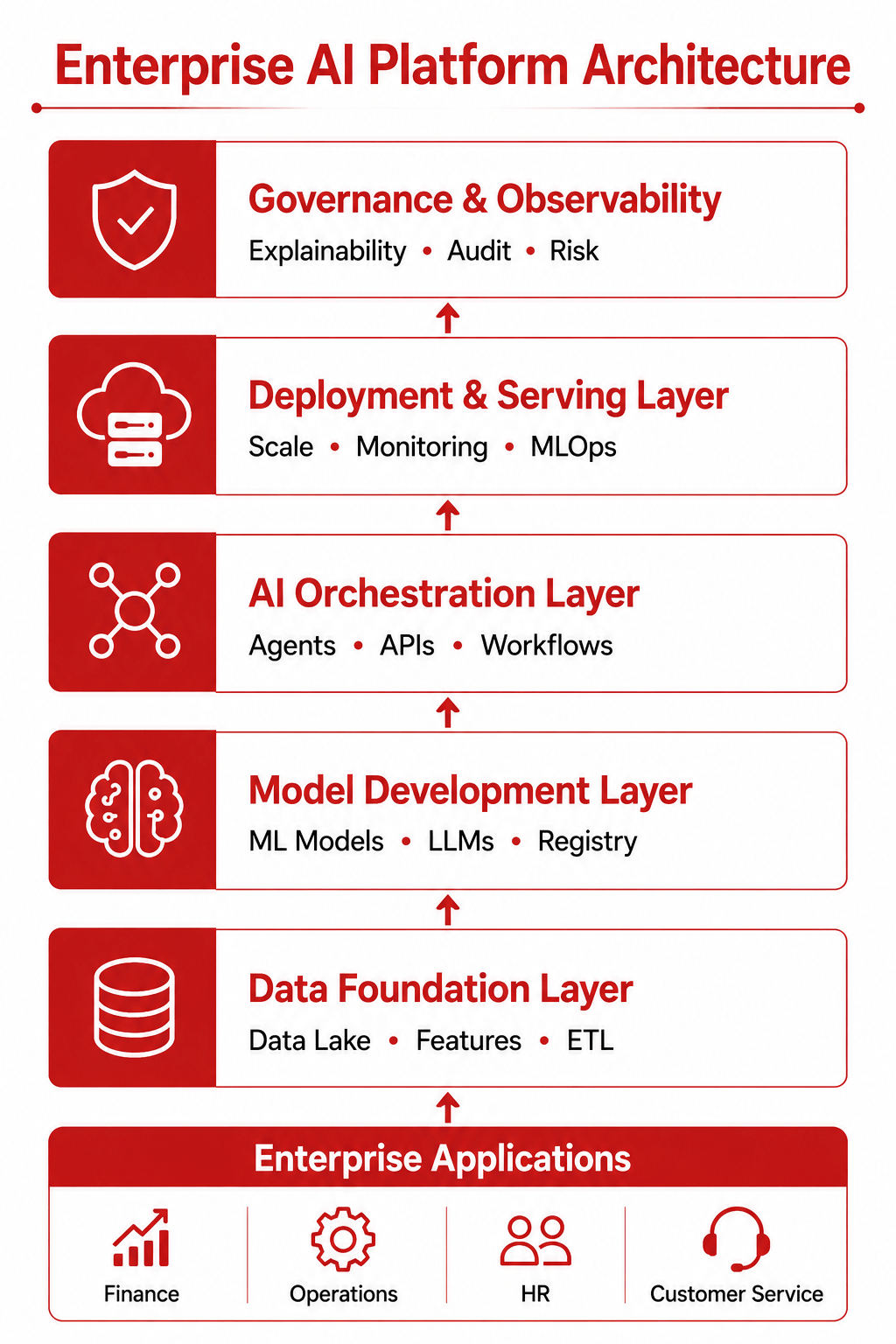
Data Foundation Layer: The Core of Enterprise AI Infrastructure
Every enterprise AI platform is ultimately only as good as its data foundation. AI models learn from data. AI applications operate on data. And the quality, accessibility, and governance of the data layer determines the ceiling on everything the platform can achieve.
- Data integration: Enterprise AI infrastructure at the data layer covers the pipelines, connectors, and transformation frameworks that make data from across the enterprise accessible to AI applications in consistent, well-governed formats without requiring each application team to build their own data access infrastructure.
- Feature engineering: Shared feature stores that pre-compute and store the data features used by AI models enable faster model development, ensure consistency between training and serving environments, and allow feature investments made for one model to be reused across multiple applications.
- Data governance: Data lineage tracking, access controls, privacy protection, and quality monitoring at the data layer ensure that AI applications operate on reliable, appropriately governed data rather than discovering data quality problems in production.
- Real-time capability: Scalable enterprise AI platform design requires data infrastructure that supports both batch processing for model training and real-time streaming for applications that need to respond to current operational data rather than historical snapshots.
Model Development Layer: Building an Enterprise Machine Learning Platform
The model layer is where AI capabilities are created and maintained, and it requires infrastructure that supports the full lifecycle from initial development through production deployment through ongoing maintenance and improvement.
- Development environment: Enterprise machine learning platform infrastructure provides the compute resources, experimentation frameworks, and collaboration tools that data science and AI engineering teams need to develop models efficiently without competing for shared resources or managing their own infrastructure.
- Model registry: Centralized model registries that track all models developed across the enterprise, including their training data, performance metrics, approval status, and deployment history, are foundational to both operational efficiency and governance compliance.
- Version control: Model versioning that tracks changes to model architecture, training data, and configuration over time enables reproducibility, supports rollback when model performance degrades, and provides the audit trail that governance frameworks require.
- Automated pipelines: MLOps pipelines that automate the model training, validation, and deployment process reduce the time from model development to production deployment while enforcing quality gates that prevent underperforming or ungoverned models from reaching production.
AI Orchestration Platform Layer: Connecting Enterprise Intelligent Systems
AI orchestration platform capabilities coordinate the interaction between models, data sources, external services, and business applications to deliver coherent AI-powered capabilities rather than isolated model predictions.
As enterprises expand AI adoption, the enterprise AI stack increasingly relies on orchestration layers that coordinate large language models, machine learning models, business workflows, and external systems through a centralized AI orchestration platform.
- Workflow orchestration: Complex AI applications frequently require multiple models, data sources, and processing steps to work together in coordinated workflows that AI orchestration platform infrastructure manages automatically rather than requiring application developers to handle coordination manually.
- Agent frameworks: Increasingly, enterprise intelligent systems are built around AI agent frameworks that coordinate multiple AI capabilities to handle complex, multi-step tasks autonomously, with orchestration infrastructure managing the interaction between agents, tools, and external systems.
- API management: Standardized APIs that expose AI capabilities to business applications ensure that AI services can be consumed consistently across the enterprise regardless of the underlying model or infrastructure, enabling composable AI platforms that allow capabilities to be assembled and reassembled as business needs evolve.
- Load management: Orchestration infrastructure that manages compute load across AI applications ensures that high-priority business applications receive the resources they need during peak demand without requiring each application to manage its own compute allocation independently.
Deployment Layer: Creating a Scalable Enterprise AI Platform
Enterprise AI deployment framework infrastructure ensures that AI models and applications can be deployed reliably, scaled efficiently, and operated consistently across the diverse infrastructure environments that large enterprises run.
- Multi-environment support: How to build a scalable enterprise AI platform requires deployment infrastructure that supports consistent deployment across cloud, on-premises, and edge environments, which is the reality that most large enterprises operate in regardless of their cloud strategy.
- Scalability architecture: AI platform scalability at the serving layer requires infrastructure that can scale compute resources up and down in response to demand fluctuations without service interruption, particularly for AI applications that experience significant variation in usage across the business day.
- A/B testing infrastructure: Deployment infrastructure that supports controlled rollout of new model versions, traffic splitting between model variants, and performance comparison between versions enables continuous improvement of AI capabilities without the risk of full production deployment of untested models.
- Monitoring integration: Enterprise AI deployment framework design integrates model performance monitoring, data drift detection, and business outcome tracking into the deployment infrastructure so that operational visibility is automatic rather than requiring each application team to build their own monitoring.
Governance Layer: AI Governance in Enterprise Platforms
Best enterprise AI platform architecture for large organizations treats governance not as a constraint applied to AI applications from outside but as an integrated capability layer that every application on the platform inherits automatically.
Why is AI governance important in enterprise intelligent systems becomes clear when you consider the consequences of AI systems making consequential decisions at scale without adequate oversight, explainability, or accountability structures. The governance layer is what makes enterprise-scale AI deployment responsible rather than reckless.
- Explainability frameworks: AI governance framework infrastructure provides explainability tools that help compliance teams, business users, and regulators understand why AI systems make specific decisions, which is a regulatory requirement in financial services, healthcare, and other regulated industries and a practical operational requirement in virtually every enterprise context.
- Bias monitoring: Continuous monitoring for bias in AI model outputs across demographic groups, customer segments, and operational contexts ensures that AI applications deliver equitable outcomes and do not inadvertently encode historical biases present in training data.
- Audit trails: Complete audit trails of AI system decisions, including the data inputs, model versions, and confidence scores that produced each decision, provide the accountability infrastructure that enterprise AI governance requires and that regulatory examination increasingly demands.
- Policy enforcement: Automated policy enforcement at the platform level ensures that governance requirements around data usage, model approval, and decision thresholds are enforced consistently across every application rather than depending on individual application teams to implement governance correctly.
AI Governance Frameworks: The Most Critical Layer in Enterprise AI Strategy
Enterprise AI governance is the capability that separates organizations that deploy AI responsibly at scale from those that create significant regulatory, reputational, and operational risk through ungoverned AI deployment.
A mature AI governance framework ensures transparency, accountability, security, compliance, and ethical AI usage across all enterprise applications. Organizations that embed AI governance in enterprise platforms from the beginning experience fewer deployment risks and faster regulatory approval.
AI governance in enterprise platforms covers four interconnected disciplines that together ensure AI systems are trustworthy, accountable, and aligned with the organization’s values and regulatory obligations.
For a deeper examination of why governance is the most commonly missing layer in enterprise AI adoption, see AI Governance: The Missing Layer in Enterprise AI Adoption.
- Model risk management: Every AI model deployed in a consequential business context should go through a model risk management process that validates its performance, assesses its failure modes, and establishes the monitoring thresholds that trigger review or intervention when model behavior changes.
- Data governance integration: AI governance solutions that operate independently from data governance create gaps where AI applications can access data they should not or use data in ways that violate privacy regulations, which means AI governance and data governance must be designed as integrated disciplines.
- Human oversight design: Key components of a modern enterprise AI stack include explicit human oversight mechanisms for AI-assisted decisions, defining which decisions can be made autonomously by AI systems, which require human review, and which must be made by humans with AI providing decision support.
- Regulatory compliance: Enterprise AI governance must address the specific regulatory requirements applicable to each business domain in which AI is deployed, including financial services model risk guidance, healthcare AI regulations, and the emerging AI-specific regulatory frameworks being developed in major markets globally.
How Enterprise AI Platforms Scale Across Departments and Business Functions
How enterprise AI platforms scale across departments is where the platform investment pays its most significant dividends, because the shared infrastructure and governance that the platform provides becomes progressively more valuable as more departments build AI applications on top of it.
How enterprises use AI platforms for decision intelligence and automation across departments follows a consistent pattern in organizations that have built this capability successfully. For detailed exploration of this scaling pattern, see Building Enterprise AI Platforms That Scale Across Departments.
- Shared services model: Departments that build AI applications on a shared platform foundation invest in developing their specific AI capabilities rather than rebuilding the data infrastructure, model management, and governance capabilities that the platform already provides.
- Cross-departmental intelligence: AI decision intelligence capabilities that draw on data from multiple departments produce insights that no single department’s AI application could generate, because the intelligence comes from the connections between departmental data rather than from any individual data source.
- Federated development: Composable AI platforms support federated development models where individual departments or business units maintain autonomy over their AI applications while sharing platform infrastructure and governance, which balances the efficiency of centralized infrastructure with the agility of decentralized development.
- Network effects: Each new department that deploys AI applications on the shared platform contributes data, use case patterns, and operational learnings that make the platform more valuable for every other department, creating the network effects that make enterprise AI platform investment compound over time.
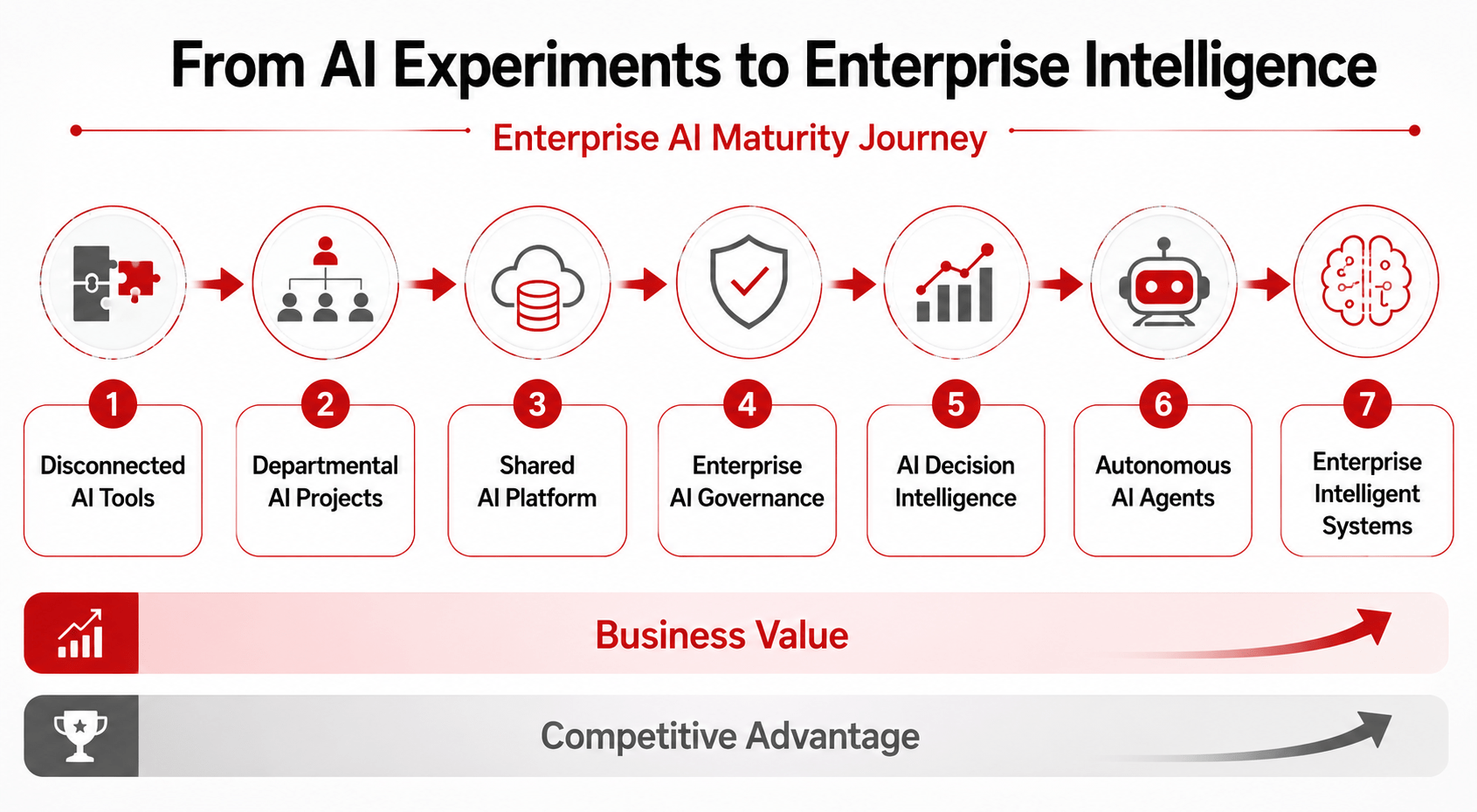
The Future of Enterprise Intelligent Systems and AI-First Enterprise Platforms
Enterprise intelligent systems are evolving faster than most technology roadmaps anticipated, and the architectural decisions organizations make today will determine whether they are positioned to adopt the next generation of AI capabilities or constrained by platforms that were designed for a previous era.
AI-first enterprise platforms that lead the market over the next five years will be distinguished by capabilities that are nascent or experimental today but are becoming architectural requirements faster than most enterprise technology cycles accommodate. See How AI-First Platforms Are Reshaping Enterprise Software Development for a detailed examination of this shift.
- Agentic AI integration: The integration of autonomous AI agents into enterprise platforms, capable of taking multi-step actions across enterprise systems without human intervention for each step, represents the most significant near-term evolution in enterprise AI platform architecture and requires new orchestration, governance, and oversight infrastructure.
- Multimodal capability: Enterprise AI platforms that handle text, image, audio, video, and structured data through unified model infrastructure rather than separate specialized systems are becoming competitive requirements in industries where customer and operational data spans multiple modalities.
- Real-time decision intelligence: How AI-driven decision systems are transforming modern enterprises is increasingly about the convergence of real-time data streaming, AI inference, and automated action triggering in integrated platforms that compress the time from event to intelligent response from hours to milliseconds. For more on this evolution, see how AI-Driven Decision Systems Are Transforming Modern Enterprises.
- Continuous learning architecture: Enterprise AI platforms that support continuous learning from production data, enabling models to improve their performance automatically as they process more real-world inputs, are replacing the static model deployment approaches that require periodic manual retraining cycles to maintain performance.
How Tntra Delivers Scalable Enterprise AI Platforms and Governance Solutions?
At Tntra, our enterprise AI consulting and enterprise AI transformation services practice is built around helping organizations make the architectural and governance decisions that determine whether their AI investment compounds into durable competitive advantage or fragments into a portfolio of disconnected experiments.
Our scalable AI engineering services cover the full platform stack, from data foundation design through model development infrastructure, AI orchestration platform implementation, deployment framework engineering, and AI governance solutions that make enterprise-scale AI deployment both effective and responsible.
Through our AI-driven enterprise automation capabilities and composable AI platforms expertise, we help enterprises build the integrated AI infrastructure that makes every subsequent AI application faster to build, more reliable to operate, and better governed than the applications that preceded it.
If your organization is ready to move from AI experimentation to enterprise AI platform capability, Connect with the Tntra team today.
FAQs
What is an enterprise AI platform?
An enterprise AI platform is an integrated technology ecosystem that enables organizations to develop, deploy, govern, and scale AI solutions across the enterprise using shared infrastructure, data, models, security controls, and governance frameworks.
What is an enterprise AI platform used for?
An enterprise AI platform provides the shared infrastructure, governance, and tooling that enables organizations to build, deploy, monitor, and scale AI applications consistently across the entire enterprise rather than rebuilding foundational capabilities for every individual AI initiative.
How does enterprise AI architecture work?
Enterprise AI architecture organizes AI capability across five integrated layers: data foundation, model development and management, AI orchestration, deployment and serving, and governance and observability, with each layer providing shared services that every AI application built on the platform inherits automatically.
What are the components of an enterprise AI stack?
The key components of an enterprise AI stack include shared data infrastructure and feature stores, model development environments and registries, AI orchestration and workflow management, scalable deployment and serving infrastructure, and integrated governance frameworks covering explainability, bias monitoring, audit trails, and policy enforcement.
What are the key layers of enterprise AI architecture?
The five key layers of enterprise AI platform architecture are:
- Data Foundation Layer
- Model Development and Management Layer
- AI Orchestration Layer
- Deployment and Serving Layer
- Governance and Observability Layer
Together, these layers support scalable, secure, and compliant AI deployment.
How do enterprise AI platforms scale across departments?
Enterprise AI platforms scale by providing shared data infrastructure, reusable AI services, centralized governance, and orchestration capabilities that allow departments to build AI applications without recreating foundational components.
What is the difference between AI tools and enterprise AI platforms?
AI tools solve individual business problems, while enterprise AI platforms provide a unified foundation that supports multiple AI applications, governance policies, data systems, and automation workflows across the entire organization.
Why is AI governance important in enterprise intelligent systems?
AI governance ensures AI systems remain transparent, secure, compliant, explainable, and accountable. Governance frameworks help enterprises manage risk, maintain regulatory compliance, and build trust in AI-powered decisions.
How do enterprises govern AI systems?
Enterprises govern AI systems through model risk management processes, explainability frameworks, bias monitoring, audit trail infrastructure, and automated policy enforcement implemented at the platform level so that governance applies consistently to every AI application rather than depending on individual teams to implement it correctly.