AI Governance Framework: Managing Risk, Compliance, and Responsible AI at Enterprise Scale
An effective AI Governance Framework is becoming one of the most critical capabilities for organizations scaling artificial intelligence initiatives. As enterprise AI adoption accelerates, businesses need structured governance frameworks to manage risk, ensure compliance, and enable responsible innovation.
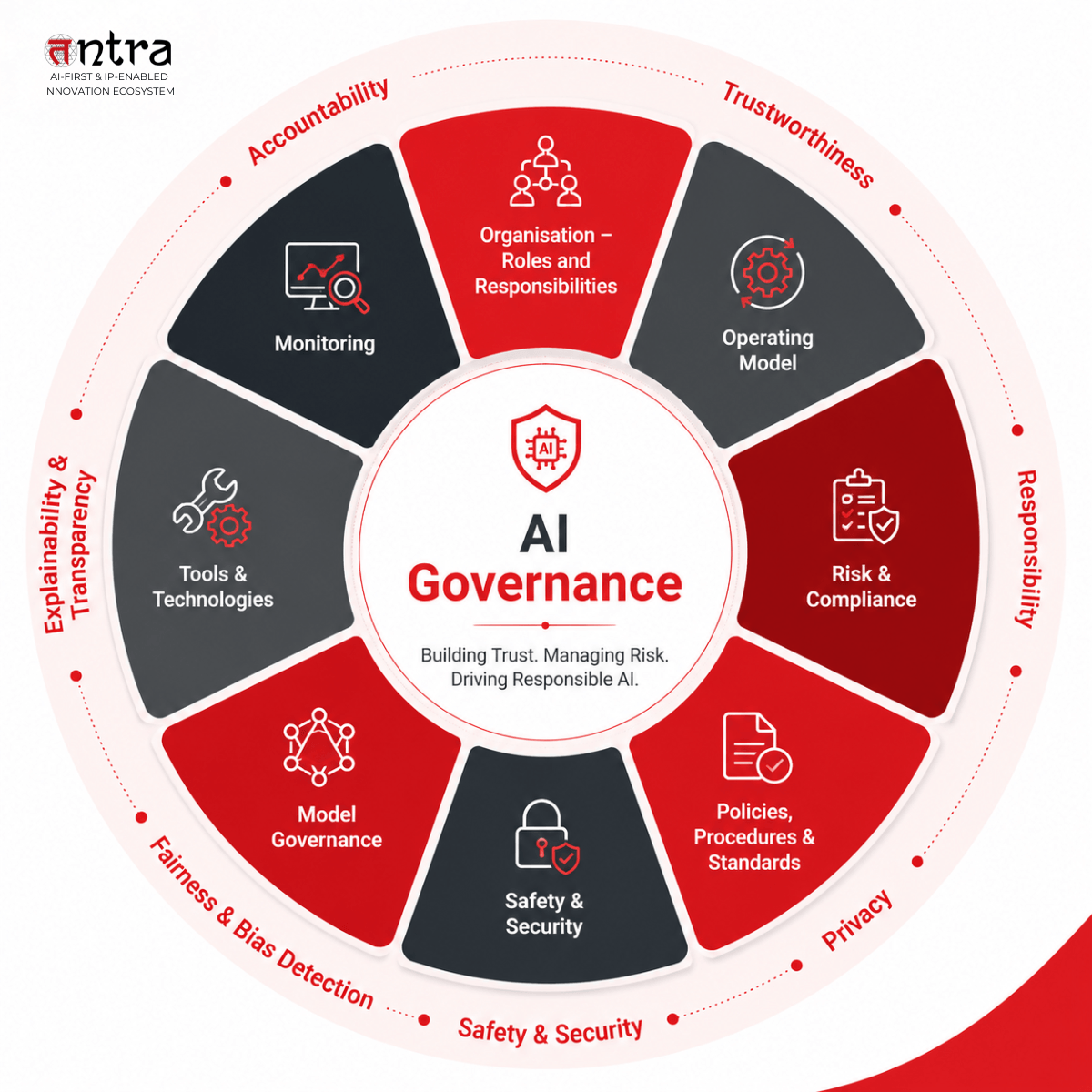
AI governance in enterprise settings has moved from a compliance consideration to a genuine strategic capability. This article walks enterprise leaders through the full governance picture, covering framework architecture, risk classification, bias and security risks, generative AI specific challenges, and the practices that separate programs with real operational teeth from ones that exist only on paper. If your organization is scaling AI and the governance question is starting to feel urgent, this is where the thinking starts. Continue reading to learn more.
Picture this. Your data science team has spent six months building a model that actually works. The accuracy numbers are strong. The pilot results are promising. The business sponsor is excited. You get the go-ahead to scale it across the organization. And then, three weeks before the planned rollout, someone from legal sends a calendar invite with a subject line that reads “Quick alignment on the AI project” and you just know that meeting is going to be anything but quick.
That meeting is happening in boardrooms and conference rooms across every industry right now. And the reason it keeps happening at the worst possible moment, weeks before launch rather than months before training, is that most organizations are still treating AI governance in enterprise AI as a late-stage concern rather than a foundational one.
This article is written for the leaders sitting in that meeting, or the ones smart enough to want to have the governance conversation before they get the calendar invite. It is a grounded look at what enterprise AI governance actually involves, what the real risks are, and what the organizations getting this right are doing differently from everyone else.
Why Every Enterprise Needs an AI Governance Framework?
Here is something worth saying plainly. Most enterprise AI governance programs exist because something went wrong, or because a regulator asked a question the organization could not answer, or because a competitor’s public AI failure scared the board into action. Very few organizations built serious governance infrastructure proactively, ahead of pressure, because they genuinely believed it was the right investment.
That is changing, slowly, but the legacy of reactive governance shows up everywhere. Policies that were written quickly to satisfy a specific audit and never updated. Risk assessments that exist as documents but have no operational teeth. Ethics principles posted on a website that the teams actually building AI have never read.
A real AI governance framework looks nothing like that. It is embedded in how work gets done, not appended to work that is already finished. It shapes decisions during model design, during data sourcing, during training, during evaluation, and during deployment. It is less a document and more a discipline, and building it requires the same organizational seriousness that you would bring to building a security program or a financial controls framework.
The organizations that understand this are the ones whose AI programs are scaling with confidence. The ones that are still treating governance as paperwork are accumulating a kind of invisible debt that tends to surface at spectacular and expensive moments.
Responsible AI Governance: Key Principles of an AI Governance Framework?
Responsible AI governance asks a set of questions that feel philosophical until they become operational, and then they become very concrete very fast.
Who is accountable when this model makes a decision that harms someone? Can you explain, in plain language, why your AI system reached a particular conclusion? Are there groups of people being treated differently by this model, and if so, can you justify that difference? What happens if this model starts behaving differently in production than it did in testing? Who finds out, how quickly, and what do they do about it?
These are not abstract ethics questions. They are the questions that regulators ask during examinations. They are the questions that plaintiffs’ attorneys ask during discovery. They are the questions that journalists ask when something goes wrong publicly. And they are, most importantly, the questions that your own customers and employees deserve honest answers to.
Ethical AI implementation starts with taking those questions seriously before you are forced to. It means building the accountability structures, the documentation practices, and the monitoring systems that allow you to answer them with confidence rather than scrambling to reconstruct an explanation after the fact.
The enterprise responsible AI strategy that holds up over time is one where the people building AI systems and the people governing them are in genuine dialogue, not adversarial relationship. When data scientists see governance as something that helps them build better systems rather than something that slows them down, you have achieved something organizationally significant. Getting there requires governance to actually be useful, proportionate, and intelligently designed rather than a checklist that generates friction without reducing risk.
How to Build an AI Governance Framework for Enterprises?
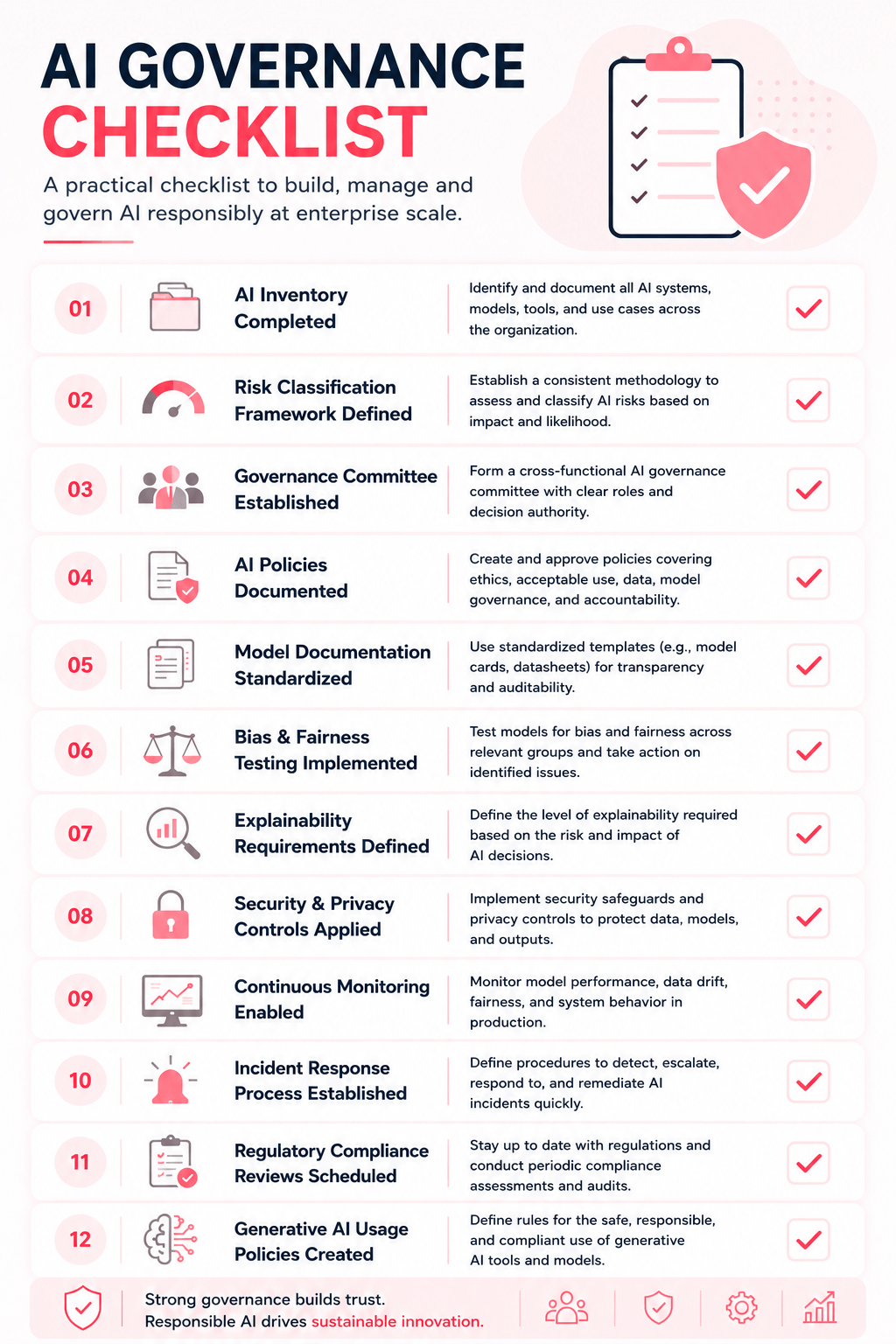
Here is the architecture of frameworks that are working in practice across large organizations.
Step 1: Create an AI Inventory
- Identify all internally developed AI models
- Catalog third-party AI solutions
- Track embedded AI within enterprise applications
- Document shadow AI usage
Step 2: Establish Risk Classification
Consider:
- Business impact
- Regulatory exposure
- Human oversight levels
- Affected user groups
- Decision criticality
Step 3: Develop Governance Policies
Define:
- Data sourcing standards
- Explainability requirements
- Bias testing requirements
- Human review protocols
- Incident response procedures
Step 4: Implement Governance Tooling
Examples:
- Model cards
- AI monitoring platforms
- Audit tools
- Compliance dashboards
Step 5: Enable Continuous Monitoring
Track:
- Model drift
- Fairness metrics
- Data quality
- Security incidents
- Regulatory compliance
Common Risks Addressed by an AI Governance Framework
Enterprise AI risk management has expanded well beyond traditional technology risk categories, and some of the most significant risks are the ones that get the least attention in early-stage governance conversations.
Key Enterprise AI Risks
Bias & Fairness Risk
- Historical data bias
- Disparate impact
- Regulatory exposure
- Customer trust issues
Explainability Risk
- Black-box decision making
- Limited auditability
- Poor human oversight
Security & Compliance Risk
- Prompt injection attacks
- Data poisoning
- Model inversion attacks
- Sensitive data exposure
Generative AI Risk
- Hallucinations
- Copyright concerns
- Data leakage
- Brand reputation damage
Third-Party AI Risk
- Vendor dependency
- Lack of transparency
- Compliance uncertainty
The AI governance framework for generative AI risk management needs to address prompt design standards, output review processes for high-stakes use cases, acceptable use policies for employees using generative AI tools, and data handling rules governing what information can and cannot be entered into external AI systems.
AI Governance Framework Best Practices for Large Organizations
The most effective AI governance programs share several characteristics that distinguish frameworks with real operational impact from those that exist only to satisfy compliance requirements.
1. Proportionality
Not all AI systems carry the same level of risk. Applying identical governance requirements across every AI use case can create unnecessary complexity while failing to provide sufficient oversight for high-risk applications.
Organizations with mature governance frameworks:
- Classify AI systems based on risk and business impact.
- Apply enhanced controls to high-risk use cases.
- Use lighter governance requirements for lower-risk applications.
- Align testing, approvals, and monitoring with the level of risk involved.
2. Integration
Governance is most effective when it becomes part of the AI development lifecycle rather than a separate process performed at the end of a project.
Leading organizations:
- Embed governance checkpoints into AI workflows.
- Automate risk assessments and compliance reviews.
- Integrate documentation into development and deployment tools.
- Build approval processes directly into AI delivery pipelines.
This reduces friction while ensuring governance remains consistent and scalable.
3. Genuine Cross-Functional Ownership
AI governance should not be owned exclusively by legal or compliance teams. Effective governance requires collaboration across business, technical, and risk functions.
Successful organizations:
- Involve data science, engineering, product, security, and compliance teams.
- Establish clear accountability throughout the AI lifecycle.
- Encourage shared responsibility for governance outcomes.
- Align governance decisions with business objectives and risk appetite.
Cross-functional ownership leads to stronger decision-making and better risk management.
4. Learning Orientation
AI governance is not a one-time exercise. As technologies, regulations, and risks evolve, governance frameworks must evolve as well.
Mature organizations:
- Conduct regular governance reviews and assessments.
- Learn from incidents, audits, and near-misses.
- Update policies and controls as new risks emerge.
- Share lessons learned across teams and business units.
A continuous learning mindset helps ensure governance remains effective, relevant, and future-ready.
Organizations that embrace proportionality, integration, cross-functional ownership, and learning orientation are better positioned to manage AI risks, maintain compliance, and scale AI initiatives responsibly.
AI Governance Framework for Financial Services
AI governance for financial services sits at the sharpest end of the enterprise governance challenge because the regulatory environment is explicit, the decisions being made are consequential, and the affected populations include some of the most vulnerable people in the economy.
Credit underwriting models, fraud detection systems, customer risk scoring, anti-money laundering algorithms, and algorithmic trading systems all require governance approaches that can satisfy not just internal risk management standards but also the examination expectations of banking regulators, securities regulators, and consumer protection agencies who are actively developing AI-specific examination frameworks.
The documentation standards required in this context are significantly more demanding than in less regulated industries. Model validation processes need to meet established regulatory guidance. Ongoing monitoring programs need to be able to demonstrate model performance, stability, and fairness on a continuous basis rather than just at the point of initial deployment.
AI risk management solutions for financial services also need to account for the particular sensitivity of financial data, the systemic risk implications of widely deployed models, and the potential for AI systems to create or amplify market instability in ways that affect participants well beyond the deploying institution.
Measuring the Success of Your AI Governance Framework
The difference between a governance framework that works and one that gathers dust is organizational capability. And building that capability takes longer than writing the policies.
AI digital transformation services that include governance capability building tend to produce more durable outcomes than those that deliver a governance framework document without the accompanying investment in people and process. The organizations that have built genuinely mature enterprise AI governance programs have trained their teams, created dedicated roles with real authority, integrated governance into their technology platforms, and built the cultural norms that make governance feel like a natural part of good engineering rather than an external imposition.
Generative AI consulting services that include governance design alongside capability building help organizations avoid the pattern of building first and governing later that creates so much unnecessary risk and remediation cost. The investment in getting governance right at the foundation is always cheaper than rebuilding it after scale.
The organizations that will feel best about their AI programs five years from now are the ones making that investment today, proactively, before the regulator exam or the public incident or the board inquiry forces their hand. That choice is available right now, and the window for making it on your own terms rather than someone else’s timeline is narrower than most leaders realize.
Build a Future-Ready AI Governance Framework with Tntra
If your organization is scaling AI and the governance question is starting to feel genuinely urgent, Tntra brings deep, practical expertise in enterprise AI solutions, generative AI consulting services, AI risk management solutions, AI digital transformation services, and responsible AI implementation frameworks built for the complexity and stakes of real enterprise environments.
Tntra works with enterprises across financial services, healthcare, and technology to design governance programs that are operationally real, not theoretically beautiful. Whether you are starting from scratch, strengthening a framework that has outgrown its original design, or navigating a specific regulatory challenge, Tntra has the methodology and the experience to move you forward with genuine confidence.
Start the conversation at Tntra and build AI governance that scales with your ambition.
FAQs
What is an AI Governance Framework?
An AI Governance Framework is a structured set of policies, processes, controls, and accountability mechanisms that help organizations develop, deploy, monitor, and manage artificial intelligence systems responsibly, securely, and in compliance with regulatory requirements.
Why Enterprise AI Governance Matters?
Because AI systems are now making or influencing decisions that affect real people, real money, and real regulatory obligations. Organizations that govern well move faster and with more confidence than those scrambling to manage AI risk reactively.
Why is an AI Governance Framework important?
An AI Governance Framework helps organizations manage AI risks, improve regulatory compliance, reduce bias, strengthen security, and build trust in AI-driven decisions.
What are the risks of Enterprise AI Adoption?
The biggest ones are bias in consequential decisions, model opacity that prevents meaningful oversight, security vulnerabilities specific to AI systems, generative AI hallucination, and concentration risk from depending heavily on third-party models your organization does not control.
How do Companies ensure responsible AI usage?
By embedding governance into the development process rather than appending it afterward, building cross-functional ownership across legal, engineering, product, and compliance, and treating AI incidents as learning opportunities rather than failures to be minimized and moved past quickly.
What are the key components of an AI Governance Framework?
Key components include governance policies, risk management processes, accountability structures, model monitoring, compliance controls, documentation standards, and continuous oversight mechanisms.
What is the difference between AI Governance and AI Ethics?
AI ethics is the set of values and principles that guide how an organization thinks about AI. AI governance is the operational infrastructure that turns those values into specific rules, processes, and accountability structures that actually shape how AI systems get built and deployed.