Why Structure is the Secret to Scalable Innovation (Not a Constraint)?
Enterprise innovation fails not from a shortage of ideas, but from the absence of a structured innovation execution model. To scale digital transformation, enterprises must transition from isolated pilots to a managed Enterprise Innovation Operating System (OS) that institutionalizes governance, repeatable lifecycles, and AI-powered resource allocation.
Every enterprise is quietly filled with the bones of ideas that almost made it. Prototypes that impressed in the boardroom and died in the hallway. Pilots that showed real promise and then simply… stopped. Innovation initiatives that began with genuine momentum, attracted serious investment, and eventually faded into the background noise of competing priorities.
Nobody killed these ideas on purpose. Nobody woke up and decided to let them fail.
They failed because the organization had no system to carry them forward.
That is the conversation most enterprises are not having honestly enough. The real bottleneck in corporate innovation is almost never a shortage of ideas. It is the absence of the architecture to take those ideas somewhere real.
The numbers make the gap impossible to ignore. Research from Simon Kucher & Partners found that 72% of new products and services fail. Only 6% of executives say they are satisfied with their innovation results, even as global R&D spending tops roughly 2.5 trillion dollars. The money is flowing. The conversion is not
At Tntra, we have a name for the discipline that closes this gap. We call it moving ideas across the Innovation Corridor, the path that carries an idea from raw insight through validation and into a funded, owned, revenue-bearing asset. Most enterprises are very good at the early stages of validation but have almost no machinery for scaling ideas into long-term impact.
Innovation management at the enterprise level is not about generating more ideas. It is about building the conversion infrastructure that transforms the ideas already inside the organization into owned, scalable business assets. And innovation portfolio management is the discipline that gives leadership the visibility to make that conversion systematic rather than accidental.
What is the “Move Fast” Trap in Corporate Innovation?
There is a version of innovation culture that got very popular and very destructive at the same time. It borrowed its language from startups. Move fast. Break things. Stay lean. Ship early. Celebrate the chaos.
For a 12-person startup with nothing to lose, that philosophy makes sense. For a global enterprise managing billions in revenue, complex regulatory environments, and thousands of interdependencies, it is a recipe for expensive theater.
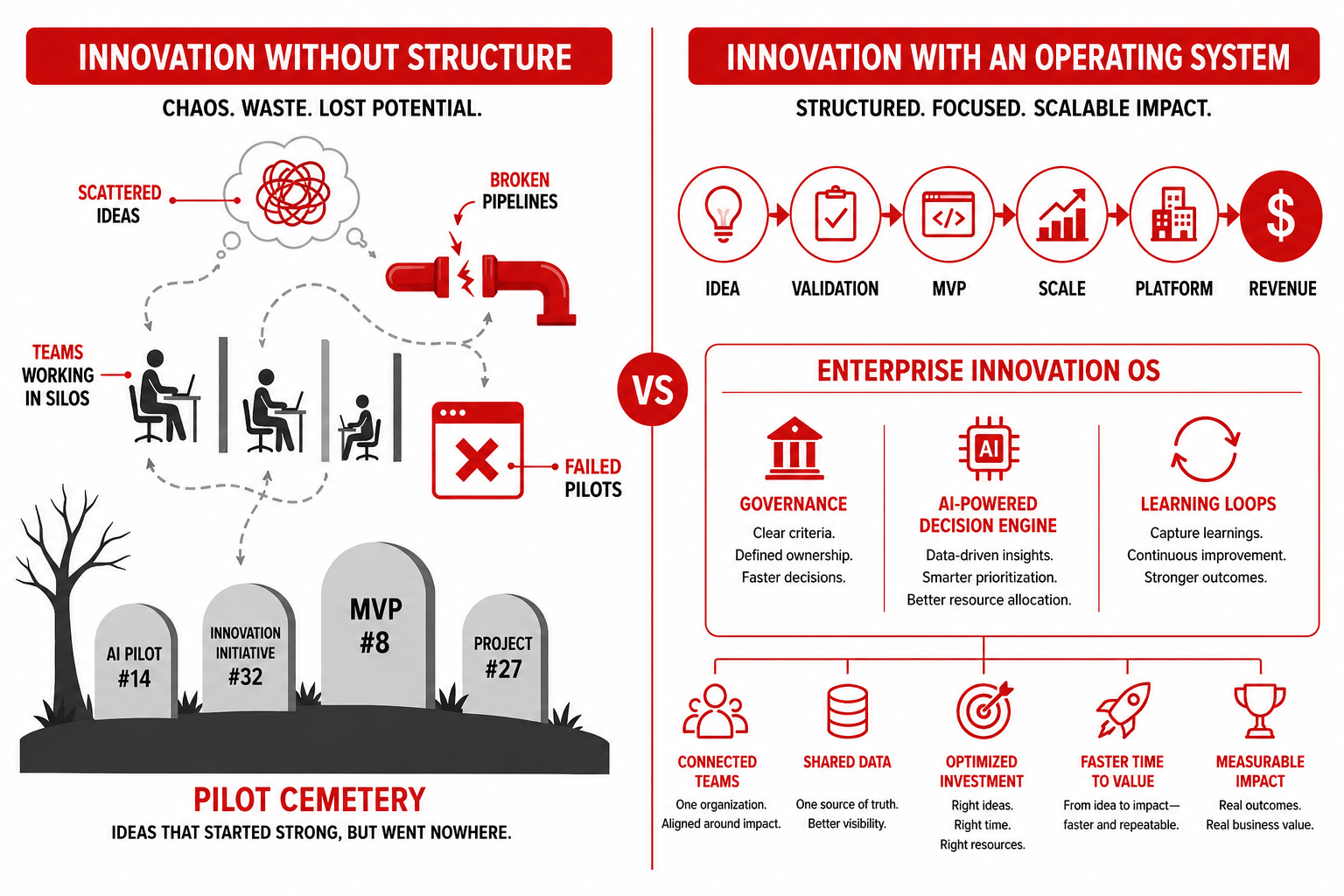
Here is what “move fast” actually produces in enterprise settings, when it operates without structure.
- Teams duplicate work across divisions because no one is tracking what is already being built elsewhere. The same problem gets solved three times in three business units, and nobody connects the dots.
- Decisions get made on persuasion rather than evidence. The ideas that survive are the ones championed by the most senior voice in the room, not the ones most likely to create value.
- Pilots multiply but platforms never appear. The organization gets very good at running experiments and very bad at scaling what works.
- When projects fail, the learning evaporates. The next team inherits none of the hard-won insight from the last one. The same walls get walked into, over and over again.
This is what runs without an Innovation Operating System. And the cost is staggering. Not just in wasted budget, but in wasted trust. Every failed initiative makes the next one harder to fund, harder to staff, harder to believe in.
The reason innovation needs an operating system to scale is not philosophical. It is mechanical. Without one, nothing compounds. Nothing transfers. Nothing builds toward something larger than itself. You keep starting from zero, every single time.
The Tntra Innovation Maturity Model
Before you can fix the conversion problem, you have to know where you sit. We map every enterprise we work with against six levels of innovation maturity. Most organizations believe they are further along than they are.
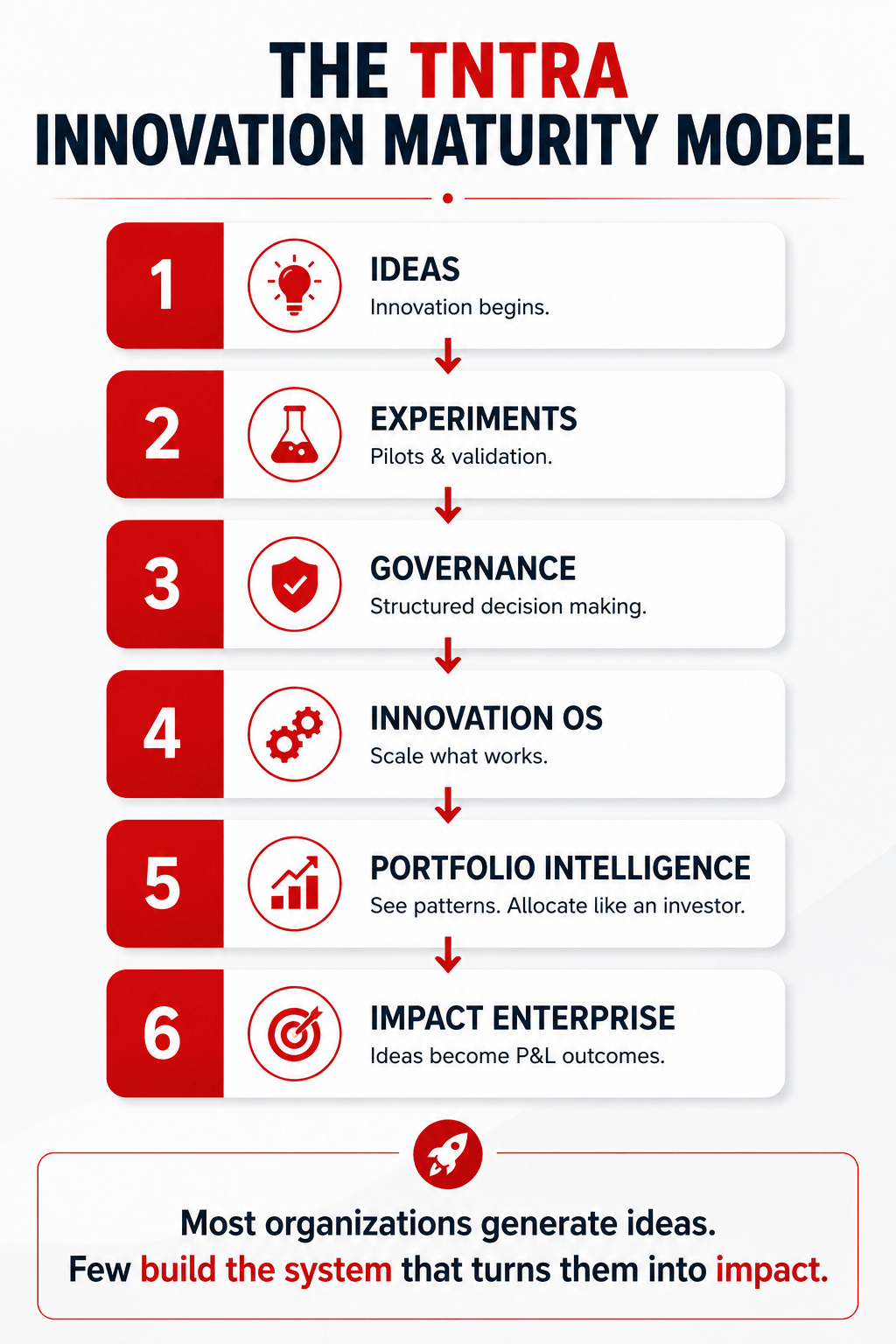
- Level 1, Ideas. The organization generates ideas but has no consistent place to put them. Innovation is a suggestion box.
- Level 2, Experiments. Pilots run, but they run in isolation. Promising results lead nowhere because there is no path forward.
- Level 3, Governance. Clear criteria and decision rights exist. The organization can now say yes and no with reasons, not politics.
- Level 4, Innovation Operating System. The full machinery is in place. Ideas route into execution, scale decisions are systematic, and learning feeds back into the system.
- Level 5, Portfolio Intelligence. The enterprise sees across all of its innovation activity at once, spots patterns, and allocates resources like an investor rather than a sponsor.
- Level 6, Innovation-to-Impact Enterprise. Innovation is a core operating capability that compounds. Ideas become P&L outcomes at a predictable, repeatable rate.
The jump that matters most is from Level 2 to Level 4. That is where the pilot cemetery either keeps filling or finally empties.
What Does Structure Mean (And What It Doesn’t)?
Here is where the conversation needs to be precise, because “structure” is a word that makes a lot of innovation leaders nervous. They hear it and picture committees. Approval chains. Eighteen-month roadmap processes. Innovation dying by a thousand meetings.
That is not a structure. That is bureaucracy wearing the structure’s clothes.
An Innovation Operating System creates the conditions in which good ideas move fast and bad ones get caught early. It makes the hard decisions systematic rather than political. It builds repeatable paths so that no new initiative has to reinvent the wheel.
An Innovation Operating System does five things:
- It routes ideas into execution paths instead of letting them accumulate
- It standardizes what qualifies for scale
- It removes decision ambiguity through defined ownership
- It captures learning and feeds it back into the system
- It connects innovation activity directly to enterprise value creation.
This is not process design. This is infrastructure design.
And it is fast. When the criteria are clear, decisions happen faster. When the system is visible, resources get allocated better. When the learning loops are working, teams stop making the same expensive mistakes.
The shift leading enterprises are making right now is to stop treating innovation as a series of events and start running it as an Innovation Operating System — a living capability that gets better over time, like any other core business function.
This is also where Tntra’s view diverges from the standard innovation playbook. We measure innovation maturity across three assets that actually accrue value: Patents, Products, and People. Patents capture defensible IP. Products turn that IP into revenue. People carry the capability so it does not collapse when a champion leaves. An idea that does not eventually strengthen one of those three is an idea the system should resolve and release, not nurse indefinitely.
Dan Phelps, CEO of Tntra, has seen the pattern too many times to ignore:
“Most enterprises think they have an innovation problem. They don’t. They have an impact problem.
Walk through any large company’s innovation pipeline and you’ll find many ideas logged, dozens approved, a handful piloted, and almost none scaled.
Ideas are abundant. Impact is scarce.
In the age of AI, delivery isn’t the bottleneck anymore. The ability to build software, automate workflows, create prototypes, and launch pilots is accelerating rapidly.
The bottleneck is everything that happens before and after delivery or launch: deciding which ideas deserve investment, governing risk, securing ownership, driving adoption, and turning a successful pilot into a funded, accountable, value-generating asset.
Ideas don’t die because they can’t be built. They die in the gap between being built and creating measurable impact.
The winners of the next decade will not out-ideate their competitors, nor will they out-code them. They will build the systems that consistently transform ideas into innovations, and innovations into impact—faster, more predictably, and at a higher success rate than everyone else.”
The 3Ps: How Tntra Measures Innovation that Creates Real Value
This is where Tntra’s perspective differs from traditional innovation frameworks. While many organizations measure innovation by the number of ideas generated or pilots launched, we evaluate innovation maturity through three assets that compound value over time: Patents, Products, and People.
- Patents
Defensible intellectual property that creates long-term competitive advantage and protects innovation investments. - Products
Scalable platforms, solutions, and services that convert innovation into measurable business outcomes and revenue. - People
The skills, knowledge, and institutional capability required to sustain innovation beyond individual champions or leadership changes.
Together, these three assets form Tntra’s IP-enabled innovation model. Every innovation initiative should ultimately strengthen at least one of these dimensions. If an idea does not contribute to new intellectual property, scalable products, or organizational capability, the system should resolve and release it rather than continue investing resources indefinitely.
At Tntra, we’ve always believed that idea-to-innovation is both an art and a science. We’ve spent years getting the science right – the frameworks, the platforms, the repeatable processes. But the art is something you can’t build alone. That’s why we love what we do with our customers and partners. Every engagement brings a new canvas.
The Specific Failure Modes that Structure Prevents
Let’s get concrete about what breaks without this. Because the patterns are remarkably consistent across industries. Without a structured workflow operating like infrastructure, enterprise digital transformation inevitably hits four catastrophic bottlenecks:
- The MVP-to-platform gap:
This is the most expensive misalignment in enterprise innovation today. A team builds an MVP. It works. Leadership celebrates. More budget flows in. And then the organization tries to scale that MVP into an enterprise platform and discovers that what it built was never designed to scale. The architecture is wrong. The data model is wrong. The governance assumptions are wrong. Rebuilding costs more than starting from scratch would have. Cost overruns average 380% at production scale versus pilot projections, and the median time from pilot approval to production shutdown is just 14 months. An Innovation Operating System catches this early, because it forces the right questions before the wrong commitments get made.
- The “every idea deserves to scale” delusion.
Smart enterprises understand something that innovative-but-undisciplined enterprises do not: the decision about what to scale is as important as the decision about what to build. Not every idea that shows early promise belongs on the path to a full platform. Some ideas are genuinely valuable but belong to a different part of the organization. Some should be partnerships rather than builds. Some should be shelved until the market or the technology is ready. The system gives the organization the discipline to make these distinctions consistently, rather than letting every promising prototype accumulate into a portfolio of permanent half-finishes.
- The sponsorship dependency trap.
In organizations without a real innovation operating model, innovation lives or dies based on the energy of whoever is championing it. The moment that person gets promoted, moved sideways, or simply burned out, the initiative collapses. Nothing was ever institutionalized. Nothing transfers. A real enterprise innovation framework moves innovation out of the personal and into the organizational, which is the only way it actually becomes a sustainable capability.
- The AI pilot cemetery.
This one is becoming uniquely urgent. Enterprises are launching AI initiatives at an extraordinary speed right now, and the vast majority of them are stalling at the pilot stage. Why? The reason is almost always structural. There is no AI innovation framework governing how AI capabilities get evaluated, integrated, and scaled. There is no innovation operating model for digital transformation that connects the AI experiment to the business process it is meant to transform. The result is a growing collection of impressive demos and negligible impact.
What a Real Innovation Operating Model Looks Like?
The enterprises getting this right are not doing anything magical. They are doing something disciplined. And that discipline has a recognizable shape.
It starts with a clear enterprise innovation strategy — an honest account of where the organization is trying to go, what capabilities it needs to build, and what kinds of innovation are actually relevant to its competitive position. Not a generic aspiration to “lead through innovation.” A specific, directional view that lets the organization say yes to the right things and no to the wrong ones without political negotiation every time.
On top of that sits the innovation execution model — the actual machinery. How ideas enter the system. How they get evaluated. What criteria determine which ones receive serious investment. How progress gets measured. What triggers a scale decision and what triggers a stop decision. The innovation to impact framework that separates high-performing enterprises from the rest is the one where this machinery runs consistently and visibly — not just in the quarters when there is executive attention on innovation.
Underneath it all runs an innovation ecosystem platform that connects the people, the data, the tools, and the governance structures that make the whole system function. Today, the most powerful version of this is an AI-powered innovation platform that does not merely manage the innovation process but makes it smarter — surfacing patterns across experiments, accelerating validation cycles, improving resource allocation decisions, and reducing the administrative overhead that historically made structured innovation programs feel slow.
The concept of an enterprise innovation OS captures the design intent precisely. Just as an operating system manages resources, schedules processes, and creates a stable environment where applications can run, an enterprise innovation operating system manages ideas, investment decisions, and execution workflows in a way that creates a stable environment where new capabilities can be built and scaled reliably — without starting from scratch each time.
T(u)lip is where this becomes operational inside Tntra’s ecosystem. It is the workspace where ideas, experiments, and scale decisions live in one visible pipeline, so that the system is something teams actually work inside rather than a diagram in a strategy deck.
And sitting across all of this is the question of governance. A well-designed innovation governance framework is not about control. It is about speed and fairness. Clear criteria mean faster decisions. Visible decision rights mean less politics. Consistent evaluation means that the teams closest to the problem, not the teams closest to the C-suite, have a real shot at seeing their ideas move forward.
What Scalable Innovation Looks Like?
It is one thing to agree that structure matters. It is another to build it. Here is what the machinery looks like when it is working.
Stage-gate decision making. Every idea moves through defined gates, and each gate has explicit criteria. An idea does not advance because someone likes it. It advances because it cleared the bar. Just as important, an idea can exit cleanly at any gate without anyone treating it as a failure.
- Portfolio Management: Leadership sees all innovation activity in one view, the way an investor sees a portfolio. That visibility is what lets the organization balance near-term bets against long-term ones and stop funding three teams solving the same problem.
- Funding Governance: Early experiments and mature platform deployments need different kinds of money. Scalable systems fund them differently on purpose, with small validation budgets up front and larger committed investment only after the evidence earns it.
- Success Metrics: Vanity metrics like number of pilots launched get replaced with conversion metrics: how many ideas reached production, how fast, and what value they returned. McKinsey found that 88% of organizations use AI in at least one function, but only 39% report any EBIT impact. Adoption is not value, and the metrics have to reflect that.
- Feedback Loops: When a project succeeds or fails, the insight gets captured and fed back into the criteria. The next team starts smarter than the last one did.
- Continuous Learning: The system itself improves. The criteria get sharper, the gates get better calibrated, and the conversion rate climbs over time. This is the difference between Level 4 and Level 6 of the maturity model.
Why AI Amplifies Structured Innovation?
AI without structure produces the same outcome that innovation without structure produces. Impressive activity, negligible conversion.
What changes when AI operates inside a structured innovation system is fundamentally different from what changes when AI is deployed as a capability layer on top of an unstructured one. The structure gives the AI something meaningful to amplify. Without it, AI accelerates the generation of inputs into a conversion process that was already broken.
Shruti AI: Tntra’s Innovation Intelligence Layer
Shruti AI is Tntra’s domain-trained generative AI engine built specifically for enterprise innovation acceleration. Unlike generic AI tools applied to innovation workflows, Shruti AI is trained on the specific patterns of enterprise innovation success and failure, making its intelligence directly applicable to the conversion problem rather than to the ideation problem that most organizations have already solved adequately.
Within the AI-First, IP-Enabled Innovation Operating System, Shruti AI operates across three critical functions.
The first function is idea evaluation and signal quality assessment. Shruti AI analyzes incoming ideas against strategic fit criteria, market opportunity signals, technical feasibility indicators, and IP landscape patterns to provide evaluation support that reduces the time and subjectivity of early-stage idea filtering. This is AI providing the structured analytical input that makes human judgment faster and better calibrated, not AI replacing human judgment.
The second function is pattern recognition across the innovation portfolio. One of the most expensive problems in enterprise innovation portfolio management is the inability to see connections across simultaneous innovation activity happening in different business units. Shruti AI surfaces these connections, identifying where teams are solving overlapping problems, where early-stage work in one division could inform advanced work in another, and where the portfolio has concentration risks that leadership needs to address before they become program conflicts.
The third function is IP landscape intelligence. Shruti AI continuously monitors the patent landscape, competitive product developments, and emerging technology signals to inform IP strategy decisions at each stage gate, ensuring that the innovations being advanced are building genuinely defensible positions rather than entering crowded IP territory without awareness.
Leader-in-the-Loop Intelligence
The governance principle that makes AI amplification responsible rather than risky is what Tntra calls leader-in-the-loop intelligence. AI within the Innovation Operating System provides analysis, surfaces patterns, flags risks, and generates recommendations. Human leaders make decisions, own accountability, and exercise the strategic judgment that AI cannot replicate.
This principle shapes how Shruti AI integrates into the governance layer of the system. Every AI-generated evaluation includes the underlying reasoning, the data signals that drove the assessment, and the confidence level of the recommendation, giving decision makers the transparency to interrogate AI input rather than accept it passively. The result is faster, better-informed decisions rather than automated decisions that remove human judgment from a process that genuinely benefits from it.
The Tntra Innovation Ecosystem
Understanding why the AI-First, IP-Enabled Innovation Operating System works in practice requires understanding the ecosystem of platforms, capabilities, and people that make it operational. Tntra’s innovation ecosystem is an integrated fabric where each component amplifies the others, not a collection of independent tools that happen to share a brand.
T(u)LIP: Ideas Made Visible and Governable
T(u)LIP, Tntra’s Technology User Lifecycle Intellectual Property platform, is where ideas enter the innovation system and become visible, trackable, and governable. T(u)LIP provides the workspace where innovation pipeline activity lives in one visible system rather than across disconnected spreadsheets, email threads, and presentation decks.
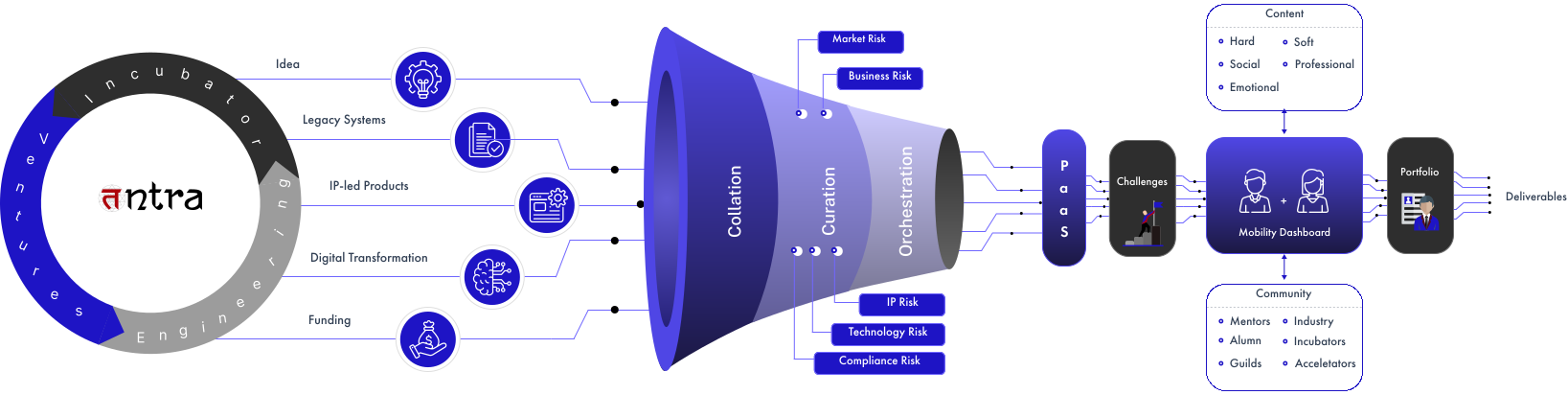
Within T(u)LIP, ideas are captured with structured metadata that makes them evaluable rather than merely documented. Stage gate criteria are built into the platform workflow, ensuring that ideas advance through the Innovation Corridor based on evidence rather than advocacy. The clean-room IP tracking that T(u)LIP enforces from the first day of development ensures that every innovation output is owned completely and documented defensibly from the moment it is created.
It functions as the core structural layer where an idea’s operational journey begins.
Shruti AI: Innovation Intelligence that Compounds
Shruti AI operates as the Intelligence layer of the ecosystem, providing the analytical capability that makes the innovation operating model smarter over time rather than remaining static between manual reviews.
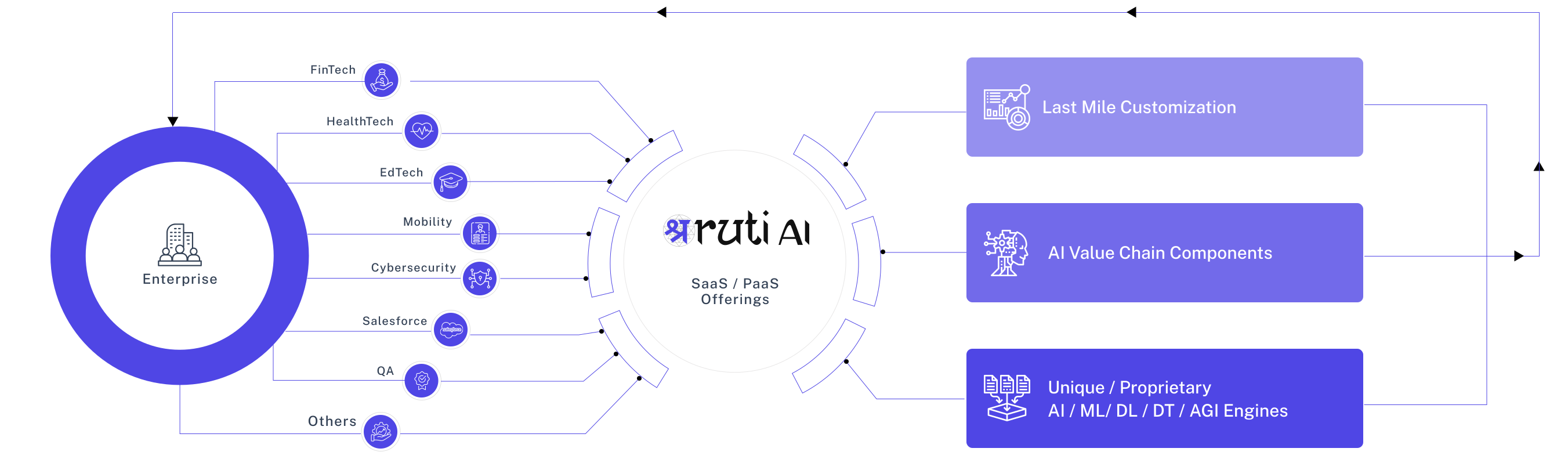
Within the ecosystem context, Shruti AI’s contribution extends beyond individual idea evaluation to portfolio-level intelligence that improves the system itself. By analyzing patterns across successful and unsuccessful innovation initiatives, Shruti AI continuously refines the criteria and signals that the governance layer uses to make stage gate decisions, creating the learning loop that moves organizations up the innovation maturity model rather than remaining stuck at the level where their initial system was designed.
Engineering Pods: Impact that is Owned
Ideas that survive the governance process and earn scaling investment need engineering execution capability that is explicitly designed for innovation-stage development rather than for production operations management.
Tntra’s Engineering Pods are cross-functional, product-centric development teams structured specifically for the IP-led software development that innovation-stage work requires. Unlike traditional staff augmentation or project outsourcing models, Engineering Pods operate with a product ownership mindset that keeps IP integrity, architectural extensibility, and clean-room development discipline at the center of every technical decision.
They bridge the gap between initial software delivery and long-term business impact, ensuring validated ideas become fully realized revenue-bearing assets.
Gurukula: Capability that Survives Champions
One of the most consistent findings from enterprise innovation program analysis is that innovation capability collapses when champions leave. The institutional knowledge that makes an innovation program work lives in individuals rather than in the organization.
Gurukula is Tntra’s capability development platform within the innovation ecosystem, designed to institutionalize innovation capability rather than leaving it concentrated in individual expertise. Through structured learning programs, mentorship frameworks, and practice community infrastructure, Gurukula transfers innovation thinking, IP strategy awareness, and structured execution capability into the organizational fabric rather than leaving it dependent on specific people.
The People dimension of Tntra’s 3P framework is what Gurukula operationalizes. An innovation operating system that does not build the organizational capability to sustain itself beyond its initial champions is an innovation program rather than an innovation capability.
IP Framework: Strategic Advantage that Compounds
The IP Framework that runs across the entire Tntra ecosystem transforms the Innovation Operating System from an operational discipline into a strategic value creation engine.
Every idea that enters T(u)LIP, every evaluation that Shruti AI supports, every product that Engineering Pods build, and every capability that Gurukula develops is governed by IP strategy that ensures innovation outputs are owned completely, documented defensibly, and structured for the valuation premium that genuine IP ownership creates.
The Category-Claim-Cloud framework within the IP layer maps every significant innovation output against the patent landscape, identifies the broadest defensible claim architecture for each innovation, and builds the overlapping IP protection network that prevents competitive replication from eroding the value of innovation investment.
Together, T(u)LIP for Ideas, Shruti AI for Innovation intelligence, Engineering Pods for Impact delivery, Gurukula for Capability development, and the IP Framework for Strategic Advantage form the integrated infrastructure that makes the AI-First, IP-Enabled Innovation Operating System executable rather than aspirational.
Innovation is Not an Event. It is an Operating Capability.
The organizations that win the next decade will not be those that generate the most ideas. They will be the ones that build the most effective systems for converting ideas into patents, products, people capability, and measurable business impact.
Innovation is not a workshop. It is not a hackathon. It is not a collection of disconnected pilots.
Innovation is an operating capability.
The enterprises that consistently outperform their competitors are not necessarily more creative. They are more disciplined in how they move ideas through validation, governance, execution, and scale. They build Innovation Operating Systems that transform ideas into intellectual property, scalable platforms, organizational capability, and long-term enterprise value.
At Tntra, this philosophy is embedded directly into our AI-First, IP-Enabled Innovation Operating System. Through the Innovation Corridor, Shruti AI, T(u)LIP, Engineering Pods, and our 3Ps framework (Patents, Products, and People), we help organizations turn innovation from an activity into a repeatable business capability.
Assess Your Innovation Maturity
Most organizations are not lacking ideas. They are lacking the structure required to scale them.
Tntra’s Innovation Readiness Assessment helps organizations identify where they sit on the Innovation Maturity Model, uncover bottlenecks in their innovation lifecycle, and determine where structure, governance, or execution capability may be limiting innovation scale.
Whether you are trying to improve innovation governance, scale AI initiatives, strengthen your innovation portfolio, or build a repeatable Innovation Operating System, we can help.
Explore Your Next Step
- Innovation Ecosystem Audit:
Connect directly with Tntra’s strategy team to review your existing pipeline architecture, evaluate technology gaps, and identify the hidden structural barriers stalling your current pilots. - Innovation-to-Impact Workshop
Map your innovation pipeline, evaluate conversion bottlenecks, and design a practical path from experimentation to enterprise impact. - CTOaaS Strategy Session
Work with experienced technology and innovation leaders to align innovation strategy, AI adoption, platform architecture, and execution planning.
Ready to transform Ideas into measurable Impact and empty your Pilot Cemetery?
Book an Innovation Maturity Review with Tntra and discover how an AI-First, IP-Enabled Innovation Operating System can turn promising ideas into scalable business outcomes.
Contact Tntra.
FAQs
How Does Structure Affect Innovation and Flexibility?
Structure gives innovation a reliable path to travel, so good ideas move faster and decisions happen with less friction. Far from limiting flexibility, the right structure creates the safe conditions where creative risk-taking actually becomes possible at scale.
What is the Structure of Innovation?
The structure of innovation is the operating model that connects ideation, decision-making, and execution into one repeatable system. It defines how ideas enter, how they get evaluated, how resources flow, and how learning comes back into the next cycle.
What is an Example of Structured Innovation?
A company that runs a quarterly innovation pipeline, where ideas are submitted, scored against strategic criteria, funded in stages, and either scaled into platforms or exited cleanly, is practicing structured innovation. The process is visible, consistent, and not dependent on any single champion.
Can You Innovate within Large Organizations?
Large organizations can absolutely innovate, and in many ways they have structural advantages that startups do not, including capital, distribution, and data. The difference between enterprises that innovate well and those that do not almost always comes down to whether they have built the operating model to support it.
How Do Companies Scale Innovation Successfully?
Companies that scale innovation successfully treat it as a managed capability, not a cultural mood. They build clear decision frameworks, define what deserves to scale versus what should stay small, connect innovation activity to business outcomes, and invest in the governance and platforms that make the whole system repeatable.
What is a Structured Innovation Framework?
A structured innovation framework is the set of processes, decision rights, investment criteria, and governance structures that move ideas through a defined lifecycle from insight to impact. It is what stops innovation from being dependent on individual heroics and turns it into a reliable organizational capability.