AI Risk Management in Enterprises: A Practical Guide
AI risk management is the structured discipline of identifying, evaluating, and controlling what AI systems do when they encounter the full complexity of real-world conditions. Enterprise AI risk management delivers its highest value when organizations treat it as the mechanism that makes confident, rapid AI deployment possible rather than the process that regulates it into slowness.
AI risk management and AI governance framework have moved to the center of enterprise technology conversations, and the timing reflects something real happening inside organizations that moved fast on AI capability without building the infrastructure to manage it.
The insight that reshapes how all of this should work sits right at the start. Most governance conversations position risk management as the tax an organization pays for the privilege of deploying AI. That framing produces the opposite of what leadership actually wants. The organizations that have built genuinely effective Enterprise AI risk management are deploying AI faster than their less-governed peers, not slower, because a credible framework removes the single most common obstacle to enterprise AI: the approval process stalling indefinitely because nobody can answer whether this specific system is safe to ship. When legal, risk, and leadership teams trust that a system has genuinely been evaluated, decisions move quickly. When that trust is absent, every consequential AI initiative circles in uncertainty until someone eventually shelves it.
AI governance framework design is therefore most accurately understood as a velocity tool. Organizations that build it well move faster. Organizations that skip it find themselves stuck at the exact moment AI starts to matter.
- Governance removes the approval bottleneck: A credible AI risk management framework gives leadership teams the confidence to approve AI initiatives quickly rather than deferring them into endless review cycles.
- Risk spans well beyond fairness: AI model risk management addresses accuracy, security, regulatory exposure, and operational reliability alongside the bias concerns that dominate most coverage.
- Embedding works, bolting on fails: Responsible AI framework design built into the development process from sprint one produces fundamentally more durable protection than retrospective review applied to finished systems.
- Trust is the actual deliverable: AI compliance and governance infrastructure is the mechanism through which an organization builds the organizational trust that allows AI adoption to expand continuously.
What Is AI Risk Management in an Enterprise
What is AI risk management in an enterprise deserves a precise answer, because the scope is wider than most people initially assume.
Enterprise AI risk management covers the full lifecycle of every AI system an organization operates, starting from the data used to train it, running through development and validation, continuing through production deployment, and extending across the entire operational life of the system as it makes decisions that affect customers, employees, and the business. The discipline identifies where systems might fail, produce harmful outputs, introduce regulatory exposure, or behave unexpectedly under real-world conditions, then puts controls in place that reduce those risks to levels the organization has consciously accepted.
What is the difference between AI governance and AI risk management clarifies the relationship between two terms that frequently get used as synonyms. AI governance is the broader structure, covering the policies, roles, decision rights, and accountability mechanisms that shape how an organization approaches AI across the board. AI risk management is the specific discipline within governance focused on identifying and controlling risks. Governance provides the operating environment, and risk management is the core practice that runs within it.
Why AI Governance Matters for Business Growth
Why is AI governance important for businesses connects to four converging pressures that have turned governance from a theoretical concern into a practical business priority.
Regulatory momentum is real and accelerating. AI-specific regulation is developing across major markets at a pace that organizations with AI governance best practices already embedded handle far more smoothly than those building governance reactively under examination pressure.
The second pressure is consequence scale. As AI systems make decisions in lending, hiring, healthcare, and customer service, the cost of a governance failure rises from a technical embarrassment to a financial, legal, and reputational event of genuine magnitude. Third is stakeholder trust.
Enterprise AI governance that demonstrably manages risk builds credibility with customers, regulators, and boards that allows organizations to expand AI use rather than retreat from it after a high-profile incident. Fourth, and most practically, is deployment velocity. Governed organizations approve AI initiatives faster because the decision infrastructure already exists.
The Key Components of an AI Governance Framework
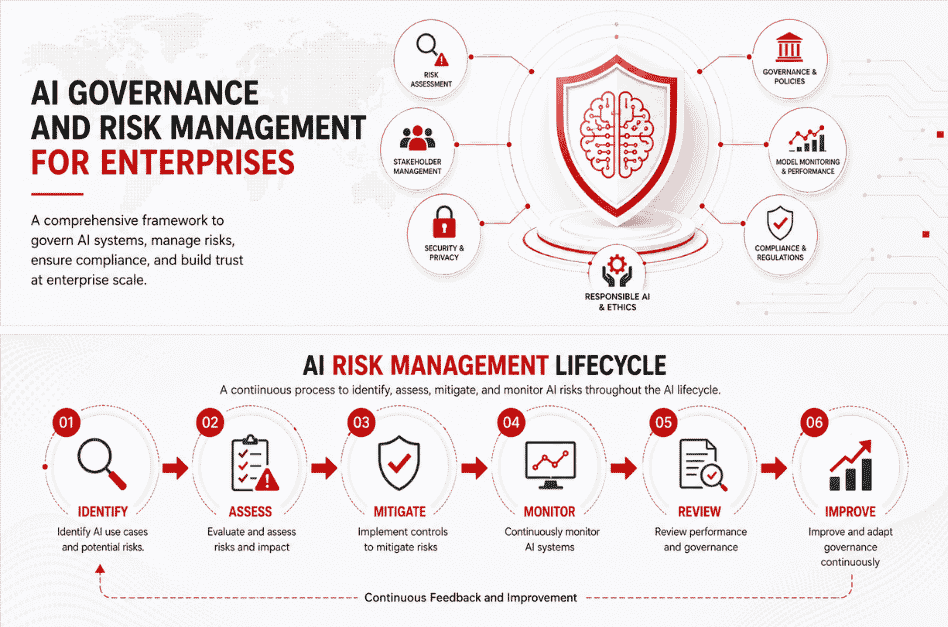
What are the key components of an AI governance framework organised across four interconnected disciplines that together provide comprehensive coverage.
AI Risk Assessment
An AI risk assessment framework gives organizations the structured methodology to evaluate each AI system against the full range of risks it introduces before it reaches production.
- Fairness and bias evaluation: Systematic assessment of whether AI outputs vary across demographic groups, customer segments, or geographic markets in ways that create ethical exposure or regulatory liability.
- Accuracy under real conditions: Validation of how systems perform across the full distribution of inputs they encounter in practice, rather than only the conditions represented in controlled testing environments.
- AI-specific security evaluation: AI security and governance assessment examines adversarial attack vulnerability, data poisoning risk, and prompt injection exposure that traditional security frameworks were never designed to evaluate.
- Consequence mapping: Explicit evaluation of what happens when a system produces incorrect or unexpected outputs, which calibrates how much oversight and control each specific system actually requires.
AI Model Risk Management
AI model risk management applies structured validation discipline to the AI systems making consequential decisions across the enterprise.
- Structured pre-deployment validation: Formal evaluation of performance, failure modes, and bias characteristics before production deployment, with documented evidence that the system has been genuinely reviewed rather than assumed to be safe.
- Continuous post-deployment monitoring: Ongoing measurement against validation benchmarks that catches model drift, input data distribution changes, and emerging bias patterns before they accumulate into significant business or regulatory exposure.
- Accountability documentation: Comprehensive records of training data, model architecture, performance characteristics, known limitations, and intended use that provide the evidence base for both internal governance and external regulatory examination.
Governance Roles and Decision Rights
AI governance implementation succeeds when accountability is explicit rather than assumed.
- Named ownership: Identified individuals accountable for each consequential AI system’s risk profile, replacing the diffuse accountability that allows governance gaps to go unnoticed across large organizations.
- Tiered review authority: Clear mapping of which decisions development teams make independently, which require governance review, and which require senior leadership involvement, calibrated to actual risk level.
- Escalation infrastructure: Defined paths for surfacing concerns when AI systems behave unexpectedly or when risk assessments surface issues exceeding a team’s authority to accept.
Responsible AI Principles in Practice
A Responsible AI framework translates organizational values into concrete operational requirements that shape how systems are built.
- Explainability requirements: Standards for AI systems to generate interpretable reasoning for their decisions, satisfying regulatory requirements in many contexts and supporting the human review that consequential decisions warrant.
- Human oversight definitions: Explicit specification of which decisions AI makes autonomously, which require human review before acting, and which remain human decisions that AI supports rather than replaces.
- Transparency standards: Requirements for communicating clearly when AI is involved in decisions affecting customers, employees, or other stakeholders subject to its outputs.
How Organizations Build Effective AI Risk Management
How do organizations manage AI risks in practice separates into two approaches that produce very different results.
Organizations that embed risk management into the AI development process, treating it as a discipline that runs alongside engineering rather than a gate applied afterward, consistently produce better outcomes across speed, quality, and protection. Organizations that treat governance as a final review before launch find themselves either shipping systems with inadequately understood risks or significantly delaying deployments while retrospective evaluation catches up.
How to implement AI risk management in enterprises follows the embedded approach across four practical steps. Assessment criteria are defined before model development begins. Governance controls are implemented at the platform level so every AI system inherits appropriate protections automatically. Monitoring runs continuously across production systems rather than at scheduled intervals. And governance decisions are documented with enough clarity that approvals for similar systems can be granted efficiently rather than rebuilt from scratch each time.
AI risk management framework for large organizations specifically must address the diversity of AI use across a complex enterprise, where dozens of systems may operate across business units with genuinely different risk profiles and regulatory contexts. An AI governance platform that provides consistent infrastructure across the whole enterprise ensures that governance quality does not depend on the individual diligence of each team.
Best Practices for Enterprise AI Governance
Best practices for enterprise AI governance have converged around several specific practices that distinguish governance that works from governance that merely exists.
Platform-level governance implementation is the highest-leverage approach, because it makes appropriate risk management the automatic default for every AI system rather than an optional extra that teams apply inconsistently. Risk-proportionate oversight keeps the governance process efficient, reserving deep review for systems with genuinely consequential outputs while providing lighter, faster processes for lower-stakes applications. Continuous monitoring rather than point-in-time assessment catches the risks that only emerge after deployment, as models encounter data distributions their training never anticipated. And governance documentation detailed enough to inform subsequent similar decisions accelerates approvals over time rather than requiring the same analytical work repeatedly.
How enterprises can reduce AI compliance risks most effectively combines all four practices into a coherent operating rhythm, where risk assessment, model validation, continuous monitoring, and accountable ownership reinforce each other as components of a single integrated system.
Building an AI Governance Strategy
AI governance strategy at the enterprise level requires sequencing decisions across three horizons simultaneously.
Immediately, organizations need risk assessment capability for AI systems already in production or approaching deployment. In the near term, they need platform-level governance infrastructure that makes consistent risk management the default for every new AI development effort. Over a longer horizon, they need AI governance best practices that mature continuously as AI capability, regulatory requirements, and organizational AI use all evolve together.
AI governance framework for responsible AI adoption that is designed around durable principles like transparency, accountability, fairness, and human oversight adapts naturally to regulatory developments across major markets, because those regulations consistently codify the same underlying principles. Organizations building governance around these foundations find themselves well-positioned for regulatory requirements as they arrive, rather than rebuilding to each new specific mandate.
Conclusion
AI Risk Management in Enterprises at its best is the infrastructure that lets organizations say yes to AI with genuine confidence rather than with fingers crossed. The difference between governance that enables and governance that constrains comes entirely from how it is designed, whether it is embedded into development processes and platforms, or applied reactively as a final review that arrives after engineering decisions have already closed off the most important risk-reduction options.
Organizations that approach Enterprise AI governance as a velocity enabler and competitive advantage will deploy more AI, more confidently, with stronger protection, than those treating it as a reluctant compliance requirement. That outcome gap is already visible in the enterprises that got this right early, and it will widen as AI becomes more consequential across every industry.
How Tntra Helps Enterprises Build AI Risk Management That Works
At Tntra, our Enterprise AI Advisory Services and AI Consulting Services are built around the principle that governance enables confident AI deployment rather than regulating it into hesitation.
Our Enterprise AI Platform embeds model risk management, fairness monitoring, and continuous observability at the infrastructure level, making appropriate governance the automatic default for every AI system built on it. Our software product engineering and enterprise software development practices ensure responsible AI principles are engineered into systems from the first sprint, producing protection that holds under real-world conditions.
Our digital transformation services connect AI governance to the broader enterprise strategy, positioning risk management as the infrastructure that makes ambitious AI adoption possible at the pace and scale leadership wants.
If your organization is ready to build AI governance that accelerates confident deployment, Connect with the Tntra team today.
FAQs
How do companies manage AI risks?
Companies manage AI risks by embedding structured assessment into the AI development lifecycle, implementing platform-level governance controls, and continuously monitoring production systems to detect bias, model drift, and security vulnerabilities before they create significant business or regulatory consequences.
Why do enterprises need AI governance?
Enterprises need AI governance to deploy AI with confidence, adapt to evolving regulatory requirements, manage the growing impact of AI in high-stakes business environments, and build the organizational trust required for sustainable AI adoption at scale.
What are the biggest risks of enterprise AI?
The biggest enterprise AI risks include biased or unfair outputs, inaccurate predictions under real-world conditions, AI-specific cybersecurity threats, regulatory non-compliance, and the operational and reputational damage caused by AI failures in production.
What is an AI governance framework?
An AI governance framework is a structured set of policies, roles, decision rights, and accountability mechanisms that guide how an organization develops, evaluates, deploys, monitors, and manages AI systems throughout their lifecycle.
How do you build an AI risk management strategy?
Building an AI risk management strategy involves integrating risk assessment into the AI development lifecycle, implementing platform-level governance controls, aligning oversight with each system’s risk level, assigning clear ownership, and continuously monitoring AI models in production.
What regulations apply to enterprise AI?
AI regulations are rapidly evolving across global markets. Organizations can prepare by adopting governance principles such as transparency, accountability, fairness, privacy, and human oversight, which closely align with emerging AI regulatory frameworks.
What is responsible AI?
Responsible AI is the practice of designing, developing, and deploying AI systems that are fair, transparent, explainable, secure, and accountable while ensuring meaningful human oversight throughout the AI lifecycle.