AI Governance: The Missing Layer in Enterprise AI Adoption
Enterprise AI adoption is accelerating, but most organizations are missing the governance layer that makes it sustainable. This article breaks down what AI governance actually means inside an enterprise, why it extends far beyond regulatory compliance, and what a working AI governance framework looks like in practice. From model monitoring and accountability structures to the real challenges that stall governance adoption, the piece offers a grounded, experience-backed perspective on building AI governance that holds. Tntra’s Enterprise AI Advisory services help organizations close the gap between where they are and where they need to be. Continue reading to learn more.
A model that nobody fully understands can quietly make thousands of business-critical decisions every day with little oversight, limited accountability, and no structured review process. That is the uncomfortable reality many enterprises are facing today.
This is why AI governance in enterprise AI has become one of the most important conversations in modern business transformation. Yet despite growing awareness, most organizations still lack a mature AI governance framework capable of supporting long-term, scalable AI operations.
This article explores what AI governance actually means in practice, why enterprise AI governance is essential beyond regulatory compliance, and how organizations can implement governance structures that make AI adoption sustainable, transparent, and trustworthy.
The Enterprise AI Governance Gap Nobody Wants to Talk About
Inside many enterprises, the pattern is familiar. A data science team builds an impressive AI model. Business stakeholders see early ROI. Leadership approves rollout. Legal reviews vendor agreements. IT signs off on integrations.
But critical questions often remain unanswered:
- Who owns accountability when the model behaves unexpectedly?
- How is model monitoring handled over time?
- What happens when outputs drift from expected performance?
- How does the organization explain AI-driven decisions to regulators or customers?
- Who reviews bias, transparency, and fairness risks?
These questions are often deferred until something breaks.
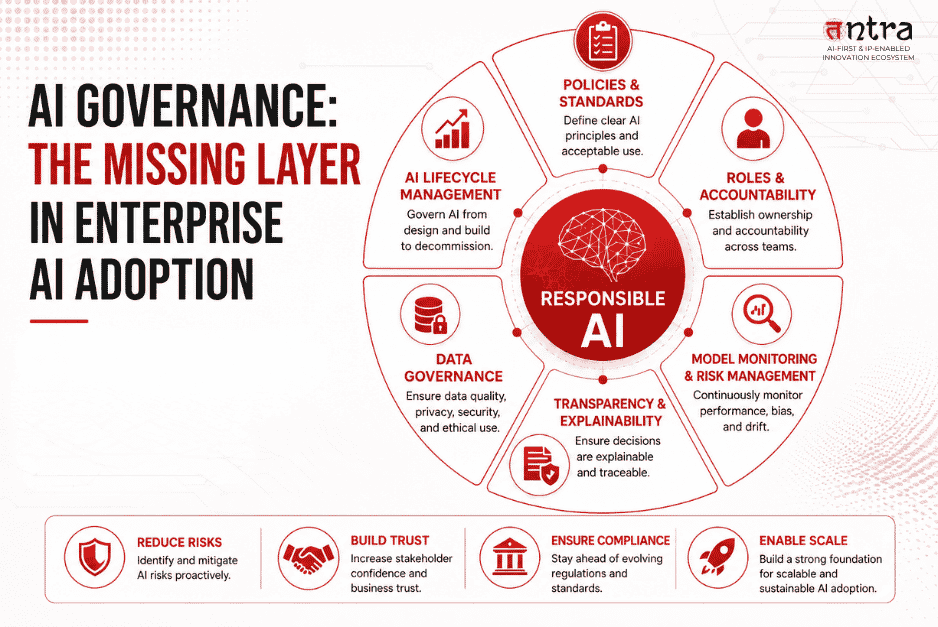
That is precisely where enterprise AI governance becomes essential. A strong governance structure creates operational accountability around how AI systems are designed, deployed, monitored, and retired across the enterprise.
Many organizations currently operate with fragmented governance approaches:
- A compliance checklist stored in a shared folder
- A legal policy document nobody references
- Occasional reviews disconnected from development workflows
These are not governance systems. They are governance placeholders.
A real AI governance framework for enterprises is embedded into the entire AI lifecycle. It includes:
- Defined ownership structures
- AI accountability processes
- Continuous monitoring infrastructure
- Risk-tiered governance policies
- Audit and compliance workflows
- Lifecycle documentation standards
Effective AI governance in enterprises is operational, measurable, and continuously evolving alongside the technology itself.
Why AI Governance is Important in Enterprises, Beyond Compliance?
Most discussions around AI compliance focus on regulations like:
- The EU AI Act
- Financial services compliance mandates
- Healthcare AI regulations
- Industry-specific governance policies
While regulation matters, governance cannot exist solely as a compliance exercise.
The real value of AI governance strategy is operational resilience.
AI systems introduce risks that evolve continuously:
- Models drift over time
- Training data becomes outdated
- Historical bias affects predictions
- AI outputs shift unpredictably
- New business conditions create unseen edge cases
Without structured AI risk management, these problems often remain invisible until they create measurable damage.
AI Governance Protects Organizational Trust
One of the most overlooked aspects of responsible AI governance is trust.
Employees increasingly question how AI influences:
- Hiring decisions
- Performance reviews
- Promotions
- Workflow automation
Customers ask:
- Why was a loan denied?
- Why did pricing change?
- How is their data being used?
Partners and regulators want visibility into:
- Data governance in AI
- AI transparency
- Decision traceability
- Security controls
Organizations with mature AI accountability structures can answer these questions confidently and consistently.
Those without governance struggle under scrutiny.
AI governance strategy is not overhead. It is what makes the investment in AI defensible over time.
What Building AI Governance in Enterprises Actually Requires?
Organizations often underestimate how operationally complex AI lifecycle management becomes at scale.
Governance Must Be Embedded, Not Added Later
One of the biggest failures in AI governance adoption happens when governance is treated as a final-stage approval gate.
By the time governance reviews occur:
- Training data choices are already locked
- Optimization objectives are defined
- Deployment architectures are finalized
- Bias risks may already exist
Governance that appears only at the end of development cannot meaningfully govern the highest-risk decisions.
Effective AI governance in enterprise AI integrates governance from day one.
AI Model Governance Requires Technical Infrastructure
Policies alone are not enough.
Successful AI model governance requires operational systems such as:
Model Documentation Standards
Every deployed AI model should include:
- Purpose definitions
- Training datasets
- Performance benchmarks
- Known limitations
- Risk classifications
Continuous Model Monitoring
Organizations need automated monitoring for:
- Output drift
- Accuracy degradation
- Fairness metrics
- Bias detection
- Security anomalies
Audit Trails and Explainability
Strong AI transparency requires:
- Decision traceability
- Version tracking
- Model lineage visibility
- Historical review capabilities
Without this infrastructure, governance becomes reactive instead of proactive.
Risk-Tiered AI Governance Frameworks Work Best
Not all AI systems carry equal risk.
A recommendation engine suggesting articles does not require the same governance depth as:
- Fraud detection systems
- Credit eligibility models
- Healthcare diagnostics
- Autonomous decision systems
This is why modern AI governance best practices for businesses emphasize risk-tiered governance structures.
High-risk models require:
- More documentation
- Deeper reviews
- Stronger oversight
- Frequent monitoring
- Clear escalation paths
Lower-risk applications can move faster with lightweight governance controls.
This balance prevents governance from becoming either:
- Excessively bureaucratic
- Dangerously permissive
The Real Challenges in AI Governance Adoption that Actually Stall Progress
The challenges in AI governance adoption that show up most often in organizations trying to do this seriously fall into a few recognizable categories.
1. Speed vs Governance Tension
Engineering teams often view governance as friction.
Poorly designed governance processes slow releases and create resistance.
The solution is not weaker governance. The solution is earlier governance integration.
When governance happens continuously instead of at the end, organizations reduce costly rework later.
2. Ownership Ambiguity
AI systems sit across:
- Data teams
- Product teams
- Legal departments
- Compliance groups
- Business operations
Without deliberate organizational design, accountability becomes fragmented.
Strong enterprise AI governance requires explicit ownership structures.
3. Governance Framework Obsolescence
AI evolves rapidly.
A framework built before generative AI may not address:
- Large language models
- Agentic AI systems
- Multimodal AI
- Autonomous workflows
Organizations need governance systems capable of evolving continuously alongside the technology landscape.
4. Measuring Governance ROI
Governance prevents problems.
That creates a difficult business challenge:
How do you quantify the value of incidents that never happened?
Successful organizations connect governance investments directly to:
- Risk reduction
- Regulatory readiness
- Customer trust
- Operational resilience
- AI scalability
AI Governance Best Practices for Businesses that are Ready to Scale
Organizations serious about enterprise AI adoption consistently follow several core governance principles.
Start with an AI Inventory
Before building frameworks, identify:
- Existing AI systems
- Decision impact areas
- Ownership structures
- Monitoring gaps
Most enterprises discover more unmanaged AI than expected.
Risk-Tier the AI Portfolio
Separate:
- High-risk systems
- Medium-risk operational models
- Low-risk automation tools
This creates proportional governance structures.
Make Documentation Mandatory
Every production AI model should include:
- Model cards
- Performance baselines
- Risk summaries
- Monitoring thresholds
Documentation culture becomes foundational for long-term scalability.
Build Monitoring Infrastructure Early
Retrofitting governance into production AI systems is significantly harder.
Strong AI lifecycle management begins before deployment.
Schedule Governance Reviews
Do not rely solely on alerts.
High-risk systems should undergo:
- Quarterly governance reviews
- Annual framework assessments
- Trigger-based escalations
Continuous governance maturity is essential.
How Enterprise AI Advisory Services Accelerate AI Governance
Most organizations are not starting from zero.
They already have fragmented governance components:
- Policies
- Review workflows
- Security controls
- Compliance procedures
What they lack is integration.
This is where enterprise AI Advisory services create measurable value.
Experienced advisory teams help organizations:
- Design scalable governance frameworks
- Build operational governance models
- Implement AI risk management systems
- Create governance accountability structures
- Align governance with industry-specific regulations
The advantage of proprietary AI Advisory services is contextual expertise.
Generic templates rarely account for:
- Organizational culture
- Industry-specific risk
- Existing technology ecosystems
- Operational maturity
Strong AI Advisory Solutions focus on building governance systems that function in operational reality, not just on paper.
At the center of this effort is the enterprise AI engine itself and the organization’s ability to understand:
- What models are doing
- Why decisions occur
- How anomalies are detected
- What escalation paths exist when failures occur
That understanding is the true foundation of sustainable AI adoption.
The Organizations that will Win at AI are Building Governance Now
Every major technology shift creates two categories of organizations.
The first group moves fast without operational foundations and eventually collides with accumulated risk.
The second group invests early in scalable infrastructure, governance, and accountability — and builds durable competitive advantage.
With AI, governance is that infrastructure layer.
AI governance in enterprise AI is what separates experimental AI adoption from sustainable enterprise transformation.
Organizations that build strong governance capabilities today will:
- Scale AI more confidently
- Earn greater stakeholder trust
- Respond faster to regulation
- Reduce operational risk
- Sustain long-term innovation
The right time to build governance is before systems fail, not after.
Thinking About Where Your Organization Stands on AI Governance?
Tntra’s Enterprise AI Advisory services help organizations build scalable governance systems grounded in real operational realities.
From:
- AI governance framework design
- AI compliance
- AI risk management
- AI model governance
- AI lifecycle management
- AI transparency
- Data governance in AI
to enterprise-wide governance transformation, Tntra’s AI Advisory Solutions are designed to help enterprises mature AI responsibly and sustainably.
If your organization is evaluating how to strengthen governance around enterprise AI adoption, Tntra’s proprietary AI Advisory services can help you build governance systems that hold under real-world complexity.
Talk to Tntra’s AI Advisory team and build an enterprise AI foundation designed for scale.
FAQs
What is an AI governance framework for enterprise AI?
An AI governance framework for enterprises is a structured system of policies, accountability processes, monitoring tools, and operational controls that govern how AI systems are developed, deployed, monitored, and retired across the organization.
Why is AI governance important in enterprises?
AI governance is important in enterprises because AI systems evolve continuously and can introduce operational, ethical, and compliance risks if left unmanaged. Governance creates accountability, transparency, and long-term scalability for enterprise AI adoption.
What is AI governance in enterprises?
AI governance in enterprises refers to the organizational structures, policies, processes, and technical systems that oversee AI usage, decision-making, accountability, and compliance across business operations.
How do organizations implement AI governance?
Organizations implement AI governance by:
- Auditing existing AI systems
- Creating governance ownership structures
- Risk-tiering AI models
- Building model monitoring infrastructure
- Embedding governance into development workflows
- Establishing review and escalation processes
Many organizations accelerate implementation through specialized Enterprise AI Advisory services.
What are the key components of responsible AI governance?
Core components include:
- AI policies and ethics standards
- AI accountability structures
- Model monitoring systems
- AI transparency and explainability
- Audit trails
- Data governance in AI
- AI lifecycle management processes