AI in Logistics: Route Optimization and Delivery Predictive Analytics for Smarter Supply Chains
In today’s fast-paced logistics landscape, AI in logistics has become a competitive advantage rather than a futuristic concept. Logistics companies are now leveraging logistics predictive analytics, AI route optimization, and delivery predictive analytics to streamline operations, reduce costs, and ensure faster, more reliable deliveries.
What is AI in Logistics? A Complete Overview
AI in logistics refers to the use of artificial intelligence, machine learning, and predictive analytics to optimize supply chain operations such as route planning, delivery prediction, demand forecasting, and real-time tracking. By using AI-driven logistics solutions, businesses can reduce costs, improve delivery accuracy, and enhance overall operational efficiency.
This article explores how AI in logistics enables smarter decision-making—from demand forecasting and AI route optimization to real-time delivery tracking and autonomous delivery systems.
Today, customers expect speed, accuracy, and transparency in logistics, making it a key competitive battleground. The question is no longer if you should adopt AI—but how to implement AI-driven logistics optimization effectively.
Why Predictive Analytics Matters in Logistics and Supply Chain Optimization with AI
Today’s customers expect speed, accuracy, and transparency. For decision-makers in logistics and operations, the question is no longer if but how to use artificial intelligence in supply chain to improve performance.
With AI in logistics, organizations can:
- Anticipate delivery bottlenecks
- Optimize fleet movement
- Improve decision-making speed
- Enhance operational efficiency
Delivery predictive analytics helps forecast demand surges, identify potential delays, and improve delivery timelines—bridging the gap between past data and future performance.
The Core Components of AI-Driven Logistics Optimization
Here’s how AI-driven logistics optimization works under the hood:
1. Data Collection & Integration for AI Logistics
Gather unified, high-quality logistics data from deliveries, GPS systems, weather, and warehouse operations. This enables data-driven logistics and ensures your AI logistics automation platform has reliable inputs.
2. Machine Learning & Predictive Models in Logistics
AI models can:
- Demand forecasting
- Predict travel times under different traffic conditions
- Delivery window estimation
- Risk and disruption detection
These capabilities drive AI-based predictive delivery systems.
3. AI Route Optimization & Decision Engines
Using real-time insights, AI route optimization algorithms balance delivery constraints, traffic conditions, and cost efficiency.
This results in AI-driven route planning and improved transportation performance.
4. Real-Time Tracking with AI Logistics Systems
Real-time AI logistics tracking compares actual vs predicted performance and adjusts routes dynamically. This adaptability is key for AI-powered logistics software used in modern transportation management systems (TMS).
5. Execution with IoT-Enabled Smart Logistics
IoT-powered systems enable AI logistics automation, allowing real-time execution adjustments based on live data.
6. Complementary AI Modules
Add-on AI tools such as:
- AI in warehouse management
- AI-based inventory management
- Autonomous delivery systems
These create an integrated intelligent logistics solution for a truly smart, scalable supply chain.
How AI Route Optimization and Delivery Predictive Analytics Work in Practice
Predicting Delivery Performance with AI
Using delivery predictive analytics, companies can predict delivery times based on traffic, weather, driver behavior, and road data. For instance, models can forecast delivery durations with confidence intervals—enabling predictive route optimization for faster delivery.
Dynamic AI Route Optimization in Real Time
AI route optimization tools continuously analyze real-time conditions and reroute vehicles to minimize delays and improve last-mile delivery.
Continuous Monitoring and AI Learning Systems
Smart logistics with AI ensures that deviations are instantly detected. The system learns from these events and continually refines itself, creating a self-learning supply chain that adapts in real time.
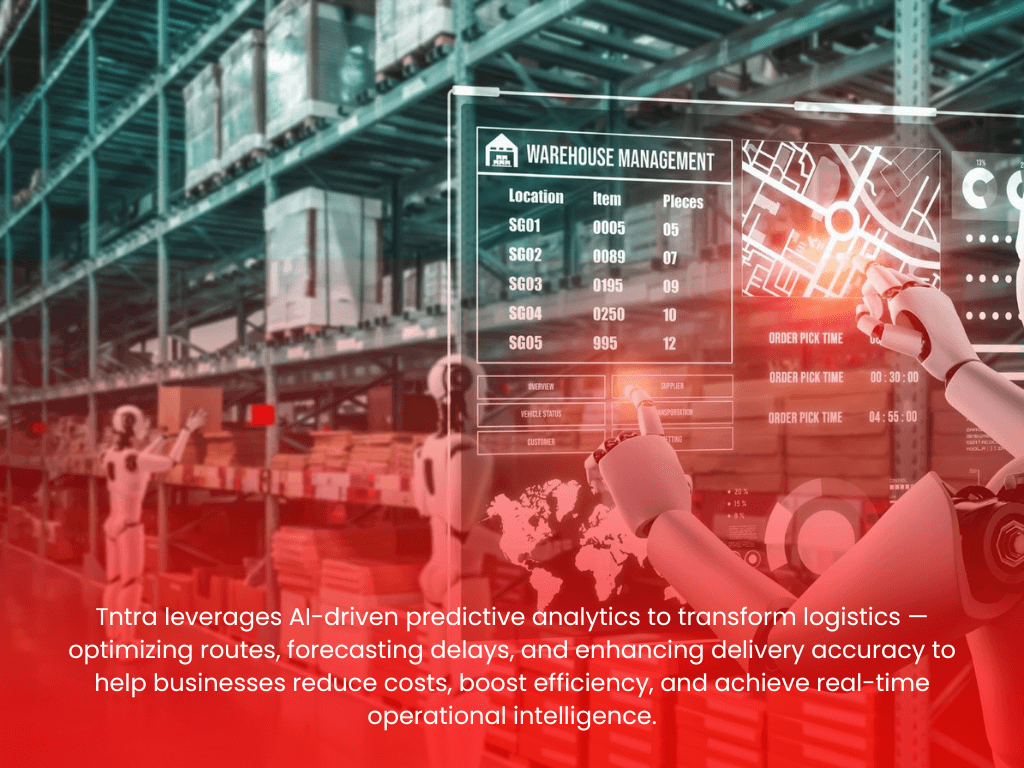
To bring this alive, let’s walk through how delivery predictive analytics and AI route optimization interplay in a real logistics operation.
Key Benefits of AI-Driven Logistics Solutions
Organizations implementing AI logistics automation and AI-driven route planning achieve:
- Cost reduction: Lower fuel, maintenance, and labor costs thanks to better routing and fewer wasted miles.
- Higher capacity & throughput: More deliveries per vehicle per day without adding headcount.
- Improved on-time delivery rates: Better adherence to time windows because predictions + planning are smarter.
- Reduced customer support load: Accurate ETAs and proactive delay notification mean fewer calls and complaints.
- Incremental learning & continuous improvement: Over time, the system becomes more precise.
- Better resource utilization: Vehicles, drivers, and warehouse operations are coordinated more tightly.
- Scalability & agility: You can respond faster to disruptions (e.g. storms, strikes, demand surges).
A notable example: AI-driven route planning enables denser routing and fuel savings while improving delivery timelines.
Enterprises adopting AI in logistics are seeing measurable improvements in delivery efficiency, cost optimization, and real-time decision-making, making AI a critical component of modern supply chain transformation.
AI Logistics Automation and Supply Chain Synergies
AI supply chain management becomes more effective when logistics, inventory, and warehousing systems interact seamlessly.
- AI-based inventory management feeds forecasts to logistics so that stock is prepositioned smartly, reducing rush deliveries.
- AI in warehouse management (robotic pickers, optimized storage, slotting) ensures that once a delivery route is planned, orders are ready at precisely the right time.
- Autonomous delivery systems, drones, robots, self-driving vehicles, can be plugged into route planning engines to automate the “last mile” more deeply. For instance, research into autonomous delivery systems for small neighborhoods is ongoing to route robots safely and efficiently.
- Predictive maintenance of vehicles, another logistics predictive analytics subdomain, ensures fewer breakdowns mid-route.
When combined, these modules enable sustainable, eco-efficient logistics management solutions.
Organizations are increasingly leveraging intelligent platforms like Shruti AI to analyze logistics data, generate predictive insights, and automate decision-making across supply chain operations.
Implementation Challenges in AI Logistics Optimization
Rolling out AI-driven logistics optimization isn’t trivial. Here are the common hurdles and how to plan for them:
| Challenge | Risk | Mitigation / Strategy |
| Data Silos / Poor Data Quality | Garbage in → garbage out | Start with data cleaning, consistent schema, centralized data platform |
| Legacy Systems & Integration | Difficulty merging AI modules with existing TMS or ERP | Use middleware, APIs, phased rollout |
| Model Accuracy & Edge Cases | Predictions may fail for rare events | Use ensemble models, fallback strategies, human override |
| Real-time Performance & Latency | Too slow to reoptimize on the fly | Optimize engineering, edge compute, pruning techniques |
| Change Management | Resistance from planners or drivers | Engage users early, show quick wins, training programs |
| Scalability & Maintainability | Model drift, scaling to more vehicles | Monitor performance, retrain periodically, modular architecture |
| Cost / ROI Uncertainty | High initial investment | Start small (pilot), measure KPIs, reinvest gains |
| Regulation & Safety | Especially for autonomous systems | Comply with local rules, rigorous testing and safety limits |
Also, when integrating autonomous delivery systems, safety, reliability, and public policy become key constraints, not just pure optimization.
One interesting academic case: researchers built AI models for sustainable logistics optimization in the U.S., focusing on reducing carbon emissions while routing. They used a variety of techniques (XGBoost, clustering, neural nets) to optimize route length and time. That kind of eco-aware optimization is an advanced next frontier.
To mitigate these, partner with a trusted supply chain software development company offering technology consulting services, digital transformation solutions, and AI logistics solutions in the Middle East to ensure seamless implementation.
Roadmap: How to Implement Predictive Analytics in Logistics
If you’re a decision-maker considering this shift, here is a suggested path:
- Define use-case & boundaries
Pick a domain: last-mile deliveries, regional route planning, returns logistics, etc. - Audit your data & systems
What data do you already have (delivery logs, telematics, traffic)? Where are the gaps? - Run a pilot
Start with one region or one fleet of vehicles. Build predictive models for that slice and run AI route optimization in a hybrid mode (human + machine). - Measure KPIs
On-time percentage, fuel cost, cost per delivery, number of stops, customer satisfaction. Compare before vs after. - Scale gradually
Expand to more regions, more vehicles. Integrate warehouse & inventory modules next. - Build feedback & model retraining workflows
Make sure your system learns from mistakes and improves over time. - Plan for autonomy augmentation
As autonomous delivery systems prove safe and viable, integrate them into your routing engine. - Governance, safety, ethics
Especially for AI/automated decision-making, keep human oversight and reviewable paths. - Continuous optimization
Over time, fine-tune models, incorporate new data (weather forecasts, social events, supply disruptions).
Future Trends & What to Watch
Looking ahead, here are some trends likely to shape how smart logistics with AI evolves:
- Self-learning supply chains & adaptive AI that adjust strategies in real time (like agentic AI)
- Integration of large language models (LLMs) into supply chain tools, for demand forecasting, anomaly explanation, and decision support.
- Autonomous fleets and drone delivery becoming part of route planning engines; the planning will encompass vehicles + robotics.
- Green logistics optimization, routes designed not just for cost, but for emissions, noise, sustainability.
- Blockchain + AI for transparent, traceable logistics across partners, helping build better predictive models.
- Edge AI / IoT-based decisioning, some predictions will happen on devices near vehicles (rather than in a central cloud) for ultra-low latency.
- Human–AI collaboration will remain critical: AI for recommendations, humans for oversight, exception handling, ethics
Conclusion: Building an AI-Driven Logistics Future
By adopting AI in logistics, AI route optimization, and delivery predictive analytics, businesses can achieve faster deliveries, reduced costs, and improved operational visibility.
Ready to transform your logistics operations with AI-driven logistics solutions?
Partner with experts in AI logistics optimization to unlock efficiency, scalability, and real-time decision-making.
Let’s build your next-gen logistics system today. Talk to Our Experts →
FAQs
What is AI in logistics and how does it improve supply chains?
AI in logistics uses machine learning, predictive analytics, and real-time data to optimize route planning, predict delivery times, and improve supply chain efficiency. It helps reduce costs, enhance delivery accuracy, and enable faster, data-driven decision-making.
What is predictive analytics in logistics?
Predictive analytics in logistics uses historical and real-time data to forecast demand, delivery times, delays, and operational risks, enabling better decision-making.
What are the benefits of AI in supply chain management?
AI improves efficiency, reduces costs, enhances delivery accuracy, enables real-time decision-making, and supports scalable logistics operations.
Is AI in logistics expensive to implement?
While initial investment may be high, AI in logistics delivers strong ROI through cost savings, efficiency gains, and improved customer satisfaction over time