Enterprise AI Platform Architecture: Components, Infrastructure, and System Design Explained (2026 Guide)
Enterprise AI platform architecture is the structured design of the infrastructure, components, and governance systems that enable organizations to build, deploy, and scale AI capabilities reliably across the entire enterprise. A well-designed enterprise AI infrastructure separates organizations that compound AI value over time from those that accumulate disconnected experiments that never add up to competitive advantage.
Enterprise AI platform architecture and enterprise AI infrastructure are the two most consequential technology decisions large organizations are making in 2026, and the stakes of getting them wrong have never been higher.
Every enterprise leadership team is under pressure to demonstrate AI progress. The board wants to see AI initiatives. The competitive landscape demands AI capability. And the technology market is generating enough noise about AI that the pressure to deploy something, anything, has become genuinely difficult to resist.
The organizations that are pulling ahead are not the ones deploying AI fastest. They are the ones building it on the right architectural foundation. The ones that designed their AI system design for enterprises to scale before they scaled it. The ones that embedded governance, security, and compliance into the platform from the beginning rather than discovering the need for them when something went wrong in production.
This guide breaks down every component of a modern enterprise AI platform implementation, explains how each layer connects to the others, and gives technology and business leaders the architectural clarity they need to make decisions that compound rather than constrain.
- Architecture stakes: The AI platform architecture framework decisions made during initial platform design determine the cost, speed, and risk profile of every subsequent AI initiative deployed on top of that foundation for years afterward.
- Integration complexity: Enterprise AI tech stack design must account for the full complexity of the enterprise technology landscape, including existing data infrastructure, security requirements, compliance obligations, and the operational systems that AI applications need to connect with.
- Governance urgency: AI governance architecture has moved from a theoretical concern to a practical operational requirement as AI systems take on more consequential roles in financial decisions, operational management, and customer interactions.
- Scale requirement: Scalable AI platform architecture is not an optional enhancement for organizations that are serious about AI. It is the prerequisite for moving from isolated pilots to enterprise-wide AI capability that delivers measurable business value.
Enterprise AI Platform Architecture at a Glance
A successful enterprise AI platform architecture combines data, infrastructure, governance, model management, orchestration, and deployment into a unified ecosystem. Instead of building isolated AI applications, organizations create shared services that accelerate AI development, improve governance, and reduce long-term operational costs.
Key Components Include:
- Data Foundation and Integration
- AI Infrastructure and Compute Resources
- Model Development & MLOps
- AI Orchestration and APIs
- Deployment & Monitoring
- AI Governance & Compliance
This layered approach enables enterprises to scale AI initiatives securely while maintaining performance, compliance, and operational consistency.
Enterprise AI Platform vs Standalone AI Tools
Many organizations begin their AI journey with individual AI tools. While these solutions can solve specific problems, they often create disconnected workflows, duplicate infrastructure, and governance challenges. A modern enterprise AI platform architecture provides a centralized foundation that supports multiple AI applications across the organization.
| Standalone AI Tools | Enterprise AI Platform |
|---|
| Built for individual departments | Shared enterprise-wide platform |
| Separate data pipelines | Unified data architecture |
| Limited governance | Centralized AI governance |
| Manual deployments | Automated MLOps pipelines |
| Difficult to scale | Designed for enterprise scalability |
| Higher operational costs | Lower long-term operational costs |
Organizations that adopt a platform-first approach can reuse data pipelines, governance policies, and AI infrastructure across multiple business initiatives, accelerating innovation while reducing complexity.
Core Components of Enterprise AI Platform Architecture
What is enterprise AI platform architecture is a question that gets answered differently by every vendor selling into this space, which makes a clear, vendor-neutral definition genuinely valuable.
Enterprise AI platform architecture is the organized design of the technology infrastructure, software components, data systems, governance frameworks, and operational processes that together enable an enterprise to develop, deploy, monitor, and govern AI applications at scale across multiple business functions and use cases.
The critical word in that definition is organized. The difference between an enterprise AI platform and a collection of AI tools is not the sophistication of individual components. It is the deliberate organization of those components into an integrated system where each layer provides shared services that every AI application built on top of it can use, rather than requiring each application team to build foundational capabilities independently.
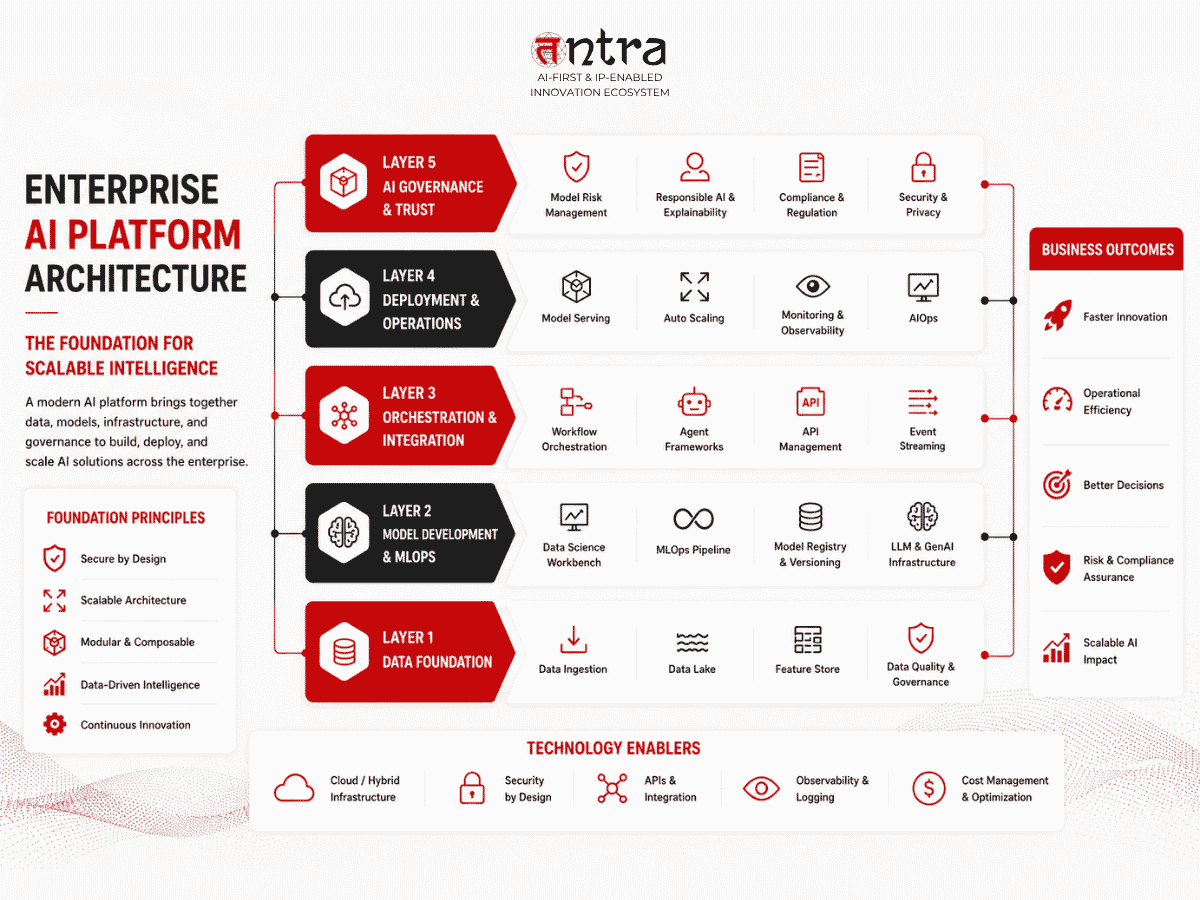
What are the core components of an enterprise AI platform is the more specific question that architecture design needs to answer, and the answer organizes across five integrated layers that each serve a distinct function in the overall platform design.
Layer One: The Data Foundation
Every discussion of enterprise AI platform architecture eventually arrives at the same conclusion: the platform is only as good as its data foundation. AI models learn from data. AI applications operate on data. And the quality, accessibility, governance, and reliability of the data layer determines the ceiling on everything the platform can achieve.
AI data platform architecture for enterprise AI covers four interconnected data capabilities that must work together reliably before any AI application can deliver consistent business value.
Data Integration and Ingestion
Enterprise AI infrastructure at the data layer begins with the pipelines, connectors, and ingestion frameworks that make data from across the enterprise accessible to AI applications in consistent, governed formats.
- Source connectivity: Enterprise data originates across dozens of operational systems including ERP, CRM, manufacturing execution systems, customer support platforms, and external data providers, all of which need to be connected to the AI platform’s data layer through reliable, monitored ingestion pipelines.
- Real-time streaming: Cloud AI infrastructure for enterprises increasingly requires real-time data streaming capabilities that make operational data available to AI applications within seconds of generation, rather than relying on batch processing that introduces latency incompatible with real-time decision intelligence use cases.
- Data transformation: Raw operational data almost never arrives in the format that AI models need, which means transformation pipelines that normalize, clean, and structure data consistently across sources are foundational infrastructure rather than optional enhancements.
- Data catalog: Enterprise-wide data catalogs that document available data assets, their lineage, quality metrics, and access policies give AI development teams the visibility into available data that enables faster, higher-quality AI application development.
Feature Engineering and Feature Stores
- Shared feature stores: Centralized feature stores that pre-compute and store the data features used by AI models enable faster model development, ensure consistency between training and serving environments, and allow feature engineering investments made for one model to be reused across multiple AI applications without redundant computation.
- Feature governance: Feature stores within enterprise machine learning infrastructure maintain documentation of how each feature is computed, what source data it derives from, and which models depend on it, creating the lineage visibility that both model governance and debugging require.
- Real-time feature serving: AI applications that make real-time decisions need features computed from current operational data served with millisecond latency, which requires feature serving infrastructure distinct from the batch feature computation used for model training.
Data Governance and Quality
- Data lineage: Complete lineage tracking from source systems through transformation pipelines through model training and inference is foundational to both AI governance and the debugging capability that production AI operations require.
- Data quality monitoring: Automated data quality monitoring that detects schema changes, value distribution shifts, and missing data before they affect model performance is critical infrastructure that most organizations deploy reactively rather than proactively.
- Privacy and access control: AI security at the data layer implements role-based access controls, data masking, and privacy-preserving techniques that ensure AI applications access only the data they are authorized to use, with complete audit trails of all data access.
Layer Two: Model Development and Management Infrastructure
The model development layer is where AI capabilities are created, and the infrastructure that supports it determines both the productivity of AI development teams and the quality and consistency of the models they produce.
How to build an enterprise AI platform architecture for model development covers the compute infrastructure, development tooling, and model lifecycle management capabilities that together enable efficient, high-quality AI model development at enterprise scale.
Compute Infrastructure
- Training compute: Enterprise machine learning infrastructure for model training requires GPU or specialized AI accelerator resources that can be provisioned on demand for training runs that range from minutes to days depending on model complexity and dataset size.
- Distributed training: Large model training across distributed compute clusters requires orchestration infrastructure that manages job scheduling, resource allocation, and fault tolerance across multiple compute nodes, enabling training of models that exceed the memory capacity of individual accelerators.
- Cost management: Compute cost management for AI training is a significant operational challenge given the resource intensity of model development, requiring infrastructure that provides visibility into compute consumption by team, project, and model to enable informed investment decisions.
MLOps and Model Lifecycle Management
Enterprise AI platform implementation requires MLOps infrastructure that automates and governs the full model lifecycle from development through production deployment through ongoing maintenance and improvement.
- Experiment tracking: Experiment tracking systems that record model architectures, training datasets, hyperparameters, and performance metrics for every training run enable the reproducibility and comparison capability that systematic model improvement requires.
- Model registry: Centralized model registries that maintain a versioned inventory of all models developed across the enterprise, including their training provenance, performance characteristics, approval status, and deployment history, are foundational to both operational efficiency and governance compliance.
- Automated pipelines: MLOps pipelines that automate model training, evaluation, and deployment reduce the time from model development to production deployment while enforcing quality gates that prevent models that fail performance or governance criteria from reaching production.
- Model monitoring: Production model monitoring that tracks prediction accuracy, input data distributions, and business outcome metrics continuously identifies model degradation before it creates business impact, enabling proactive retraining rather than reactive incident response.
Generative AI Platform Infrastructure
The generative AI platform layer has become a required component of modern enterprise AI platform architecture as large language models and other generative AI capabilities move from experimental to production in enterprise applications.
- LLM integration: Infrastructure for connecting enterprise AI applications to large language models, whether through API access to foundation model providers or through self-hosted open source models, with appropriate security, latency, and cost management controls.
- RAG architecture: Retrieval-augmented generation infrastructure that combines LLM capabilities with enterprise knowledge bases enables accurate, contextually relevant AI responses grounded in proprietary enterprise data rather than only in the LLM’s training data.
- Prompt management: Enterprise-grade prompt management systems that version, test, and govern the prompts used in production AI applications bring the same engineering discipline to prompt engineering that software engineering applies to code management.
- Fine-tuning infrastructure: Infrastructure for fine-tuning foundation models on enterprise-specific data creates proprietary AI capabilities that generic models cannot replicate, building the owned AI assets that constitute genuine competitive advantage.
Layer Three: AI Orchestration and Integration
AI platform modernization strategy increasingly centers on the orchestration layer that coordinates AI capabilities, data flows, and business application integrations into coherent, reliable enterprise AI workflows.
How enterprises design scalable AI systems that work across multiple use cases and business functions depends critically on the orchestration infrastructure that manages the complexity of multi-model, multi-data-source AI workflows.
- Workflow orchestration: Complex AI applications frequently require multiple models, data retrieval steps, validation checks, and business logic to execute in coordinated workflows that orchestration infrastructure manages automatically, rather than requiring each application to handle coordination logic independently.
- Agent frameworks: AI ecosystem evolution toward agentic AI systems requires orchestration infrastructure specifically designed for autonomous agents that take multi-step actions across enterprise systems, with the governance controls that ensure agent behavior remains within defined boundaries.
- API management: Standardized API management that exposes AI capabilities to business applications consistently, with appropriate authentication, rate limiting, monitoring, and versioning, enables AI capabilities to be consumed reliably across the enterprise regardless of the underlying model or infrastructure changes.
- Event-driven integration: Event-driven architectures that trigger AI workflows in response to operational events from business systems enable AI to participate in business processes in real time rather than as a periodic batch activity.
Layer Four: Deployment and Serving Infrastructure
AI deployment architecture determines whether AI models can actually deliver business value at the scale, speed, and reliability that enterprise operations require.
Best enterprise AI infrastructure for scalable AI deployment covers the serving, scaling, and operational infrastructure that makes AI capabilities reliably available to the business applications and users that depend on them.
- Model serving: Inference serving infrastructure that hosts trained models and responds to prediction requests with the latency, throughput, and reliability that production AI applications require, with serving optimization techniques including model quantization, caching, and batch inference that balance performance and cost.
- Auto-scaling: Serving infrastructure that automatically scales compute resources in response to demand fluctuations ensures that AI applications maintain consistent performance under variable load without requiring manual capacity management or maintaining expensive idle compute capacity.
- Multi-environment deployment: Enterprise AI platform development requires deployment infrastructure that supports consistent deployment across cloud, on-premises, and edge environments, reflecting the reality that most large enterprises operate across hybrid infrastructure rather than exclusively in the cloud.
- Canary deployment: Controlled rollout infrastructure that directs a small percentage of production traffic to new model versions before full deployment enables safe validation of model performance in production conditions without exposing the full user population to untested model behavior.
AI Operations Infrastructure
- Observability: Comprehensive observability infrastructure that captures model prediction logs, performance metrics, and system health indicators across all production AI applications provides the operational visibility that responsible AI operations require.
- Alerting and incident management: Automated alerting on model performance degradation, data quality issues, and system failures enables rapid response to AI operational incidents before they create significant business impact.
- Cost attribution: Infrastructure that attributes AI inference and training costs to specific applications, business units, and use cases gives leadership the visibility needed to manage AI investment efficiently and prioritize resources toward the highest-value applications.
Layer Five: AI Governance Architecture
AI governance architecture is the layer that most organizations underinvest in during initial platform design and most consistently regret underinvesting in once AI systems are operating at scale in consequential business contexts.
Enterprise AI architecture best practices consistently place governance as a platform-level concern rather than an application-level one, implementing governance controls in the shared platform infrastructure so that every AI application built on the platform inherits appropriate governance automatically.
What is included in enterprise AI tech stack governance covers four interconnected governance disciplines that together ensure AI systems are trustworthy, accountable, and aligned with the organization’s values and regulatory obligations.
Model Risk Management
Model risk management in the enterprise AI context applies the same disciplined approach to AI model risk that financial institutions have long applied to quantitative models, extending it to the broader range of AI applications now operating in enterprise contexts.
- Pre-deployment validation: Structured model validation processes that assess model performance, failure modes, bias characteristics, and business impact before production deployment ensure that consequential AI decisions are made by models that have been appropriately reviewed.
- Ongoing monitoring: Post-deployment model monitoring that tracks performance against validation benchmarks continuously identifies model drift, data quality degradation, and emerging bias that require intervention before they create business or regulatory consequences.
- Documentation requirements: Comprehensive model documentation covering training data, architecture, performance characteristics, known limitations, and intended use cases provides the accountability record that both internal governance and external regulatory examination require.
Responsible AI and Explainable AI
Responsible AI and explainable AI capabilities are governance infrastructure requirements in regulated industries and increasingly important operational requirements across all enterprise AI contexts.
- Explainability tools: Explainable AI frameworks that generate human-interpretable explanations of AI model decisions enable compliance teams, business users, and regulators to understand why AI systems make specific decisions, which is a regulatory requirement in financial services, healthcare, and other regulated industries.
- Bias monitoring: Continuous monitoring for disparate impact across demographic groups, customer segments, and geographic markets ensures that AI applications deliver equitable outcomes and do not amplify historical biases present in training data.
- Human oversight: Governance architecture that defines which AI decisions can be made autonomously, which require human review, and which must be made by humans with AI providing decision support implements the human oversight principle that responsible AI requires.
Compliance Framework
Compliance framework integration within the AI governance architecture ensures that AI systems operate within the regulatory boundaries applicable to each business domain and geography.
- Regulatory mapping: Mapping AI applications to the specific regulatory requirements that apply to their use case and deployment geography creates the compliance visibility that both internal audit and regulatory examination require.
- Audit trail integrity: Immutable audit trails of AI system decisions, including inputs, model versions, confidence scores, and outcomes, provide the accountability infrastructure that compliance frameworks require for consequential AI decisions.
- Policy enforcement: Automated policy enforcement at the platform level ensures that governance requirements are applied consistently across all AI applications rather than depending on individual application teams to implement compliance correctly.
Building the Complete Enterprise AI Tech Stack
AI tech stack architecture for large enterprises brings the five layers together into an integrated platform that is greater than the sum of its parts, with each layer’s shared services amplifying the value of every other layer.
Enterprise AI system design for governance and compliance requires that the platform be designed as an integrated system from the beginning rather than assembled from independently designed components that must be integrated retroactively.
- Platform coherence: The value of an integrated enterprise AI platform comes from the coherence between layers, where data governance at the foundation layer enforces the same data quality and access controls that model governance at the management layer and compliance governance at the governance layer all depend on
- Shared services model: Every AI application built on the platform benefits from the shared data infrastructure, model management, governance controls, and operational monitoring that previous applications built, making each new application faster, cheaper, and better governed than the applications that preceded it
- Evolution architecture: AI platform modernization strategy requires that the platform be designed to evolve as AI technology advances, with modular architecture that allows individual components to be updated or replaced without rebuilding the entire platform
AI decision intelligence capabilities built on this architectural foundation deliver the decision support, automation, and optimization that enterprise AI promises, grounded in the data quality, model governance, and operational reliability that enterprise-scale deployment requires.
AI-first platforms that lead competitive markets are built on architectural foundations that treat every component as shared enterprise infrastructure rather than as application-specific tooling.
Common Challenges in Enterprise AI Platform Implementation
Building an enterprise AI platform involves more than deploying AI models. Organizations frequently encounter technical, operational, and governance challenges that must be addressed early in the architecture design.
Data Silos
Business data often resides across ERP, CRM, cloud applications, and legacy systems, making unified AI data access difficult.
Legacy Infrastructure
Older systems may not support modern AI workloads, requiring modernization or integration strategies.
AI Governance
Without clear governance policies, organizations risk model bias, security issues, compliance failures, and inconsistent AI outcomes.
Infrastructure Costs
GPU resources, storage, networking, and model training environments can significantly increase operational expenses if not managed effectively.
Talent and Operational Readiness
Successful AI implementation requires collaboration between data engineers, data scientists, software engineers, security teams, and business stakeholders.
Addressing these challenges during architecture planning creates a stronger foundation for scalable AI adoption.
Enterprise AI Platform Implementation Roadmap
Implementing an enterprise AI platform is most successful when approached as a phased transformation rather than a single deployment.
Step 1: Assess AI Readiness
Evaluate business objectives, existing technology infrastructure, data maturity, governance requirements, and organizational readiness.
Step 2: Build the Data Foundation
Integrate enterprise data sources, establish data quality processes, implement metadata management, and create governed data pipelines.
Step 3: Deploy AI Infrastructure
Provision cloud, on-premises, or hybrid infrastructure capable of supporting model training, inference, storage, and high-performance computing.
Step 4: Implement MLOps
Automate model training, deployment, monitoring, versioning, and continuous improvement using enterprise-grade MLOps practices.
Step 5: Establish AI Governance
Implement responsible AI policies, explainability frameworks, security controls, model risk management, and regulatory compliance processes.
Step 6: Scale Across Business Functions
Expand AI capabilities across departments using reusable services, shared infrastructure, and continuous performance optimization.
Best Practices for Enterprise AI Platform Architecture
Organizations building scalable AI platforms should follow several proven architectural principles.
- Design for modularity rather than tightly coupled systems.
- Build reusable data and AI services across business units.
- Implement governance at the platform level instead of application level.
- Automate model deployment and monitoring through MLOps.
- Prioritize data quality before model development.
- Continuously monitor performance, cost, security, and compliance.
- Plan for future AI technologies through flexible, cloud-native architecture.
These practices improve scalability while reducing technical debt as AI adoption grows.
Enterprise AI Platform Architecture Across Industries
A well-designed enterprise AI platform supports a wide range of business applications across industries.
Financial Services
- Fraud Detection
- Credit Risk Assessment
- Loan Processing
- Regulatory Compliance
Healthcare
- Clinical Decision Support
- Medical Image Analysis
- Patient Risk Prediction
- Hospital Operations Optimization
Manufacturing
- Predictive Maintenance
- Quality Inspection
- Supply Chain Optimization
- Production Forecasting
Retail
- Personalized Recommendations
- Inventory Optimization
- Dynamic Pricing
- Customer Service Automation
A shared AI platform enables organizations to expand these use cases without rebuilding foundational infrastructure.
Build vs Buy Enterprise AI Platform
Organizations often evaluate whether to develop a custom AI platform or adopt an existing commercial solution.
| Build Your Own | Buy Commercial Platform |
|---|---|
| Full customization | Faster implementation |
| Greater IP ownership | Lower initial investment |
| Flexible integrations | Vendor-supported updates |
| Higher development effort | Limited customization |
| Long-term competitive advantage | Faster time-to-value |
Many enterprises adopt a hybrid approach by combining commercial AI infrastructure with proprietary applications and governance frameworks.
Building the Complete Enterprise AI Tech Stack
AI tech stack architecture for large enterprises brings the five layers together into an integrated platform that is greater than the sum of its parts, with each layer’s shared services amplifying the value of every other layer.
Enterprise AI system design for governance and compliance requires that the platform be designed as an integrated system from the beginning rather than assembled from independently designed components that must be integrated retroactively.
- Platform coherence: The value of an integrated enterprise AI platform comes from the coherence between layers, where data governance at the foundation layer enforces the same data quality and access controls that model governance at the management layer and compliance governance at the governance layer all depend on.
- Shared services model: Every AI application built on the platform benefits from the shared data infrastructure, model management, governance controls, and operational monitoring that previous applications built, making each new application faster, cheaper, and better governed than the applications that preceded it.
- Evolution architecture: AI platform modernization strategy requires that the platform be designed to evolve as AI technology advances, with modular architecture that allows individual components to be updated or replaced without rebuilding the entire platform.
AI decision intelligence capabilities built on this architectural foundation deliver the decision support, automation, and optimization that enterprise AI promises, grounded in the data quality, model governance, and operational reliability that enterprise-scale deployment requires.
AI-first platforms that lead competitive markets are built on architectural foundations that treat every component as shared enterprise infrastructure rather than as application-specific tooling.
Conclusion: Architecture is the Strategy
Enterprise AI platform architecture is not a technical implementation detail that technology teams manage independently of business strategy. It is the organizational infrastructure that determines whether AI investment delivers competitive advantage or generates expensive experiments that never add up to enterprise capability.
The architectural decisions made when the platform is designed determine the cost and speed of every subsequent AI initiative, the governance posture that protects the organization from AI-related risk, and the compounding value that shared infrastructure creates as more AI applications build on the same foundation.
Getting architecture right is genuinely hard. It requires making decisions about future requirements before the full scope of future AI ambition is known. It requires investing in infrastructure that does not deliver immediate visible value but that dramatically reduces the cost and risk of everything that comes after. And it requires organizational commitment to building for the long term in a technology environment where short-term pressure to deploy AI quickly is genuinely intense.
The organizations that make these investments deliberately and design their enterprise AI platform implementation with architectural integrity will build AI capabilities that compound in value over years. The organizations that skip the architectural work and deploy AI tactically will build capabilities that impress in demonstrations and underperform in production, creating the technical debt that their next architecture program will need to address.
How Tntra Builds Enterprise AI Platform Architecture That Scales
At Tntra, our Enterprise AI Solutions practice is built around the architectural and governance decisions that determine whether AI investment compounds into durable competitive advantage.
Our AI Governance Framework practice ensures that governance is designed into the platform foundation rather than applied reactively when AI systems create business or regulatory risk. Our Intelligent Automation Platform capabilities connect AI platform architecture to the business process automation that translates AI capability into operational value. And our Digital Transformation Strategy work ensures that AI platform investment is integrated into the broader enterprise technology strategy rather than managed as a separate AI initiative competing for the same organizational resources.
If your organization is ready to build enterprise AI platform architecture that delivers at scale, connect with the Tntra team today.
FAQs
What is enterprise AI platform architecture?
Enterprise AI platform architecture is the foundation that brings together data, infrastructure, AI models, and governance into one unified system, making it easier to build and scale AI across the business.
Why do enterprises need AI platform architecture?
Without a shared AI platform, projects often remain isolated and difficult to scale. A strong architecture helps teams build faster, maintain consistency, and manage AI securely across the organization.
What is AI infrastructure in an enterprise?
Enterprise AI infrastructure includes the computing resources, data pipelines, storage, and deployment tools needed to develop, run, and manage AI applications at scale.
What technologies are included in an AI tech stack?
A typical AI tech stack includes data integration, machine learning tools, MLOps, AI models, APIs, deployment platforms, monitoring, and governance capabilities.
How do you design a scalable enterprise AI platform?
Start with a solid data foundation, then add scalable infrastructure, MLOps, governance, and deployment capabilities. A modular approach makes it easier to grow as business needs evolve.
What are common challenges in enterprise AI implementation?
The biggest challenges include poor data quality, legacy systems, governance gaps, infrastructure costs, and moving from small AI pilots to enterprise-wide adoption.