How Do You Build Enterprise AI Platforms that Scale Across Large Organizations?
Most enterprises today have at least one AI success story, but very few have achieved true enterprise AI platform development across the organization. A finance team may automate invoice processing, while customer service deploys chatbots and marketing adopts predictive analytics independently. These wins are real, but without a scalable AI platform for enterprises, every department continues building AI in isolation. This fragmentation limits growth, slows innovation, and prevents organizations from realizing the full value of AI platform integration across departments and connected enterprise intelligence.
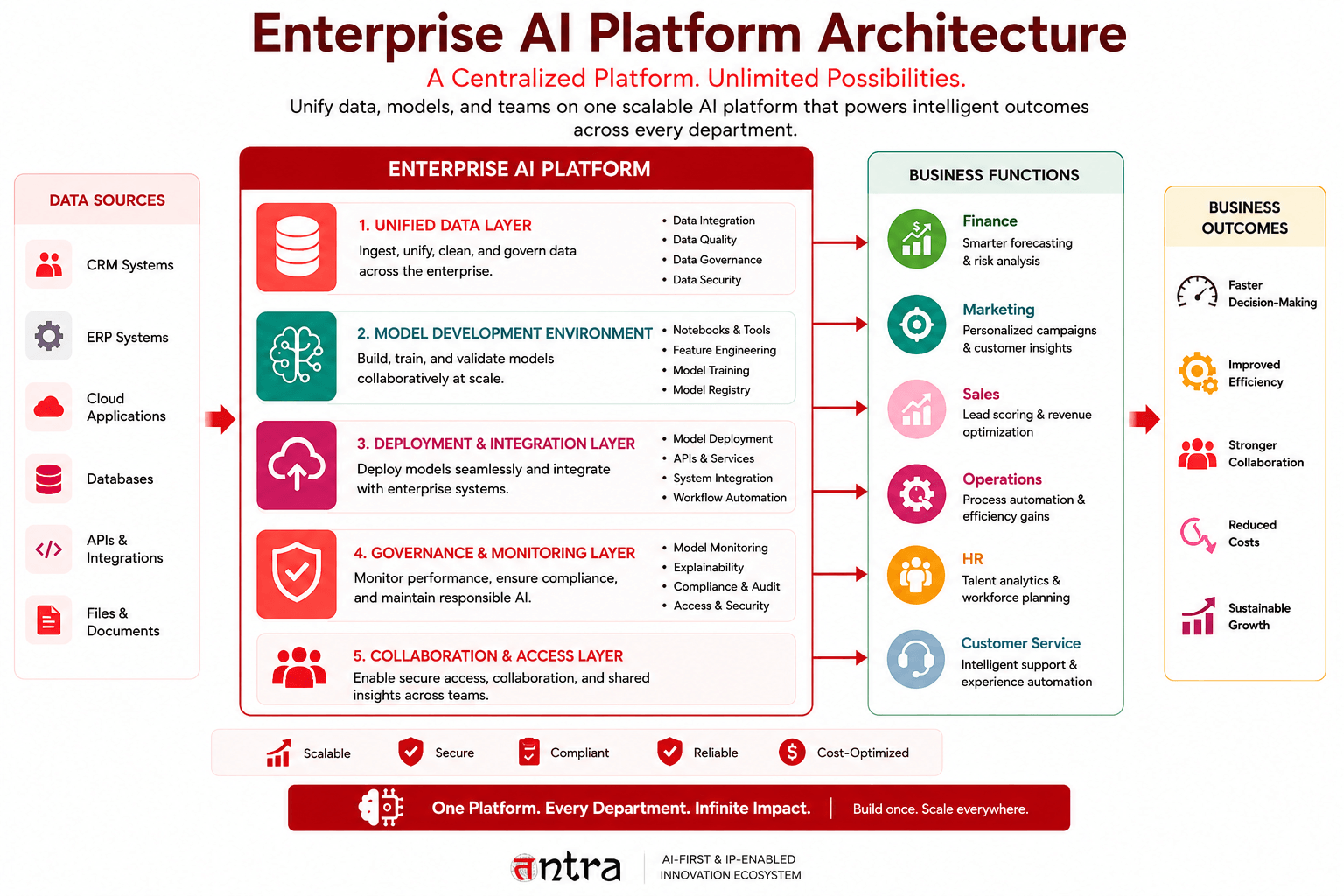
But here is the question that rarely gets asked in the celebration: why is each of these teams building AI in isolation? Why does the finance AI have nothing to do with the marketing AI, which has nothing to do with the customer service AI? And more importantly, what does the organization lose because of that fragmentation?
The answer is significant. Enterprises lose speed, lose learning, lose compounding value, and lose the ability to make decisions that connect insights across the business. The fix is not more AI experiments. The fix is enterprise AI platform development done right, once, at the foundation level, so every department builds on the same infrastructure instead of starting from scratch.
Organizations investing in a scalable AI platform for enterprises are now prioritizing centralized intelligence, governance, and long-term scalability over disconnected pilots. This shift is driving a new generation of AI-powered digital transformation solutions designed to support enterprise-wide growth.
What is an Enterprise AI Platform and How Does it Work?
Why Are Enterprise AI Platforms Important for Large Enterprises?
What is an enterprise AI platform and how does it work? An enterprise AI platform is a centralized technology infrastructure that provides shared data pipelines, model development environments, deployment tools, governance controls, and integration capabilities that every department can build on top of.
Think of it like a city’s electrical grid. Every building in the city needs electricity. The smart solution is to build one grid that every building connects to rather than asking each building to generate its own power. An enterprise AI architecture framework works the same way. The platform manages the shared infrastructure while departments focus on solving business-specific problems.
Without this foundation, organizations end up with disconnected AI experiments that are expensive to maintain, impossible to scale, and difficult to govern. This is exactly why AI platform scalability challenges and solutions have become one of the biggest priorities for enterprise technology leaders.
How Does a Scalable Enterprise AI Platform Work Across Departments?
A well-designed scalable AI platform for enterprises sits between enterprise data systems and business applications. It:
- Collects and unifies data from multiple sources
- Cleans and structures information for AI readiness
- Supports model training and experimentation
- Deploys AI models into production environments
- Continuously monitors performance, compliance, and accuracy
The key advantage is centralization. A centralized AI platform for business operations allows HR, finance, marketing, sales, and operations teams to build AI solutions on the same governed infrastructure.
This creates shared intelligence instead of isolated automation.
Why Do Most Enterprise AI Projects Fail to Scale?
What Problems Do AI Silos Create Inside Enterprises?
How do companies scale AI across multiple departments?
Most organizations attempt to replicate successful AI pilots team by team. Unfortunately, this approach creates duplication, inefficiency, and fragmented learning.
Every department:
- Rebuilds data pipelines
- Purchases separate tools
- Solves the same governance problems
- Learns identical lessons independently
This is where AI platform integration across departments becomes critical. Shared infrastructure eliminates redundant effort and dramatically reduces deployment time for new AI initiatives.
Why Do Enterprise AI Initiatives Break at Scale?
Why do enterprise AI projects fail to scale? The most common reason is that they were never designed for enterprise-wide deployment.
A team builds an AI solution using:
- Their own data structure
- Their own workflows
- Their own technical stack
- Their own governance standards
The result works perfectly for one team but collapses when applied elsewhere.
The second major issue is governance. Without a centralized framework, organizations struggle with:
- Data inconsistency
- Model bias
- Compliance gaps
- Lack of accountability
- Security risks
Successful AI implementation for large enterprises requires architecture built for scalability from day one.
What Are the Key Components of Enterprise AI Architecture?
1. Unified Data Layer
The data layer is the backbone of every successful enterprise machine learning platform solutions strategy.
It handles:
- Data ingestion
- Data normalization
- Governance
- Accessibility
- Security
Organizations that fail to unify data almost always struggle to scale AI across departments.
2. Shared Model Development Environment
This environment allows engineers, analysts, and data scientists across departments to:
- Build models collaboratively
- Standardize workflows
- Reuse AI assets
- Accelerate deployment
A shared development ecosystem is essential for cross-department AI integration strategy success.
3. Deployment and Integration Layer
This layer connects AI models to enterprise systems such as:
- CRM platforms
- ERP systems
- Customer portals
- Supply chain applications
- Internal dashboards
Strong integration capabilities are foundational to successful custom enterprise AI software development.
4. Governance and Monitoring Framework
Governance ensures AI systems remain:
- Transparent
- Explainable
- Secure
- Auditable
- Compliant
This is especially important in regulated sectors such as banking and FinTech.
How to Build a Scalable Enterprise AI Platform Across Departments?
Start with Business Decisions, Not Technology
The best cross-department AI integration strategy starts with a simple question:
Which business decisions would improve significantly with AI support?
This approach shifts focus from technology experimentation to measurable business outcomes.
Instead of asking:
“What AI should we build?”
Organizations ask:
“Which decisions can AI improve across the enterprise?”
This mindset is the foundation of effective AI-powered digital transformation solutions.
Build Shared Infrastructure before Expanding AI Use Cases
The most successful enterprises invest in:
- Shared data architecture
- Common deployment frameworks
- Unified governance
- Centralized monitoring
- Scalable integration layers
This is how organizations successfully answer the question:
how to build a scalable enterprise AI platform across departments?
What are the Benefits of Centralized AI Platforms in Enterprises?
Faster AI Deployment
The biggest operational advantage of a centralized platform is speed.
Departments no longer need to rebuild:
- Infrastructure
- Security controls
- Data pipelines
- Deployment workflows
This accelerates enterprise-wide innovation.
More Consistent Decision-Making
A centralized platform creates:
- Shared metrics
- Governed data
- Consistent reporting
- Comparable AI outputs
This improves leadership confidence in AI-driven decisions.
Compounding Organizational Intelligence
The real power of enterprise AI comes from connected intelligence.
For example:
- Finance insights improve fraud detection
- Marketing segmentation improves product strategy
- Supply chain forecasting improves procurement decisions
This compounding effect is impossible without AI platform integration across departments.
Where Custom Enterprise AI Software Development Fits in?
Platform Standardization + Business Specificity
Even with standardized infrastructure, enterprises still require custom enterprise AI software development tailored to:
- Unique workflows
- Industry-specific data
- Proprietary business logic
- Competitive differentiation
The right enterprise AI solutions company builds platforms flexible enough to support custom applications without disrupting the core architecture.
This balance between standardization and customization is what separates scalable AI ecosystems from rigid enterprise systems.
Enterprise AI Platform Architecture for Banking and FinTech
Why Regulated Industries Require Specialized AI Architecture?
Financial services organizations face stricter requirements around:
- Explainability
- Auditability
- Compliance
- Risk management
- Data governance
That is why enterprise AI platform architecture for Banking and FinTech must include governance at every layer.
Strong FinTech AI solutions are designed to satisfy:
- Regulators
- Risk teams
- Business stakeholders
- Security teams
all at the same time.
This is why enterprises often partner with specialized providers offering:
- AI consulting services
- AI development services
- Enterprise integration expertise
- Compliance-focused engineering
What Challenges Do Companies Face When Scaling AI Across Business Units?
Common Enterprise AI Scaling Challenges
Organizations commonly struggle with:
- Data silos
- Legacy system integration
- Governance inconsistencies
- Lack of executive alignment
- Poor AI adoption
- Security and compliance concerns
These are the core challenges in scaling AI across business units and how to solve them.
Solutions That Actually Work
Successful enterprises address these problems by:
- Building centralized governance models
- Standardizing enterprise AI architecture
- Creating reusable AI services
- Investing in enterprise-grade integrations
- Measuring outcomes instead of experimentation volume
This is how organizations turn disconnected AI initiatives into scalable business capability.
What is the Best Enterprise AI Platform for Multi-Department Integration?
The best enterprise AI platforms are not defined by the number of AI tools they include. They are defined by how effectively they:
- Connect departments
- Standardize governance
- Enable secure scaling
- Integrate with enterprise systems
- Support continuous learning
A truly scalable platform creates enterprise-wide intelligence rather than isolated departmental automation.
How Much Does It Cost to Build an Enterprise AI Solution?
The cost of developing enterprise AI platforms for large organizations depends on:
- Data complexity
- Existing infrastructure maturity
- Compliance requirements
- Integration scope
- Number of departments involved
- Customization requirements
However, the larger cost is often the cost of fragmentation:
- Duplicate effort
- Slower innovation
- Poor visibility
- Inconsistent decisions
- Missed opportunities for shared intelligence
How Can Enterprises Make AI Transformation Successful?
AI transformation only creates value when systems are:
- Adopted organization-wide
- Continuously optimized
- Governed effectively
- Connected across departments
The organizations succeeding with enterprise AI today share common characteristics:
- They invest in data infrastructure first
- They treat AI as a strategic platform, not isolated projects
- They prioritize governance from day one
- They build for scalability early
- They measure business outcomes instead of pilot activity
An experienced enterprise software development company can significantly accelerate this journey by providing:
- Proven architecture frameworks
- Enterprise integration expertise
- Governance best practices
- AI platform engineering support
Why Should Enterprises Invest in a Scalable Enterprise AI Platform Now?
Tntra delivers enterprise AI platform development services designed for long-term scalability, governance, and enterprise-wide intelligence. As an experienced enterprise AI solutions company, Tntra combines platform architecture expertise, AI engineering depth, and enterprise integration capabilities to help organizations connect data, models, and decision-making across every department.
Whether you are starting your AI journey or scaling existing systems, Tntra provides:
- AI consulting services
- Digital transformation solutions
- Fintech AI solutions
- Enterprise-grade platform engineering
FAQs
How do you implement AI across departments in an enterprise?
Start by building a centralized AI platform that serves as shared infrastructure. Departments can then plug their specific AI use cases into the same governed ecosystem, reducing duplication and accelerating deployment.
What is the best architecture for enterprise AI platforms?
The strongest architecture combines:
- A unified data layer
- Shared model development environments
- Deployment and integration infrastructure
- Governance and monitoring frameworks
How much does it cost to build an enterprise AI solution?
Costs vary based on data complexity, integrations, compliance requirements, and scale. Large enterprises should focus on long-term ROI and operational efficiency rather than only upfront development costs.
What challenges do companies face when scaling AI?
The biggest challenges include fragmented systems, governance gaps, legacy integrations, inconsistent data quality, and AI models that were never designed for enterprise-wide scalability.
How can AI improve cross-functional collaboration?
A centralized AI platform creates shared intelligence across departments, allowing teams to align decisions using the same governed data and AI-driven insights.
What industries benefit most from enterprise AI platforms?
Industries with high-volume, data-intensive operations benefit the most, including:
- Financial services
- Healthcare
- Retail
- Manufacturing
- Logistics
- Supply chain operations