FinOps for AI: 8 Cost Optimization Strategies to Scale AI Workloads Efficiently
AI workloads are resource-intensive, rapidly scaling, and financially complex. FinOps for AI brings structure to this complexity—enabling organizations to align AI spending with measurable business outcomes.
Artificial Intelligence has moved from experimentation to core enterprise infrastructure—powering customer experience, fraud detection, decision intelligence, and real-time operations. But this shift introduces a new challenge: AI costs do not scale linearly—and without discipline, neither does value.
If you are leading AI initiatives, the questions are no longer technical—they are economic:
- Why is AI spend growing faster than outcomes?
- Where is infrastructure being underutilized or misallocated?
- How do we scale AI without eroding margins?
This is where FinOps for AI becomes critical. It is not a cost-cutting function.
It is a financial operating discipline—bringing accountability, visibility, and control to cloud-based AI workloads.
In this article, we outline eight strategic levers that leading organizations use to make AI scalable, efficient, and economically sustainable.
At Tntra, our expertise in fintech software development and fintech practice ensures AI and financial systems are implemented with scalability and cost efficiency in mind.
What is FinOps for AI and How It Enables AI Cloud Cost Management
FinOps for AI is a financial operations framework that enables organizations to manage, optimize, and govern AI-related cloud spending—ensuring that every workload is aligned to business value.
AI has become foundational to enterprise growth—but it operates on a fundamentally different cost model than traditional software
- Costs scale with compute intensity, not just usage
- Model complexity directly impacts infrastructure spend
- Generative AI introduces consumption-based cost variability
The result: cost unpredictability at scale.
Organizations commonly encounter:
- Rapidly increasing AI bills without proportional ROI
- Over-provisioned compute environments
- Limited visibility into cost vs. performance
- Fragmentation between engineering and finance
FinOps for AI resolves this by introducing a shared framework—where cost, performance, and business impact are measured together, not in isolation.
Why FinOps for AI is Now a Board-Level Priority
Artificial Intelligence now sits at the core of enterprise value creation.
However, it also introduces a fundamentally different economic dynamic. AI costs scale non-linearly—driven by data, model architecture, and usage intensity.
This creates a structural shift in financial behavior:
- Costs scale faster than utilization if unmanaged.
- Cloud spend becomes variable and difficult to forecast.
- Margins are impacted by infrastructure inefficiency—not strategy.
- ROI shifts from projected value to provable unit economics.
Industry signals already reflect this challenge:
- Enterprises waste ~30% of cloud spend due to inefficiencies and a lack of visibility.
- Generative AI workloads can increase compute costs by 5–10x at scale.
In effect, AI becomes a capital allocation problem—not just a technology investment.
This is why FinOps for AI is emerging as a board-level discipline that requires alignment across CFO, CTO, and product leadership.
Organizations that fail to establish this discipline risk scaling AI capabilities faster than their financial controls, resulting in technically successful but economically unsustainable initiatives.
Top 8 AI Cost Optimization Strategies
In this article, we’ll break down the top 8 AI cost optimization strategies that leading companies adopt to make AI sustainable, scalable, and accountable. These aren’t vague tips — they’re actionable strategies you can use to govern, manage, and optimize AI workloads in the real world.
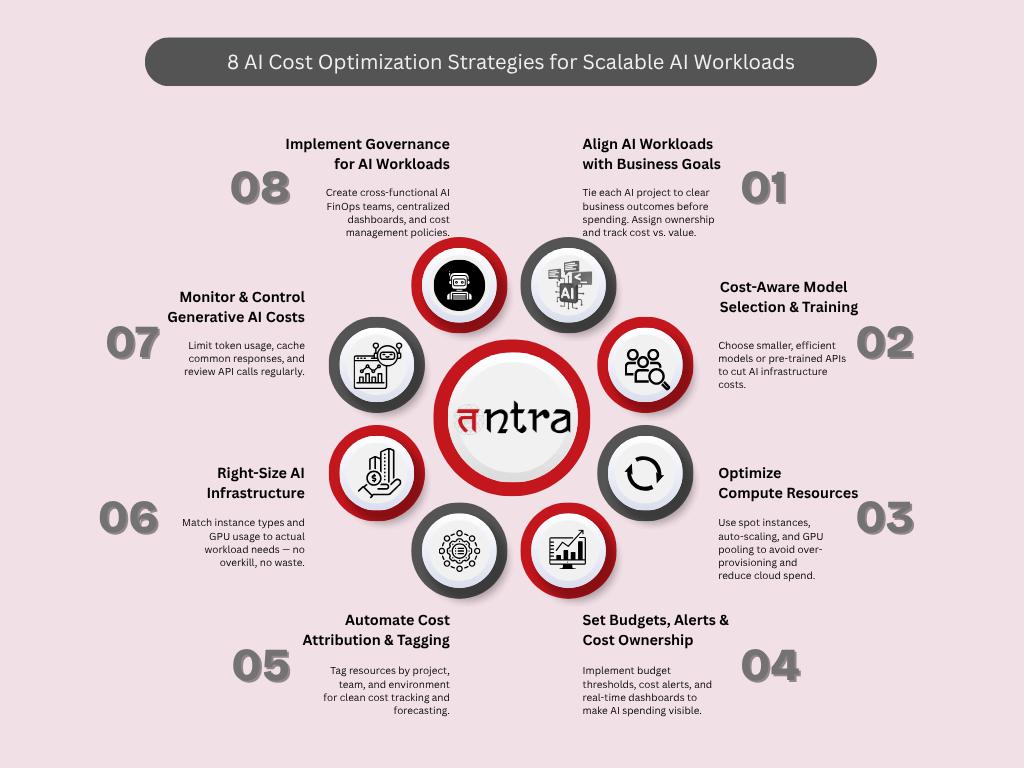
1. Align AI Workloads with Business Objectives (Before Spending a Dollar)
The first principle of FinOps for AI is alignment.
Every AI workload represents a capital allocation decision.
Yet many organizations initiate model training and experimentation without clearly defined business outcomes—resulting in fragmented investments and unclear ROI.
Leading organizations establish clarity upfront:
- What business problem is being solved?
- How is success measured (accuracy, latency, revenue impact)?
- Who owns the outcome—and the budget?
This shifts AI from experimentation to accountable investment.
Assigning ownership and linking cost to outcome ensures that AI initiatives are evaluated continuously—not just technically, but economically.
Before you train, fine-tune, or deploy, tie the initiative to a business outcome. This helps prevent waste and gives you a lens to evaluate cost vs. value at every stage. For example, in our Risk Mitigation Services Case Study, aligning technology adoption with financial outcomes was key to reducing exposure and improving ROI.
FinOps best practice: Assign a “business owner” to every AI workload and track success metrics alongside cost metrics.
2. Use Cost-Aware Model Selection and Training
Model selection is one of the most underestimated cost drivers in AI.
More powerful models are not always more economically efficient.
Organizations that scale AI effectively prioritize:
- Smaller, fit-for-purpose models.
- Transfer learning and fine-tuning.
- API-based consumption over full-scale training.
Training costs can vary by orders of magnitude depending on architecture, data size, and hyperparameters. A thoughtful approach to model design can cut your AI infrastructure costs by 50–90%.
FinOps for cloud AI tip: Incorporate cost simulations or budget forecasts into your model selection process.
3. Optimize Compute for AI Workloads: Spot Instances & Auto-scaling
When it comes to AI workloads, compute is king — and also the biggest cost driver.
That’s why smart teams use spot instances, reserved capacity, and auto-scaling policies to stretch their budget.
- Spot instances (e.g. AWS EC2 Spot, Azure Spot VMs) offer up to 90% discounts, but require smart job scheduling.
- Auto-scaling ensures you’re not over-provisioned during idle times.
- GPU pooling across teams reduces duplication and idle time.
Managing compute efficiently is one of the core pillars of AI FinOps strategies. It transforms your infrastructure from “always-on and overkill” to “just-enough and cost-smart.”
FinOps best practice for AI: Use workload-aware orchestration tools like Kubernetes, Ray, or MosaicML to manage dynamic compute needs.
4. Set Clear Budgets, Alerts, and Cost Ownership
AI initiatives often operate without financial guardrails.
This lack of visibility is one of the primary drivers of cost overruns.
Organizations that scale AI sustainably implement:
- Budget thresholds tied to workloads.
- Real-time cost monitoring.
- Automated anomaly detection.
Financial visibility enables proactive control—not reactive correction.
It also creates accountability across teams, ensuring that cost becomes a shared metric—not just a finance concern.
Pro tip: Use tools like AWS Budgets, GCP Billing, Azure Cost Management, or third-party FinOps platforms like CloudHealth or Apptio.
5. Automate Cost Attribution and Tagging
You can’t manage what you can’t see. And in AI, visibility is everything.
Use automated tagging frameworks to label resources by:
- Project
- Team
- Model type
- Environment (dev/test/prod)
- Business unit
This allows for clean cost attribution, easier forecasting, and more accountability across the org. Without tagging, AI becomes a black box on your cloud bill.
AI cloud cost management tip: Enforce tagging via IaC (Infrastructure as Code) policies using Terraform or Pulumi.
By doing this, you bolster AI workload cost forecasting with FinOps and clear visibility into AI resource allocation.
6. Right-Size Your AI Infrastructure
It’s tempting to go big — more GPUs, more memory, more nodes. But right-sizing is your secret weapon.
Not all AI workloads need NVIDIA A100s or top-tier TPUs. In fact:
- Many training jobs run fine on lower-tier instances with longer training time.
- Batch inference can be parallelized across cheaper CPUs or mixed compute types.
- Memory usage can often be optimized through batching and gradient checkpointing.
Right-sizing ensures your AI model cost management is tightly matched to workload needs, not vanity specs.
FinOps for AI insight: Periodically audit instance usage vs. actual performance benchmarks to identify overkill.
Through this you achieve AI infrastructure cost optimization.
7. Monitor and Control Generative AI Costs
Generative AI costs, from LLM APIs to custom foundation model training, can spiral fast. o control them, organizations can apply token-aware patterns and caching. This mirrors lessons learned in our Cashless Payments CBDC Case Study, where cost-efficient transaction scaling was crucial.
Why? Because every prompt, every completion, and every token has a price. And if you’re running GenAI at scale across your products, it adds up quickly.
Effective strategies include:
- Token optimization through prompt engineering
- Caching frequently used responses
- Monitoring API usage patterns
- Setting usage limits at user and application levels
Generative AI cost control tactic: Set hard and soft usage limits by user/team/application, and revisit weekly.
This is especially important in FinOps for machine learning (ML) and Cloud-native FinOps for AI settings.
8. Build a Governance Layer for AI Workload Management
Cost optimization without governance is unsustainable.
Organizations that scale AI effectively establish structured oversight through:
- Cross-functional FinOps teams
- Regular cost-performance reviews
- Centralized dashboards
- Standardized provisioning policies
Governance introduces consistency, accountability, and long-term control.
Cloud spend management insight: Create an “AI Cost Council” that owns policies, reviews decisions, and evolves best practices.
Real-World AI Implementation Challenges — And How FinOps Solves Them
Across industries, organizations are not struggling to build AI—they are struggling to scale it economically.
The pattern is consistent: early AI success at the pilot level, followed by cost escalation, fragmentation, and diminishing returns at scale.
The root cause is not technology—it is the absence of financial and operational discipline aligned to AI workloads.
The Four Structural Challenges
1. Limited Visibility into Cost vs. Value
Most organizations can measure model performance (accuracy, latency), but cannot map that performance to business outcomes or cost efficiency.
This creates a disconnect:
- High-performing models with unclear ROI
- Increasing spend without proportional value creation
Implication: AI becomes a cost center rather than a value driver.
2. Over-Provisioned and Underutilized Infrastructure
AI workloads are often provisioned for peak demand but operate at average or below-average utilization.
- GPU clusters remain idle outside training cycles
- Inference workloads are over-allocated “just in case”
- Redundant environments exist across teams
Implication: Significant capital is locked into unused or inefficient compute capacity.
3. Misalignment Between Finance, Engineering, and Product
Engineering teams optimize for performance.
Finance teams optimize for cost.
Product teams optimize for speed and experience.
Without a unifying framework, these priorities conflict rather than align.
Implication:
- Delayed decision-making
- Reactive cost control measures
- Friction that slows innovation
4. Uncontrolled Experimentation at Scale
AI thrives on experimentation—but without guardrails, experimentation becomes unbounded.
- Multiple parallel model experiments
- Duplicate datasets and pipelines
- Lack of lifecycle management for unused models
Implication: Innovation scales—but so does inefficiency.
How FinOps for AI Resolves These Challenges
FinOps introduces a unified operating layer that integrates cost, performance, and business value into a single decision framework.
It enables organizations to:
- Establish cost-to-value visibility at the workload level
- Optimize infrastructure utilization dynamically
- Align cross-functional teams around shared metrics
- Introduce governance without slowing innovation velocity
The outcome is not just cost reduction—it is economic clarity.
Organizations move from:
- Reactive cost control → Proactive cost optimization
- Fragmented decision-making → Integrated financial governance
Experimental scaling → Disciplined, repeatable growth
FinOps for AI: Executive Checklist for Scalable Implementation
Most FinOps checklists focus on execution.
At scale, what matters is decision discipline.
This framework outlines the eight critical levers leadership teams must operationalize to ensure AI scales efficiently—not just technically.
1. Align AI Workloads to Measurable Business Outcomes
Every AI initiative must be anchored to quantifiable business impact—revenue, cost efficiency, or risk reduction.
Executive implication:
Workloads without measurable value should not scale.
2. Design for Cost-Efficiency at the Model Level
Model architecture decisions directly determine long-term cost structures.
Executive implication:
Over-engineered models create permanent cost inefficiencies that compound at scale.
3. Implement Dynamic Compute Optimization
Infrastructure must shift from static allocation to demand-driven consumption.
Executive implication:
Idle compute is not a technical issue—it is a margin leakage problem.
4. Establish Real-Time Cost Visibility and Controls
Financial observability must move from periodic reporting to real-time decision support.
Executive implication:
Without visibility, cost overruns are discovered too late to correct.
5. Enable Granular Cost Attribution
AI costs must be traceable to specific workloads, teams, and business functions.
Executive implication:
Accountability is impossible without ownership at the cost layer.
6. Continuously Right-Size Infrastructure
Infrastructure must be continuously calibrated against actual workload requirements.
Executive implication:
Over-provisioning becomes embedded inefficiency if not actively managed.
7. Actively Manage Generative AI Consumption
Generative AI introduces usage-driven cost dynamics that scale with behavior.
Executive implication:
Uncontrolled usage can outpace infrastructure optimization efforts.
8. Institutionalize Governance and Operating Discipline
FinOps must be embedded as a cross-functional operating model—not a reporting layer.
Executive implication:
Without governance, optimization efforts remain fragmented and unsustainable.
“Together, these levers define the difference between AI that scales technically—and AI that scales economically.”
Quick Checklist: FinOps Best Practices for AI
Here’s a snapshot you can share with your team:
| Strategy | Action Item |
|---|---|
| Business Alignment | Tie each AI workload to clear business goals |
| Model Selection | Choose cost-effective models or APIs |
| Compute Optimization | Use spot instances and auto-scaling |
| Budgeting & Alerts | Set budgets and real-time alerts |
| Cost Attribution | Tag and track resources by project |
| Right-Sizing | Match instance specs to actual needs |
| GenAI Monitoring | Control token usage and API calls |
| Governance | Create an AI FinOps task force and policies |
The Future of AI is Scalable — and Financially Engineered
AI will continue to advance in capability.
But capability alone will not determine market leaders.
The defining factor will be the ability to scale AI efficiently—without eroding economic value.
This introduces a fundamental shift in competitive advantage:
- From who can build AI
- To who can scale AI sustainably
Organizations that embed FinOps early gain:
- Predictable cost structures despite variable workloads
- Faster scaling decisions backed by financial clarity
- Stronger alignment between innovation and profitability
- Reduced waste across the AI lifecycle
In this context, FinOps becomes a strategic enabler of growth—not just a cost control mechanism.
Final Takeaways
- FinOps for AI is a financial operating discipline for scaling intelligence—not a cost-reduction initiative
- AI introduces non-linear cost structures that require active management
- Economic visibility is a prerequisite for meaningful AI ROI
- Generative AI amplifies both opportunity and cost risk
- Organizations that operationalize FinOps early build a structural advantage in AI adoption
If your AI costs are scaling faster than your outcomes, the issue is not technical—it is operational.
Most organizations do not lack AI capability.
They lack a financial and governance model to scale it effectively.At Tntra, we partner with enterprises to:
- Assess AI cost maturity and inefficiencies
- Design FinOps-aligned operating models
- Implement scalable, cost-efficient AI architectures
- Establish governance frameworks for long-term control
The goal is simple:
Enable AI systems that are not only intelligent, but economically sustainable.→ Book a consultation to evaluate your AI cost structure and define a FinOps-led scaling roadmap.
FAQs
What is FinOps in simple terms?
FinOps is a way for engineering, finance, and business teams to work together and manage cloud costs more effectively. It’s about spending smarter, not just spending less.
What is FinOps for AI?
FinOps for AI applies cloud financial operations to AI workloads. It helps teams manage and optimize the cost of training, deploying, and scaling AI models in the cloud.
Why is FinOps important for AI workloads?
AI costs scale rapidly due to compute and usage demands. FinOps ensures alignment between spending and business value.
Can small businesses benefit from FinOps?
Yes. Even smaller teams benefit from cost visibility, governance, and efficient resource usage.
What are the main challenges in AI cost optimization?
Unpredictable workloads, over-provisioning, lack of visibility, and uncontrolled generative AI usage