Why Innovation Fails after Launch: The Operating Model Gap Most Companies Miss?
Innovation rarely fails because the idea was wrong. Most enterprise innovation strategy failures happen because the innovation operating model was never redesigned to support execution at scale. It fails because companies update the strategy without updating the innovation operating model behind it. The internal machinery of people, processes, governance, and technology was built for the existing business, and when that machinery does not evolve to support what the innovation team has launched, even the most promising initiatives stall in the months after release.
Why Enterprise Innovation Fails after Launch?
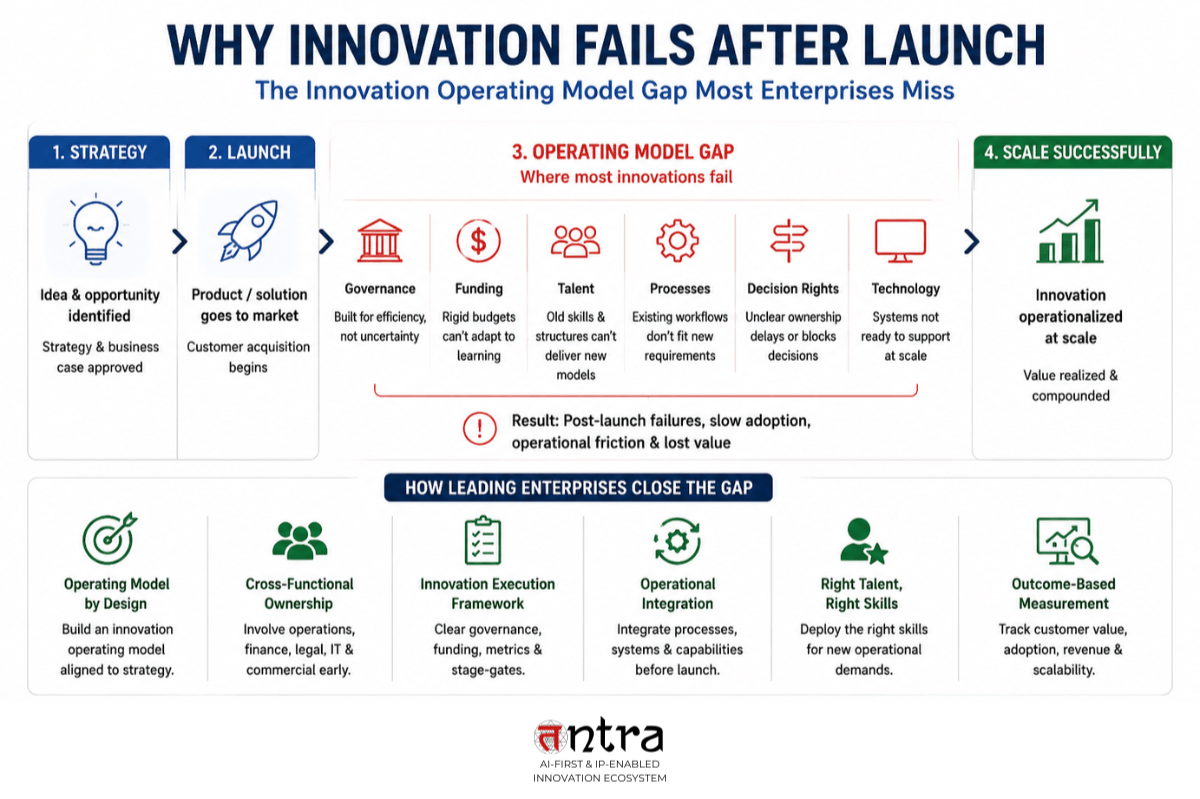
Enterprise innovation fails after launch when governance, operational processes, funding models, talent structures, and technology systems are not redesigned to support innovation execution at scale.
Most innovation post-mortems get the timing wrong.
When an initiative fails, the conversation usually focuses on the launch event. What went wrong at go-live. What the market reaction was. Whether the product was ready. But the failure that actually killed the initiative almost always happened months earlier, in a series of quiet decisions that nobody flagged as risky at the time.
The decisions about how the new thing would be governed. Where it would sit in the organization. How it would be funded after the initial budget was spent. Who would own its operational success once the innovation team handed it over. What metrics would be used to measure whether it was working. Who had the authority to make decisions when the inevitable surprises emerged.
These are operating model decisions. And when they get deferred, ignored, or made by default rather than by design, the launch becomes the visible moment of a failure that was structurally guaranteed long before anyone realized it.
This is the pattern that explains why innovation fails after launch in nearly every large enterprise that has ever attempted serious transformation. The strategy was sound. The product was real. The team was capable. What broke down was the connective tissue between what the organization decided to build and how the organization actually operates day to day.
- Translation gap: Strategy defines what to innovate while the innovation operating model defines how to deliver that innovation, and the mismatch between the two creates a translation gap where initiatives stall or fail in the months after launch.
- Post-launch reality: Post-launch innovation failure is the most common and most expensive failure mode in enterprise innovation because the cost has already been incurred by the time the failure becomes visible
- System dependency: Why innovation projects fail at scale traces back to operating model components that were never updated to support the new initiative, including governance, resource allocation, processes, and talent.
- Execution focus: Enterprise innovation strategy that does not address operating model change is incomplete by definition, regardless of how rigorous the strategy work itself may have been.
What an Innovation Operating Model is and Why It Matters?
An innovation operating model is the governance, funding, talent, process, and technology framework that enables enterprises to operationalize innovation successfully.
The phrase operating model gets used loosely across most organizations, which is part of the reason updating it gets treated as optional.
An operating model is the interconnected set of components that allow a company to deliver value. It covers governance structures, decision rights, funding mechanisms, processes and workflows, technology infrastructure, talent and capability deployment, and the performance metrics that measure whether the system is working. Every component connects to every other component, which is why changing one without changing the others creates the dysfunction that kills innovation initiatives.
When a new product, service, or business model is introduced, the operating model that supports it almost always needs to evolve. The governance designed for stable, efficient operations is rarely suitable for high-uncertainty initiatives. The funding model designed for predictable annual cycles is rarely flexible enough to support the iteration that innovation requires. The processes designed for established customer segments are rarely fit for the new ones the innovation is meant to serve.
- Governance reality: Existing innovation governance framework structures are typically designed for efficiency in core stable businesses, not the uncertain nature of new innovations, which leads to premature termination of initiatives that needed time and protection to mature.
- Resource pressure: Operationalizing innovation fails when innovation efforts are isolated from business units, funded independently from the operations they need to integrate with, or forced to compete for resources with existing products that have established revenue streams.
- Process mismatch: A new product frequently requires different workflows, sales channels, supply chains, or customer support models that the current operational structure simply cannot accommodate without deliberate redesign.
- Talent deployment: Organizations consistently fail to shift talent to support new operational needs, relying on existing capabilities and team structures to deliver something that requires fundamentally different skills.
This is what makes scaling innovation in enterprises so much harder than launching innovation. So why does innovation fail after launch even when the product itself works? In most cases, the operating model was never designed to support long-term execution.
How do companies scale innovation successfully without operational breakdowns? They redesign governance, operational ownership, and execution models before scaling begins.
The Innovation to Execution Gap Explained in Practical Terms
The gap shows up in predictable ways across nearly every enterprise innovation program. Recognizing the patterns helps leadership teams identify the risk before it becomes a failure.
Governance designed for efficiency, not exploration. The board meetings, stage gates, and approval processes that govern a mature business are designed to enforce discipline, manage risk, and ensure predictable outcomes. When the same governance is applied to innovation initiatives, it creates impossible standards. The innovation cannot meet the certainty thresholds that mature business decisions require. So the governance either kills the initiative prematurely or forces the innovation team to inflate confidence in ways that create different problems later. Why enterprise innovation fails is frequently rooted in this governance mismatch more than any other single factor.
Funding models that cannot adapt to learning. Annual budgets work when the work to be done is reasonably predictable. Innovation work is not predictable. The funding model that supports it needs to accommodate the reality that the second phase of an initiative will look different from what the first phase suggested, that some investments will need to be doubled down on while others get killed, and that the timeline from investment to return is longer and less linear than the existing financial planning processes assume.
Operational integration that nobody planned for. This is the failure mode that hits hardest after launch. The innovation team built something. The marketing went out. Customers started using it. And then the operational reality hit. Customer service did not have the playbooks. Finance did not have the systems to bill correctly. Legal had not finished the contractual frameworks. Supply chain was not configured for the new flow. Every operational function that the innovation depended on was running on processes designed for the existing business.
- Workflow gaps: Innovation lifecycle management that ends at launch leaves the operational integration work to be discovered in real time by teams that were never briefed on what was coming, which is the moment most post-launch failures begin.
- Decision rights: When something unexpected happens after launch, the question of who has authority to respond, the innovation team, the business unit, the operations function, or the executive sponsor, is frequently unresolved, which means decisions get delayed or escalated rather than made.
- Performance metrics: The metrics used to measure innovation success after launch are frequently the wrong metrics, either too rooted in core business measures that the innovation cannot yet meet, or too vague to drive real operational accountability.
- Talent mismatch: Innovations that require new operational capabilities frequently launch into operational teams whose skills were built for the previous business, creating immediate execution gaps that erode early customer experience.
Why the Innovation to Execution Gap is So Hard to Close?
Innovation to execution gap is the more precise way to describe what most organizations experience as innovation failure. The work of generating ideas and validating concepts is well understood. The work of taking validated concepts and embedding them into the operational reality of a large enterprise is genuinely difficult, and most organizations are structurally underequipped to do it well.
Part of the difficulty is organizational politics. The innovation team that built the new capability is not the team that will operate it. The business unit that will inherit operational responsibility frequently had limited involvement in the design phase, which means they are receiving something they did not shape, often with limited understanding of why specific decisions were made.
Part of the difficulty is incentive structures. Business unit leaders are measured on the performance of their existing portfolio. Taking on a new innovation, with its uncertain trajectory and operational complexity, frequently looks like risk without commensurate reward from the perspective of someone whose bonus depends on hitting this year’s numbers.
- Bridging the gap: Bridging the gap between innovation strategy and execution requires deliberate organizational design that addresses incentives, ownership, and accountability as core components of the innovation operating model.
- Cross-functional reality: Common reasons innovation initiatives fail in enterprises almost always include the absence of cross-functional engagement during the design phase, leaving operations, legal, IT, and commercial teams to discover their integration requirements at launch.
- Ownership clarity: Enterprise innovation challenges are dramatically reduced when ownership of post-launch operational success is defined and committed before significant investment is made, rather than negotiated after the fact.
- Capability gaps: Why enterprise innovation fails after product launch is frequently traced to capability gaps that were visible during development but deferred because addressing them felt premature, only to become critical exactly when the organization had the least time to respond.
How to Close the Innovation Operating Model Gap?
The encouraging part of this analysis is that the operating model gap is solvable. The organizations that get this right have built deliberate practices that prevent the post-launch failure pattern from repeating.
How to Build a Scalable Innovation Operating Model?
Create a dedicated innovation operating model:
How to build a scalable innovation operating model starts with establishing the model itself as a strategic priority, not as an administrative afterthought. The model defines how innovation strategy connects to operational discipline across governance, funding, talent deployment, and performance measurement. It gives every initiative a consistent framework for navigating the path from concept to operationalized capability. A strong innovation execution framework ensures that innovation initiatives move smoothly from experimentation to enterprise-wide operational adoption.
Define clear, outcome-based metrics:
Most innovation measurement focuses on input metrics like the number of ideas generated, the number of POCs completed, or the size of the innovation pipeline. These metrics tell you about activity. They tell you almost nothing about impact. Operationalizing innovation requires outcome-based metrics that measure whether innovations are reaching customers, generating value, and integrating successfully into the business.
Integrate operational functions early:
The single highest-leverage intervention in closing the innovation execution framework gap is involving operations, legal, finance, IT, and commercial teams during the design phase rather than at launch. When these functions are engaged early, they contribute their constraints and capabilities to the design, which both improves the design and prepares their functions for the operational changes the innovation will require.
Empower decision making:
Streamlining decision rights and governance is one of the most underappreciated levers in innovation scalability framework design. Innovation initiatives encounter unexpected situations frequently. When decisions about how to respond require escalation through multiple layers, momentum dies. When decision rights are explicit and pushed to the appropriate level, initiatives can adapt at the pace the work requires.
- Operating model first: Best framework for scaling enterprise innovation successfully treats operating model design as foundational infrastructure that must be built before significant innovation investment, not as a course correction applied after problems emerge.
- Stage gate evolution: Why operating model change puts innovation at risk is most visible when stage gates are designed to enforce certainty rather than to enable learning, which means innovations either get killed prematurely or distorted to fit governance designed for a different purpose.
- Capability planning: Innovation lifecycle management done well includes deliberate planning for the operational capabilities required at each lifecycle stage, ensuring that talent, processes, and systems are in place before the initiative depends on them.
- Continuous learning: Innovation operating system for enterprises at its most mature includes mechanisms for capturing what is learned from each initiative and feeding those learnings back into the operating model itself, creating compounding improvement over time.
How Leading Enterprises Operationalize Innovation Successfully?
How do leading enterprises operationalize innovation is a question with consistent answers across the organizations that have built durable innovation capability.
They treat the innovation operating model as a strategic asset rather than an organizational chart. This is considered the best framework for scaling enterprise innovation successfully because it aligns innovation investments with operational readiness from the beginning. The operating model gets the same level of leadership attention, ongoing investment, and continuous refinement that the core business operating model receives.
They build cross-functional ownership into the design of every significant initiative. The operations leaders, the technology leaders, the commercial leaders are partners in the design phase, not recipients of finished plans at launch.
They invest in innovation-led software engineering capabilities and enterprise AI platform solutions that give innovation teams the infrastructure they need to move quickly without creating technical debt that the operations function will inherit.
They engage CTO as a Service consulting and external transformation partners when internal capacity or capability gaps would otherwise slow execution, treating the right partnerships as accelerators rather than as admissions of weakness.
And they connect every innovation initiative to a clear digital transformation framework and enterprise transformation strategy, ensuring that individual initiatives accumulate into systemic capability rather than scattering across disconnected experiments.
How Tntra Helps Enterprises Close the Operating Model Gap?
At Tntra, we work directly with enterprise leadership teams to design and implement the innovation operating model infrastructure that turns innovation strategy into durable business impact.
Our product engineering services practice combines deep technology execution with the strategic frameworks that ensure what gets built can be successfully operationalized at scale. Our CTO as a Service consulting brings senior technology and innovation leadership to organizations navigating the most consequential operating model decisions, from governance design through capability development through partnership architecture.
We work across the full innovation execution stack: from enterprise AI platform solutions that give organizations the infrastructure layer modern innovation depends on, to innovation-led software development that ensures every build accumulates into reusable capability, to the strategic advisory work that helps leadership teams design the operating model evolution their innovation strategy actually requires.
If your organization is ready to close the innovation operating model gap and build a scalable enterprise innovation strategy, connect with the Tntra team today to accelerate innovation execution at scale.
FAQs
Why do Business Model Innovations Fail?
Business model innovations fail when the operating model behind them is not redesigned to support the new value proposition. The strategy defines a new way to create and capture value, but if governance, processes, talent, and technology continue running on the old logic, the innovation cannot deliver its intended outcomes at scale.
What are the Common Causes of Innovation Failure?
The most common causes of innovation failure are incompatible governance designed for stable businesses, resource misallocation that isolates innovation from core operations, process misalignment between new requirements and existing workflows, and talent gaps where organizations rely on old capabilities for fundamentally new tasks. Each of these is an operating model issue rather than an idea quality issue.
What is the 70-20-10 Rule for Innovation?
The 70-20-10 rule for innovation suggests allocating 70% of innovation investment to core business improvements, 20% to adjacent opportunities that extend existing capabilities, and 10% to transformational bets that explore entirely new markets or business models. The framework helps enterprises balance near-term performance with the long-term experimentation required for sustained competitive advantage.
Why do Most Innovation Projects Fail?
Most innovation projects fail not because the ideas were weak but because companies update their strategy without updating the operating model required to deliver it. The translation gap between what was launched and how the organization actually runs day to day is where the majority of post-launch innovation failures originate.
What are the 3 P’s of Business Success?
The 3 P’s of business success are typically defined as People, Process, and Product, representing the three foundational pillars of sustained performance. In the innovation context, the same framework expands to include the operating model components that connect these pillars, which is why innovation failures so frequently trace back to gaps in how people, processes, and products were aligned at launch.