Why 90% of Innovation Never Scales — And How to Fix It?
Most enterprise innovation fails to scale because of structural misalignment, not idea quality. The barriers are almost always internal: governance gaps, cultural resistance, disconnected execution, and the absence of a repeatable innovation operating model. Here is how to identify and fix each one.
Every large organization has a lot of dead ideas.
A pilot that genuinely impressed the leadership team. A proof of concept that had everyone in the room nodding. A prototype that passed every technical test. And then, somewhere between “this works in the lab” and “this works everywhere,” it disappeared. No dramatic failure. No single bad decision. Just silence.
This is the defining problem of enterprise innovation strategy in 2026. Companies are investing more in innovation than at any previous point in history, yet most of that investment never produces outcomes at scale. McKinsey research shows only 6% of executives feel genuinely satisfied with their organization’s innovation performance. Gartner data puts the failure rate of enterprise innovation scaling challenges even higher, with over 70% of digital initiatives falling short of their intended scale.
The question every leadership team keeps circling back to is why innovation does not scale. The answer is almost never what they expect.
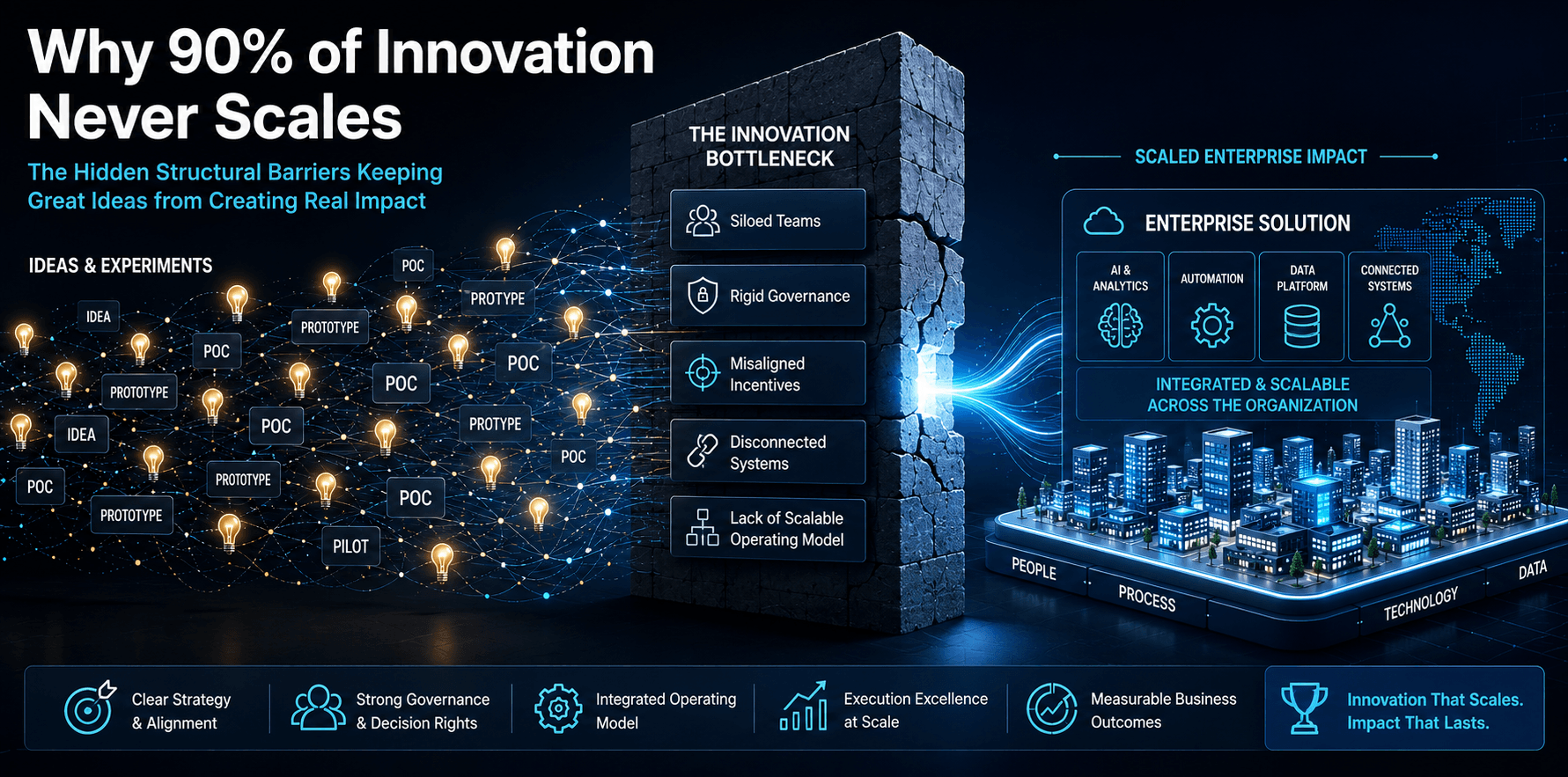
- Structural misalignment: Organizations are designed for operational efficiency, not transformational change, and that design actively works against innovation scalability.
- Invisible barriers: Most innovation scalability challenges only become visible when a project hits a governance wall or a sudden resource cliff.
- Idea versus system: The gap between pilot success and enterprise-wide adoption is almost never about the quality of the idea itself.
- Systemic roots: Barriers to innovation scaling almost always trace back to wrong incentives, wrong ownership structures, and the absence of a real innovation operating model framework.
This article breaks down the hidden structural reasons why innovation initiatives fail and gives you a practical, actionable path to fix every one of them.
Why Most Enterprises are Structurally Allergic to Scale?
Before blaming budget shortfalls or talent gaps, look at how the organization itself is actually wired.
Large enterprises are built for repeatability. Their systems, hierarchies, performance metrics, and culture all reward predictability and risk avoidance. That design is excellent for running operations efficiently. It is genuinely damaging for scaling enterprise innovation.
When a new innovation project enters that machine, it gets processed exactly like everything else: the same approval chains, the same quarterly budget reviews, the same risk filters that were designed to protect the core business. And that processing is precisely what kills innovation before it reaches scale.
- Design conflict: Enterprise growth barriers are often invisible because they look like normal organizational process rather than active obstruction.
- Incentive misfire: Organizations reward managers for hitting established targets, not for experimenting, which suffocates innovation culture and system problems at the middle management layer.
- Isolation problem: Most innovation teams operate separately from the core business, which means their work never integrates into the systems that actually reach customers at scale.
- Logic gap: Strategic innovation execution requires a completely separate operating logic, one that most enterprises have never deliberately designed or documented.
Many enterprises fail to move innovations beyond the pilot stage. The operational gap between proof of concept and full deployment is one of the most underestimated challenges in enterprise growth. We explored this gap in detail here: Why Enterprise Innovation Fails Beyond POC Stage
Barrier 1: The POC Trap and Why Pilots Never Graduate
This pattern repeats itself with remarkable consistency across industries and company sizes.
A team secures a small budget, builds something genuinely impressive in a controlled environment, and delivers a demo that generates real excitement. Stakeholders are engaged. Leadership is interested. And then the project sits in a holding pattern for months because nobody actually owns what happens next.
This is what makes innovation scalability problems so deeply frustrating. The pilot was designed to prove a concept. But proving a concept and scaling a solution are two completely different goals, and most organizations never build the bridge between them.
- No pathway: Pilots are funded as experiments with no defined route to production or enterprise-wide deployment, leaving successful ideas stranded after the demo.
- Graduation criteria: How companies scale innovation successfully always starts with defining clear conditions that move a project from pilot phase to full program status.
- Bandwidth competition: Without a structured innovation lifecycle management process, successful pilots compete with everything else for engineering resources, budget, and leadership attention.
- Reinvention cost: The absence of a real innovation operating model framework means every project must invent its own path to scale, and most of them get lost in that process.
The fix: Design a two-track system from day one. Track one covers exploration, meaning pilots, experiments, and proofs of concept. Track two covers exploitation, meaning scaling, integration, and operationalization. Every innovation project must have a declared owner for both tracks before it receives funding.
Barrier 2: Governance that Protects the Status Quo
Enterprise innovation governance is one of the most misunderstood and most consequential levers in the entire scaling equation.
Most enterprises land in one of two failure modes. Either they have excessive governance where every decision requires multiple layers of approval and projects spend months in review cycles while the market moves forward, or they have almost no governance where innovation teams operate as disconnected skunkworks units with no real integration into core business strategy. Both extremes produce the same outcome: ideas that never scale.
- Over-governance failure: Excessive approval requirements drain momentum from innovation projects, turning weeks of work into months of waiting while competitive windows close.
- Under-governance failure: Innovation teams without governance produce impressive demos that never connect to the actual enterprise technology stack or customer delivery systems.
- Execution gap source: Innovation execution gaps almost always trace directly back to a governance model that was designed for business-as-usual operations, not for managing a portfolio of innovation bets.
- Balance requirement: Scaling innovation across organizations requires governance that is flexible at the edges and firm at the core, protecting strategic priorities without micromanaging how teams execute.
The fix: Build a three-tier governance model. Tier one handles strategic alignment through executive sponsors and portfolio-level decisions. Tier two handles operational oversight through program leads and resource allocation. Tier three gives innovation teams defined decision rights and clear guardrails within which they can move fast without constant escalation.
Barrier 3: A Culture that Rewards Exactly the Wrong Behaviors
This barrier is the hardest to fix because it is the least visible on any org chart or strategy document.
Innovation culture and system problems rarely appear in board presentations. They show up in behavior. In how people react when a project fails publicly. In whether middle managers protect their team’s time for experimentation when quarterly targets are under pressure. In whether an engineer who surfaces a hard technical truth gets celebrated or reassigned.
- Incentive architecture: Organizations that struggle with how to scale innovation in enterprises almost always have performance systems that punish failure, including smart, fast, and well-documented failure that produces valuable learning.
- Middle management layer: Middle managers are the most underestimated barrier to scaling enterprise innovation because they control the time, attention, and psychological safety of the people doing the actual innovation work.
- Leadership responsibility: Innovation leadership strategy must actively redesign incentive architecture across the organization, not simply add an “innovation culture” section to the annual all-hands presentation.
- Measurement shift: Companies that scale innovation well treat experimentation as a core performance metric, measuring how many experiments a team ran and how fast they killed bad ideas, not just whether they hit their delivery targets.
The fix: Add innovation participation metrics to performance reviews at every level. Measure experiment velocity, learning documentation quality, and idea-to-pilot conversion rates. Make failing fast and learning visibly look like professional growth, not professional risk.
Barrier 4: No Shared Innovation Operating Model
If you ask ten executives at the same company to describe their innovation management framework, you will almost certainly get ten meaningfully different answers. That inconsistency is itself the problem.
Operationalizing innovation in enterprises requires a shared, documented, and consistently applied operating model. Without one, every business unit and every team runs its own version of innovation, with its own tools, its own stage gates, its own definition of what success looks like, and its own way of deciding when to stop.
- Playbook absence: Enterprise innovation transformation strategy must include a standardized innovation playbook that defines roles, decision rights, funding mechanisms, and success metrics in language every function understands.
- Integration failure: How to scale innovation in enterprises always requires connecting the innovation function directly to product, engineering, and commercial teams rather than keeping it isolated in a dedicated innovation lab.
- Unified agenda: The digital transformation and innovation strategy must be a single integrated narrative, not two parallel conversations happening in separate rooms with separate sponsors.
- Full lifecycle design: Enterprise product innovation model design must account for the complete lifecycle from ideation and validation through development, deployment, and continuous improvement, not just the exciting early stages.
The fix: Build and publish your innovation operating model framework as an internal standard. It should define who owns what at every stage, how ideas move through the funnel, how funding decisions get made, and how success is measured at each gate. Revisit and update it every six months based on what you learn.
Barrier 5: Treating Digital Transformation and Innovation as Separate Agendas
This disconnect is responsible for more wasted enterprise investment than almost any other single factor, and it is extraordinarily common.
Digital transformation and innovation strategy are frequently managed by completely different teams with different budgets, different executive sponsors, and fundamentally different definitions of what success means. The transformation team is modernizing legacy infrastructure. The innovation team is building new capabilities on top of it. And the two groups rarely talk to each other in any meaningful way.
- AI integration gap: Enterprise AI strategy services only generate real business value when AI innovation is embedded into the transformation roadmap rather than managed as a separate parallel initiative with its own governance.
- Foundation dependency: Innovation scalability requires new capabilities to be built on top of a modernized, stable digital foundation, otherwise pilots scale into brittle, unmaintainable systems that create more technical debt than value.
- Shared infrastructure: Scaling innovation across organizations depends on shared data infrastructure, shared API layers, and shared engineering capacity, all of which live inside the transformation agenda and must be planned accordingly.
- Platform decisions: Enterprise innovation platform choices must be made with both short-term innovation velocity and long-term architectural integrity in mind, which only happens when both agendas share a decision-making table.
The fix: Assign a senior leader who owns both the transformation and innovation agendas simultaneously. Build a shared roadmap that explicitly shows how transformation deliverables unlock future innovation capabilities. Treat the two as one integrated strategy.
What Successful Innovation Scaling Looks Like in Practice?
The companies that can genuinely answer how do successful companies scale innovation across teams with real confidence share a set of consistent characteristics that go beyond culture or leadership style.
They have a dedicated innovation consulting function or a deeply embedded external partner that brings pattern recognition across industries and geographies. They invest in innovation-led software development as a core organizational discipline rather than a project-by-project decision. They treat their enterprise innovation platform as a strategic asset that compounds in value over time.
- External perspective: Innovation strategy consulting brings pattern recognition that internal teams rarely develop on their own because experienced consultants have seen what works and what fails across dozens of industries and innovation cycles.
- Leadership access: CTO as a Service models give mid-market and scaling enterprises access to senior architectural and innovation leadership without the cost and timeline of a full-time executive search.
- Engineering discipline: Product engineering services built around innovation principles consistently produce more scalable and more maintainable outputs than traditional staff augmentation or project outsourcing models.
- AI partnership: AI transformation company partners deliver the most lasting value when they are embedded within the innovation operating model from the start rather than brought in as one-off implementation vendors.
The Fix in Summary: Build the System, Not Just the Ideas
Innovation scalability is fundamentally an organizational design problem that has been misdiagnosed as a creativity problem for decades. The ideas inside most large enterprises are genuinely good. The system surrounding those ideas is almost always what breaks down.
Here is what a truly scalable enterprise innovation system requires:
- Operating model: A clear innovation operating model framework that defines roles, stage gates, funding mechanisms, and success metrics that every function understands and uses.
- Governance design: An enterprise innovation governance structure that balances strategic control at the top with genuine execution autonomy at the team level.
- Lifecycle management: An innovation lifecycle management process that creates a defined, funded, and owned pathway from pilot to production for every project that earns it.
- Leadership incentives: An innovation leadership strategy that redesigns performance incentives across the organization rather than simply running culture workshops.
- Unified strategy: A digital transformation framework that treats transformation and innovation as one integrated program with shared ownership and shared accountability.
- Right partners: Innovation consulting services and platform partnerships that accelerate what internal teams cannot realistically build alone within competitive timeframes.
Scaling innovation organization-wide is genuinely hard. But it is entirely predictable and entirely fixable once leadership stops treating it as a mystery of creativity and starts treating it as a solvable operating model problem.
How Tntra Helps Enterprises Build Innovation That Can Scale
At Tntra, our entire model is built around closing the gap between brilliant ideas and real business outcomes at scale.
Through our enterprise innovation platform TuLIP, our AI transformation capabilities with Shruti AI, and our integrated innovation strategy consulting and engineering services, we help enterprises design and execute innovation operating model frameworks that perform in the real world, not just in strategy presentations.
Our CTO as a Service offering gives organizations the senior technology leadership they need to make the right architectural decisions before they commit to scaling. Our innovation-led software development practice ensures that everything built is designed to grow with the business over time, not just to impress in a quarterly demo.
If your organization is ready to get serious about scaling enterprise innovation and turning accumulated ideas into durable, scalable business value, Talk to the Tntra team today.
FAQs
Why do Innovations Fail to scale?
Most innovations fail to scale because organizations optimize for experimentation instead of operational integration. Common causes include weak governance, disconnected innovation teams, unclear ownership, competing priorities, and the absence of a structured innovation operating model that supports enterprise-wide execution.
Why do Innovation Projects Fail after launch?
Most innovation projects fail after launch because they were designed to prove a concept, not to survive at scale. Without a defined owner, a scaling pathway, and integration into core business systems, even successful pilots lose momentum and disappear.
What is an Innovation operating model?
An innovation operating model is a documented framework that defines how a company identifies, funds, develops, and scales new ideas across the organization. It covers roles, stage gates, decision rights, and success metrics so innovation follows a repeatable, governed process rather than depending on individual champions.
How do companies scale Innovation successfully?
Companies that scale innovation successfully treat it as an organizational design challenge, not a creativity challenge. They build dedicated governance structures, connect innovation teams directly to product and engineering, align transformation and innovation under one strategy, and measure experimentation as a core performance metric.
What are the barriers to Enterprise Innovation?
The biggest barriers to enterprise innovation are structural: misaligned incentives that punish failure, governance models designed for operations rather than experimentation, isolated innovation teams disconnected from core business systems, and the absence of a shared, documented innovation operating model that every function understands and follows.
Why do proof of concepts Fail in Enterprises?
Proof of concepts fail in enterprises because they are funded and designed as experiments, not as the first step in a scaling journey. When there is no defined graduation criteria, no dedicated owner for the next phase, and no connection to engineering and commercial roadmaps, successful POCs have nowhere to go.
What is Innovation Governance in Digital Transformation?
Innovation governance in digital transformation refers to the structures, decision-making processes, accountability models, and oversight mechanisms that help organizations manage innovation initiatives while maintaining alignment with business strategy, risk management, and operational priorities.
How can leadership improve Innovation Scalability?
Leadership improves innovation scalability by creating clear ownership structures, aligning incentives with experimentation and execution, funding long-term innovation pathways, and integrating innovation directly into enterprise strategy, engineering, and operational decision-making.
How does AI help Enterprises Scale Innovation?
AI helps enterprises scale innovation by improving decision-making, accelerating experimentation, identifying operational risks earlier, automating governance workflows, and enabling organizations to manage innovation portfolios with greater visibility and speed.