From Ideas to Impact: How Enterprises Turn Innovation into Scalable Platforms
Every enterprise believes it has an innovation engine. Whiteboards are full. Pipelines are active. POCs are being showcased. And yet, almost none of it turns into something that actually scales.
Not because the ideas are weak.
But because the system behind them is.
The organizations that consistently close the gap between promising ideas and production-grade platforms share one defining characteristic. They don’t treat innovation as a series of initiatives. They treat it as a system — one that converts ideas into scalable platforms repeatedly, not occasionally. This is the foundation of any platform-led innovation strategy worth pursuing.
This is about that system. What it looks like, why most enterprises don’t have it, and what it actually takes to build one.
Why Enterprise Innovation Keeps Stalling?
Picture a typical scenario. A team identifies a real opportunity. Leadership gets excited. Budget gets approved. A proof of concept gets built — and it works. Beautifully, in a demo. Stakeholders nod. And somehow, six months later, it still hasn’t moved into production.
This is the most common story in enterprise innovation, and it happens for a completely predictable reason.
A POC is designed to succeed in isolation. A platform is designed to survive reality.
Building a working prototype and building a scalable platform are two entirely different problems. A POC answers “can this work?” A platform answers “can this work for thousands of users, across departments, under compliance requirements, connected to legacy systems, while continuing to improve?” Those are different questions. They require different architecture, different leadership, and different thinking about what you’re actually building.
The real failure point is not ideation or validation. It is the transition architecture between MVP and platform. Understanding enterprise innovation challenges and how to scale solutions begins with recognizing this exact gap.
Most organizations treat the POC as the hard part. It isn’t. Converting a POC into a scalable digital product platform involves far more than adding infrastructure. It requires rethinking ownership, integration, security, governance, and the business model that will sustain the platform well beyond its first release. The steps to convert POC into scalable digital product platform are rarely about more code — they are about more deliberate design.
Why Most Innovation Projects Collapse After Launch — and How to Fix It – Read More.
The most important question any team can ask before a single line of code is written: are we building a feature, a product, or a platform?
Features solve one problem. Products solve a cluster of related problems for a defined user. Platforms create infrastructure that allows multiple products, teams, or external partners to build on top. Confusing these three ambitions is exactly where most enterprise innovation gets quietly buried.
What an Enterprise Innovation Platform is?
At its core, an enterprise innovation platform is the operating infrastructure that connects strategy to execution across the full innovation lifecycle — from idea generation through validation, engineering, deployment, and continuous improvement. It combines technology architecture, governance frameworks, talent models, and feedback loops into a single coordinated system.
This is fundamentally different from buying a suite of tools. Tools help you complete tasks. A platform creates leverage, where each initiative makes the next one cheaper, faster, and smarter. The right innovation consulting services help organizations recognize this distinction before millions are spent in the wrong direction.
The MVP gets you to your first real insight. The platform gets you to your tenth product.
The most common question executives ask: what is the difference between an MVP and a scalable platform? The MVP is a learning vehicle — built to test assumptions with minimum investment. A scalable platform is a compounding asset, built to grow, integrate, and generate increasing returns as more users, data, and capabilities are layered in.
The best framework to scale MVP into enterprise-grade platform holds both ambitions in deliberate tension.
A strong innovation strategy has to hold both of these things at once. You need the speed and flexibility of MVP thinking to stay relevant. You need the rigor of platform thinking to make sure what you build actually scales. The tension between these two is healthy — provided someone is managing it deliberately.
The organizations that get this right follow a structured progression: moving from ideas to validated innovation to measurable impact. Without that structure, innovation is episodic. With it, innovation becomes a repeatable capability that compounds over time. This is the essence of how enterprises build and scale digital innovation platforms.
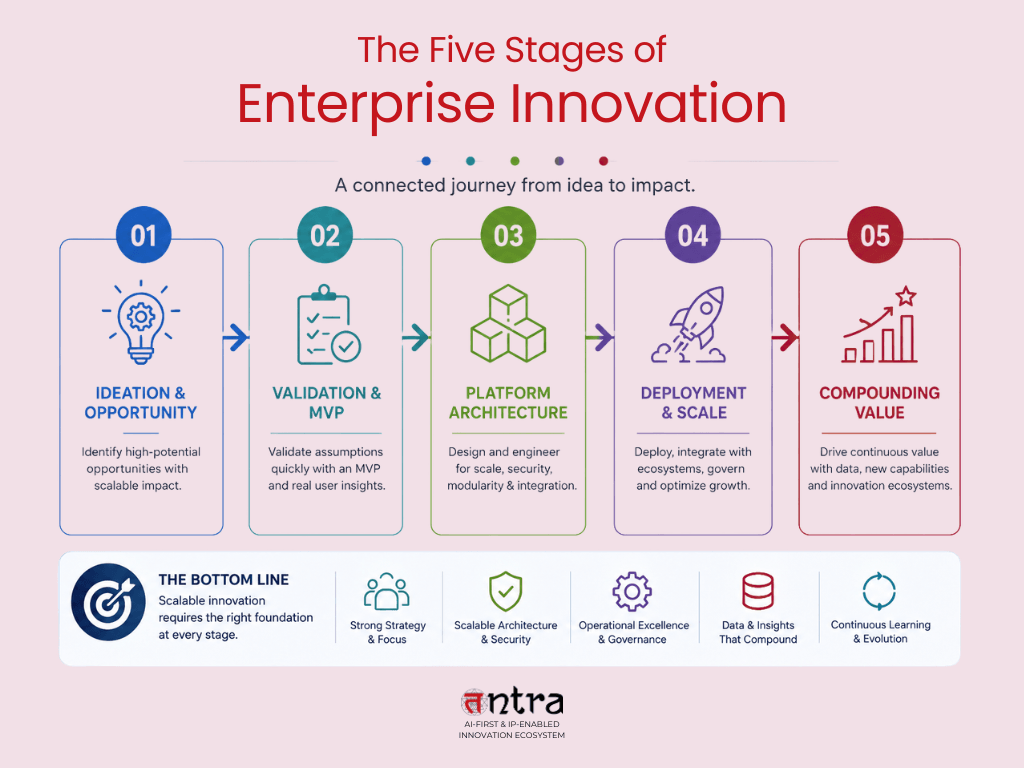
The Five Stages of Enterprise Innovation
Understanding the stages of the enterprise innovation lifecycle helps organizations know exactly where they are — and what decisions matter most at each stage. These stages are not linear checkpoints. They function as an interconnected system where decisions made early directly shape the ability to scale later.
Stage 1: Ideation and Opportunity Framing
The core question here is not “what could we build?” It’s “if this works, does it create infrastructure others can build on, or does it solve exactly one problem once?” Filtering signal from noise at this stage is where most organizations either set themselves up for scale or commit to a very expensive dead end.
Stage 2: Validation and MVP Development
Speed matters more than scale here. The goal is to learn fast enough to make a confident investment decision about platform architecture. Build the smallest possible version that generates real learning — not the version that impresses in a board presentation.
Stage 3: Platform Architecture and Engineering
This is where the most consequential decisions get made and, too often, where the most expensive shortcuts are taken. Decisions about data models, API design, integration patterns, security, and modularity determine whether the platform scales gracefully or accumulates the kind of technical debt that slows everything down for years. A strong enterprise platform architecture for innovation is what makes the next stages possible at all.
Enterprise product engineering at this stage means building for the tenth user and the tenth product — not just the first.
Stage 4: Deployment and Scale
How does the platform integrate with existing systems? Who owns it? How is it governed? How is ROI measured? Scale comes down to execution discipline — clear ownership, structured feedback loops, and leadership that treats the platform as a long-term asset, not a completed project. This is where how enterprises scale digital products is decided in practice, not on slides.
Stage 5: Compounding Value
This is the stage of innovation to scalable platform framework most enterprises never reach. A platform that compounds creates new capabilities, attracts new users, generates proprietary data, and enables entirely new products over time. This is what separates platform-led innovation from a collection of disconnected digital projects.
Building the System that Actually Scales
How to turn innovation ideas into scalable enterprise platforms comes down to four things working in parallel: architecture, governance, talent, and operating model. Getting any one of these wrong is enough to stop a promising platform in its tracks.
Architecture
Decisions made early have a long haljf-life. Treat AI not as a feature bolted on later, but as a foundational layer that shapes data design, API architecture, and feedback mechanisms from the very beginning. An AI-driven innovation framework is no longer optional — it is the default starting point for any platform designed to compound value. Organizations that retrofit AI into existing platforms consistently spend two to three times more than those who design for it upfront. Build modular — in components that can be upgraded or replaced without tearing down the entire system.
Governance
Governance is where most digital transformation efforts fall short. It gets treated as a compliance checkbox — something that reviews what has already been built and flags problems after the fact. Real governance means building audit trails, approval workflows, ethical guidelines, and compliance controls directly into the platform architecture. Not after launch. Before.
Talent and Operating Model
The most common failure pattern is building a platform under a dedicated innovation team, then handing it off to an operations team with no context, no mandate, and no budget to evolve it. Platform leadership must persist beyond launch — with clear accountability, funding, and roadmap ownership.
A practical innovation operating model includes:
- A clear platform owner with P&L accountability, not just technical ownership
- Cross-functional pods spanning product, engineering, data, and governance — working in continuous sprints rather than project phases
- A defined feedback loop from production users back into the roadmap
- A governance council that reviews compliance, security, and ethical posture on a regular cadence
- A compounding IP strategy — patents, proprietary data assets, and platform-specific models that create defensible long-term value
This innovation operating model is what separates enterprises that ship one good product from enterprises that ship ten.
Why Platform-Led Wins Every Time?
A platform is not the sum of its features. It is the system that makes new features possible.
Every platform that compounds in value does so because someone made the deliberate decision to build infrastructure and an innovation operating model for enterprises rather than applications — to create the conditions for scale rather than just delivering the first use case. That decision rarely feels urgent in the moment. It almost always proves decisive in hindsight.
The goal is not to deliver a fixed scope and hand it over. The goal is to build the system, embed the operating model, and make sure the organization has the genuine capability to evolve the platform independently over time. Platform-led innovation will always prioritize compounding value over short-term delivery — even when that means accepting slower early progress in exchange for significantly faster scale once the architecture is solid.
Resist the urge to build features for one user before the platform can support many.
Treat governance, architecture, and operating model as first-class strategic concerns, not implementation details. Measure success in terms of platform capability growth — new use cases enabled, new teams onboarded, new products launched on the foundation you built.
“Every enterprise I have worked with has no shortage of ideas. What separates the ones that scale from the ones that stall is a single, deliberate choice: to build infrastructure instead of applications. To invest in the foundation before the demand feels urgent. The organizations that will define the next decade are already thinking beyond the first use case. They are designing systems that compound, that learn, that make every future initiative faster and more powerful than the last. That is the shift. From delivering solutions to building the conditions for scale.”
– David, Global CTO, Tntra
What this Looks Like in Practice?
The organizations that successfully execute an innovation-to-platform strategy share a recognizable pattern. They work with an innovation consulting company that starts with clear strategic intent — not “let’s explore AI” but “we will build a platform that enables this specific capability across these business units within this timeframe.” They invest in architecture early, even when it feels slower than shipping a quick prototype. They assign real ownership — not a committee, but a person with authority, accountability, and a budget. They embed governance from day one.
This is the discipline that the Tntra AI-first innovation platform is designed around — and what the broader Tntra innovation ecosystem is built to support across industries.
The practical steps:
- Validate the core assumption with an MVP before over-engineering anything
- Define the platform’s scope — what it will do, what it will enable, and what it will not do
- Design the architecture for the tenth use case, not just the first
- Build governance, compliance, and security into the foundation before you scale
- Assign long-term ownership and an operating model before deployment — not after
- Measure compounding value: new capabilities enabled, new users onboarded, new products launched on top of the platform
The difficulty is never knowing these steps. The difficulty is having the leadership, execution discipline, and architectural thinking to follow through on all of them simultaneously — under real business pressure, with real stakeholders who want results yesterday.
Frameworks like Tntra’s I3 Innovation model, supported by i3 Consulting and the broader I3 ecosystems, are designed precisely for this transition — turning innovation intent into scalable platform reality.
What this Means for You?
If you’re leading innovation inside an enterprise, the question is not whether you need more ideas.
You probably don’t.
The real question is whether your organization knows how to carry an idea all the way to scale — before it commits to building it.
Ask yourself:
- Are we building this to prove something — or to scale something?
- Are we solving for immediate output — or long-term capability?
- Do we know what this becomes after it works — or are we deferring that decision?
Because if those answers are unclear at the start, they don’t get clearer later.
They get embedded into architecture, ownership, and cost.
The organizations pulling ahead are not the ones moving faster through ideas.
after Launch
They’re the ones that are more deliberate about their enterprise product engineering strategy and knowing what deserves to scale — and disciplined about building the system required to scale it.
Conclusion
The difference between enterprises that scale innovation and those that accumulate it is not creativity. It is system design.
The question is not whether your organization has ideas. It almost certainly does.
The question is whether your system is designed to turn any of them into something that survives contact with reality.
Because innovation does not fail in ideation.
It fails in the transition to scale.
Until innovation is treated as a platform capability — with architecture, governance, and ownership aligned to scale — enterprises will continue to mistake activity for progress.
The organizations that win are not the ones that innovate occasionally — but the ones that have made innovation repeatable, governed, and scalable by design.
Ready to Transform Innovation into Scalable Enterprise Value?
Partner with Tntra to build AI-first platforms, modern operating models, and enterprise-grade digital systems designed for long-term scale and measurable business impact.
FAQs
What is an Enterprise Innovation Platform?
An enterprise innovation platform is the operating infrastructure that connects strategy to execution across the entire innovation lifecycle. It combines architecture, governance, talent, and feedback loops into one coordinated system that turns ideas into scalable products repeatedly.
How Do Enterprises Turn Ideas Into Products?
They convert ideas into products through a structured progression — ideation, MVP validation, platform architecture, deployment, and compounding value, backed by clear ownership and governance. The organizations that succeed treat this as a repeatable system, not a one-time initiative.
What is a Scalable Platform in Digital Transformation?
A scalable platform is a compounding digital asset designed to grow with more users, data, and capabilities without rebuilding its foundation. Unlike a feature or product, it creates infrastructure that other teams, products, and partners can build on top of.
What is an Innovation Framework for Enterprises?
An innovation framework is a structured approach that guides ideation, validation, engineering, deployment, and scale within a unified operating model. It ensures that innovation becomes a governed, repeatable capability rather than a series of disconnected experiments.
How Long Does it Take to Scale a Digital Platform?
Most enterprises take 12 to 24 months to move from MVP to a fully scaled platform, depending on architectural decisions, governance maturity, and ownership clarity. The bigger determinant is not time — it is whether the foundation was designed for scale from day one.
What are the Key Components of Platform Architecture?
The core components include modular design, AI-ready data models, secure API frameworks, embedded governance, and integration patterns built for long-term evolution. Together, these define whether the platform compounds in value or accumulates technical debt.