AI in Supply Chain Management: Benefits, Use Cases, and Future Trends (2026)
AI in supply chain management enhances efficiency by enabling real-time visibility, predictive demand forecasting, intelligent inventory management, and proactive risk mitigation. It helps businesses reduce costs, improve service levels, and build resilient, data-driven supply chains.
In the new economy, supply chains are no longer linear—they are dynamic, data-driven ecosystems. Businesses must operate faster, smarter, and more efficiently to stay competitive.
AI in supply chain management is transforming traditional operations into intelligent, adaptive systems. By combining predictive analytics, automation, and real-time data, AI enables enterprises to optimize performance, reduce risks, and improve decision-making.
Companies like Kraft Heinz are already leveraging AI to optimize logistics, reduce inefficiencies, and strengthen supply chain resilience.
According to industry insights from Gartner, AI and automation are expected to significantly increase their impact on supply chain operations over the next five years, while McKinsey & Company highlights how AI-driven supply chains are delivering measurable improvements in efficiency and decision-making.
At the same time, global investment in AI-powered supply chain solutions continues to grow rapidly. The AI-enabled supply chain software market is projected to reach $17.5 billion by 2028, with AI-driven supply chains being up to 67% more effective than traditional models.
Early adopters have already reported up to 15% reduction in logistics costs and 65% improvement in service levels—clearly demonstrating the business impact of AI adoption.
This blog explores the benefits, use cases, technologies, and future trends of AI in supply chain management to help enterprises stay ahead.
What is AI in Supply Chain Management?
AI in supply chain management uses machine learning, predictive analytics, and automation to optimize demand forecasting, inventory management, logistics, and supplier coordination. It enables real-time decision-making and improves operational efficiency.
AI helps businesses:
- Analyze large datasets
- Predict demand patterns
- Automate workflows
- Improve supply chain visibility
Benefits of AI in Supply Chain Management
AI improves supply chain performance by increasing efficiency, reducing costs, and enabling faster decision-making.
Top Benefits:
- Improved demand forecasting accuracy
- Reduced operational and logistics costs
- Real-time visibility across supply chains
- Better risk management and disruption handling
- Enhanced customer satisfaction
Enterprises using AI-enabled supply chains are up to 67% more efficient than traditional systems.
AI Solutions Growing Influence on Supply Chain Management
According to a recent market study, the use of Artificial Intelligence in the supply chain is increasing. The value of Artificial Intelligence in the global Supply Chain Management (SCM) software market will be about $17.5 billion by 2028. The reports emphasize that their market analysis shows Supply Chains with AI are 67% more effective than those without AI. The lower risks and overall costs that AI integration delivers are responsible for this increased efficiency.
Reports also suggest the different forms of AI systems, including cloud-based AI as a service solution, which is anticipated to be worth more than $3.7 billion by 2028. Within the next five years, it is expected that this industry will hold more than 21% of the market.
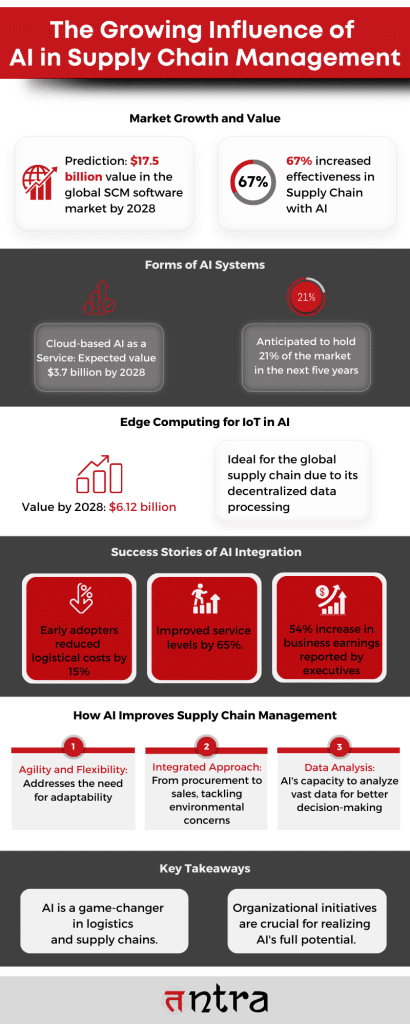
Additionally, it is believed that by 2028, Edge computing for IoT (Internet of Things) systems will be used in AI technology for Supply Chain software solutions, reaching a value of $6.12 billion. The widely scattered structure of global supply chains makes Edge computing a particularly good fit because it gathers and processes data closer to the real data sources as opposed to in a centralized place.
Early adopters that successfully incorporated supply-chain management powered by AI have overtaken their more cautious competitors. They managed to reduce logistical costs by an amazing 15% while simultaneously improving service levels by 65%. 54% of executives said integrating AI into their supply chain operations significantly increased business earnings. This clearly illustrates the undoubted potential of AI technology in the field of logistics and supply chains.
Key AI Technologies Transforming Supply Chains in 2025
AI-powered supply chains rely on a combination of technologies that enable real-time visibility, predictive intelligence, and automated decision-making across operations.
These technologies work together to transform supply chains from reactive systems into intelligent, adaptive networks capable of responding instantly to disruptions.
Predictive Analytics
Predictive analytics uses historical data, market trends, and external signals to forecast demand accurately and optimize planning.
Advanced systems analyze data from point-of-sale systems, customer behavior, and market signals to detect demand shifts and trigger real-time alerts, enabling proactive decision-making.
Generative AI (GenAI)
Generative AI enhances supply chain planning by improving communication, automating insights, and supporting faster decision-making.
Nearly 40% of supply chain organizations are already investing in GenAI for knowledge management and planning optimization. It enables teams to interact with supply chain systems using natural language and generate forecasts, reports, and recommendations instantly.
IoT (Internet of Things) for Real-Time Visibility
IoT devices such as GPS and RFID sensors provide real-time tracking of goods, shipments, and inventory across the supply chain.
This level of visibility reduces delays, minimizes losses, and improves delivery accuracy. Businesses can monitor shipments in transit and respond quickly to disruptions, improving overall operational efficiency.
Edge Computing
Edge computing processes data closer to the source, enabling faster insights and reducing latency in decision-making.
This is particularly valuable in global supply chains, where decentralized operations require real-time processing without relying on centralized systems.
AI + IoT Integration (End-to-End Visibility)
By combining AI with IoT, businesses gain end-to-end visibility across suppliers, manufacturers, and logistics partners. This integrated approach enables faster coordination, improved collaboration, and more efficient supply chain operations.
How AI Improves Supply Chain Efficiency
AI improves supply chain efficiency by enabling accurate demand forecasting, optimizing inventory levels, automating logistics decisions, and providing real-time operational visibility across the entire supply chain.
Modern AI-powered supply chain platforms are shifting operations from reactive processes to predictive, data-driven decision-making. By analyzing real-time signals such as demand fluctuations, weather conditions, and supply disruptions, AI enables faster and more accurate responses at every stage.
Key Areas of Impact
Demand Forecasting
AI analyzes historical data, market trends, and external factors to predict demand accurately.
This allows businesses to reduce stockouts, avoid overstocking, and improve planning accuracy. Advanced AI systems can detect demand anomalies in real time and trigger immediate corrective actions.
Inventory Management
AI optimizes inventory levels by continuously analyzing real-time data and recommending optimal stock levels.
This reduces carrying costs, prevents inventory obsolescence, and enables just-in-time inventory management. AI-driven inventory optimization also improves cash flow and operational efficiency.
Supplier Management
AI monitors supplier performance, identifies risks, and recommends alternative sourcing strategies.
By analyzing supplier data, compliance metrics, and external risk signals, AI enables proactive risk mitigation and builds more resilient supply chain networks.
Logistics and Operations Optimization
AI automates route planning, shipment tracking, and delivery optimization using real-time data. This reduces delays, lowers transportation costs, and improves overall service levels.
AI in Supply Chain vs Traditional Supply Chain
AI-driven supply chains are proactive, data-driven, and highly adaptive compared to traditional reactive systems.
| Aspect | AI-Driven Supply Chain | Traditional Supply Chain |
| Decision-making | Data-driven | Reactive |
| Visibility | Real-time | Limited |
| Forecasting | Predictive | Historical |
| Efficiency | High | Moderate |
| Risk management | Proactive | Reactive |
Real-World Case Studies of AI in Supply Chain
AI in supply chain management delivers measurable business impact by improving efficiency, reducing costs, and enabling smarter decision-making. Here are real-world examples of how organizations are using AI to transform operations.
Kraft Heinz: AI-Driven Logistics Optimization
Kraft Heinz leveraged AI to address challenges in demand forecasting, inventory optimization, and logistics planning.
By integrating AI into its supply chain operations, the company was able to analyze large volumes of data—including production trends, inventory levels, and customer demand—to improve decision accuracy and operational agility.
Impact:
- 42% reduction in operational alerts
- $30 million increase in sales
- Improved demand forecasting and route optimization
This demonstrates how AI enables large enterprises to move from reactive supply chains to predictive, data-driven operations.
Tntra Case Study: AI-Powered Multilingual Logistics Automation
Tntra developed a serverless AI-powered solution for a global logistics provider to automate Bill of Lading (B/L) processing across multiple freight platforms.
The solution integrates with a centralized ERP system, automatically extracts and maps shipment data, and supports multiple languages—eliminating manual processing bottlenecks.
Impact:
- Processes 15,000 B/Ls daily
- Improves operational efficiency by 30–40%
- Reduces manual effort and operational costs
This showcases how AI-driven product engineering can transform complex logistics workflows into scalable, automated systems.
Explore how Tntra builds intelligent, scalable supply chain solutions with AI-powered product engineering.
Explore How Tntra Enabled 15,000 B/Ls Daily – Read the Case Study Now!
5-Step Framework to Implement AI in Supply Chain
1. Identify supply chain inefficiencies
2. Define AI use cases
3. Integrate data across systems
4. Deploy AI models using cloud infrastructure
5. Continuously optimize using real-time insights
Why AI is Critical for Modern Supply Chains
AI in supply chain management is critical because it enables faster decision-making, reduces operational risks, and improves end-to-end visibility.
Businesses adopting AI:
- Reduce costs
- Improve service levels
- Respond faster to disruptions
Enterprises that delay AI adoption risk losing competitiveness in an increasingly digital and fast-moving market.
Future of AI in Supply Chain Management
The future of supply chains is autonomous, intelligent, and adaptive—driven by AI-powered systems that can predict, decide, and act in real time.
As global supply chains become more complex and interconnected, AI is evolving from a support tool into a core decision-making engine—enabling organizations to move from reactive operations to predictive and self-optimizing systems.
Key Trends Shaping the Future:
- AI-powered digital twins for scenario simulation and planning
- Real-time adaptive supply chains that respond instantly to disruptions
- Autonomous logistics systems with minimal human intervention
- End-to-end visibility across suppliers, partners, and customers
Organizations adopting these capabilities are not just improving efficiency—they are building resilient, future-ready supply chain ecosystems.
Why Partnering with the Right Product Engineering Company Matters
As AI adoption accelerates, the ability to design, build, and scale intelligent supply chain solutions becomes a critical competitive advantage.
Enterprises need more than tools—they need a strategic partner who can translate AI capabilities into real-world business outcomes.
At Tntra, we help organizations:
- Build AI-powered supply chain platforms
- Enable real-time data integration across systems
- Automate complex logistics workflows
- Scale intelligent, cloud-native solutions
Our product engineering approach ensures that AI initiatives move beyond pilots and deliver measurable impact at scale.
Conclusion: From Intelligent Systems to Business Advantage
AI is no longer optional in supply chain management—it is a strategic necessity.
Organizations that adopt AI:
- Improve efficiency
- Reduce operational risks
- Respond faster to market changes
Those that delay risk falling behind in an increasingly competitive and fast-moving global landscape.
The future of supply chains is intelligent. Are you ready to lead?
Talk to Tntra’s AI and product engineering experts to design and scale your next-generation supply chain solution.
Contact AI experts today to discuss your custom AI-based Supply chain management (SCM) solution.
FAQs
What is the role of AI in enhancing supply chain efficiency?
AI plays a vital role in enhancing supply chain efficiency by automating routine tasks, improving demand forecasting, optimizing inventory levels, and providing real-time visibility. With AI in supply chain management, businesses can make data-driven decisions, reduce delays, minimize costs, and respond proactively to disruptions across the supply chain.
What are the benefits of AI in supply chain management?
Benefits include improved forecasting, reduced costs, real-time visibility, and better risk management.
What industries benefit from AI in supply chains?
Industries like retail, manufacturing, logistics, healthcare, and e-commerce benefit the most.
How does AI increase efficiency?
AI increases efficiency by analyzing vast datasets quickly and accurately, identifying patterns, and offering predictive insights. In the supply chain, AI can streamline logistics, optimize routes, forecast demand, manage warehouse operations, and automate decision-making processes—leading to faster, smarter, and more cost-effective outcomes.
What is the future of AI in supply chain management?
The future involves autonomous, self-optimizing supply chains powered by AI, IoT, and advanced analytics.
How does generative AI improve supply chain management?
Generative AI improves supply chain management by enhancing knowledge sharing, scenario planning, and decision support. It enables natural language interactions with systems, allowing teams to query data and receive actionable insights instantly. GenAI also automates content generation, such as demand forecasts and reports, driving smarter planning and collaboration across the supply chain.
What are some real-world examples of AI supply chain solutions?
Real-world examples include predictive analytics for demand planning, AI-powered route optimization for logistics, intelligent chatbots for procurement, and computer vision for quality control. Companies like Amazon, DHL, and Kraft Heinz have adopted AI supply chain solutions to improve efficiency, reduce waste, and enhance customer satisfaction.
How can companies get started with AI in supply chain planning?
Companies can start by identifying pain points in their supply chain operations and exploring targeted AI supply chain management solutions such as forecasting tools, warehouse automation, or AI-driven analytics platforms. Partnering with a trusted software engineering firm like Tntra can help design scalable, tailored artificial intelligence in supply chain planning strategies that align with business goals.