Product Architecture Consulting Services: How CTOs Design Scalable Products for Long-Term Growth?
Growth changes a product. What works beautifully for an early MVP often starts to strain when users multiply, integrations deepen, data grows, and enterprise expectations rise. That is where product architecture consulting services become valuable. They help leadership teams shape technology foundations that support speed, reliability, flexibility, and long-term business value. Today, the strongest CTOs see architecture as a business decision as much as an engineering one, and that mindset is what drives scalable product architecture design in fast-moving companies.
At a practical level, What is product architecture consulting and why is it important? It is the process of evaluating how a digital product is structured, how its systems interact, where future bottlenecks may appear, and how the technology roadmap should evolve as the business grows. In high-growth environments, architecture affects release velocity, uptime, infrastructure cost, security posture, and the ability to add new features without creating fragility. That is why many companies turn to software product architecture consulting and enterprise product architecture solutions when they move from MVP traction to scale, or from a successful product to a broader platform play.
A thoughtful CTO product architecture strategy usually begins with a simple question: what kind of scale are we designing for? Scale can mean more users, more transactions, more products, more geographies, more tenants, more compliance requirements, or more internal teams building on the same core platform. Once that is clear, the CTO can connect architecture choices with business goals. This is the heart of how to design scalable software architecture in a way that feels grounded, realistic, and commercially smart.
The screenshots you shared echo what many modern CTOs prioritize. They highlight modular and decentralized structure, loose coupling, asynchronous communication, horizontal scaling, better data management, cloud infrastructure, CI/CD automation, observability, and security. Those themes are fully consistent with current guidance on scalable software systems, especially for SaaS and enterprise products where agility and resilience need to grow together.
How CTOs Start Scalable Product Architecture Design with Business Clarity?
When CTOs design products for scale, they usually begin with business context, not tooling. A product serving 10,000 users with a narrow feature set requires a very different architecture from a SaaS platform serving multiple customer segments, integrating with external systems, and supporting analytics, AI, workflow automation, and role-based permissions. This is why How do CTOs design scalable product architectures? begins with understanding revenue model, user behavior, compliance needs, product roadmap, and expected growth patterns.
For startups, the most effective path is often progressive evolution. That is a big part of product architecture best practices for startups. Early teams benefit from simplicity because speed matters. A clean monolith, strong domain boundaries, clear APIs, and disciplined engineering practices can carry a company further than many founders expect. As complexity rises, architecture can evolve in phases rather than through a full rewrite. This measured evolution is usually the best product architecture consulting approach for scaling startups because it protects momentum while preparing for change.
This is also where CTO as a Service for product strategy can become highly useful. Many growth-stage firms need senior architectural thinking before they need a full-time enterprise CTO. An experienced external CTO or consulting partner can assess the current stack, identify risk zones, define modernization priorities, and create a roadmap that aligns product, engineering, and business teams. That kind of guidance often creates clarity much faster than isolated technical fixes.
A mature product architecture framework for high-growth tech companies usually balances five priorities: speed, resilience, extensibility, cost efficiency, and governance. The strongest frameworks help teams ship quickly while keeping the system readable, modular, and observable. They also make room for future capabilities such as AI services, advanced analytics, global scaling, or enterprise integrations without forcing constant rework.
Key Components of Scalable Software Architecture
So, What are the key components of scalable software architecture?
The answer usually includes modular services, well-defined interfaces, resilient data systems, automation, strong observability, and cloud-aware infrastructure. The screenshots reflect these pillars clearly, especially through ideas like loose coupling, asynchronous communication, horizontal scaling, caching, replication, Kubernetes, and security by design. These are not isolated technical choices. Together, they create the operating rhythm of a scalable product.
CTOs Usually Prioritize These Core Elements:
- Modular system design with clear service boundaries, so teams can update parts of the product independently and reduce cross-system friction.
- API-first and event-driven communication, which supports extensibility and helps products handle traffic spikes more gracefully through asynchronous patterns.
- Data strategies such as caching, replication, storage tiering, and sharding, which improve performance and support growing read and write loads across SaaS and enterprise products.
- Cloud infrastructure with containers, orchestration, autoscaling, and managed services, which strengthens elasticity and operational efficiency for modern digital products.
- CI/CD, observability, and security controls, which keep releases reliable and allow engineering teams to spot issues early while maintaining trust and compliance.
These choices become even more important inside a scalable SaaS product architecture framework. SaaS systems need tenant management, performance isolation, billing logic, access control, uptime protection, and integration readiness. As a result, how CTOs design scalable product architecture for SaaS platforms often centers on service separation, strong APIs, cloud elasticity, and deployment automation. SaaS growth rewards architectures that make feature delivery smoother while keeping operations predictable.
For larger organizations, How to build a scalable product architecture for enterprise applications? usually includes an additional layer of governance. Enterprise products often need auditability, identity management, compliance controls, integration with legacy systems, and performance consistency across regions or business units. That is why enterprise application architecture design services and enterprise product architecture solutions often combine technical modernization with process maturity, platform standards, and a broader digital transformation consulting framework.
Monolithic vs Microservices Architecture: What CTOs Need to Know?
A question that comes up in almost every architecture conversation is this: What is the difference between monolithic and microservices architecture? A monolith keeps the application in one deployable unit, which makes early development simpler and faster. Microservices split the application into smaller independently deployable services, which can improve scalability, flexibility, and fault isolation when managed well.
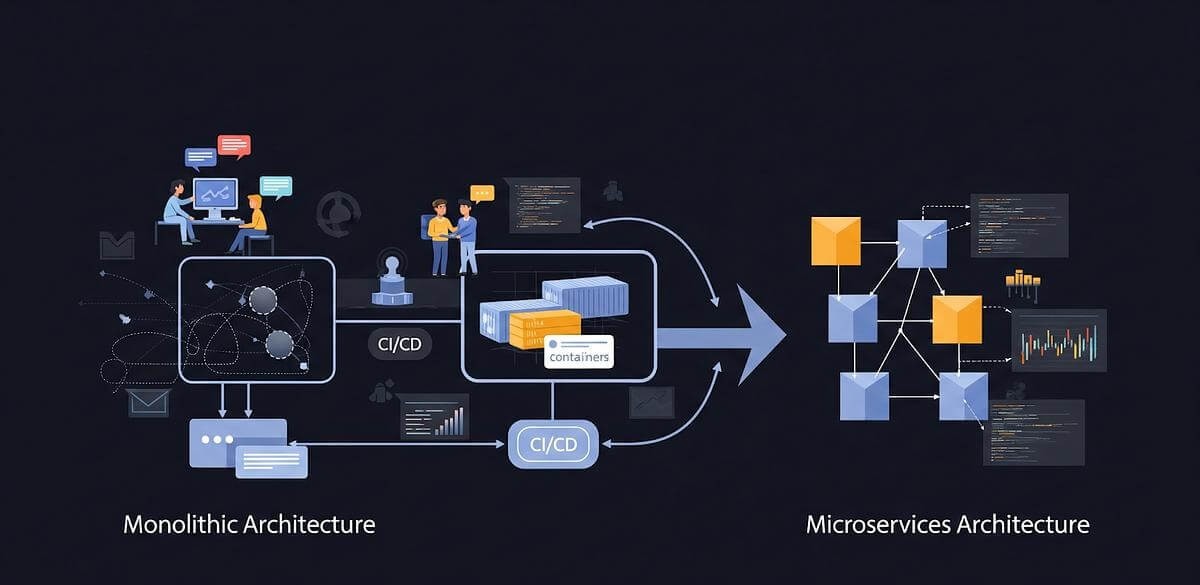
In real-world scaling, the issue is less about trends and more about timing. Many successful SaaS businesses begin with a monolith because it helps small teams move quickly. Over time, certain functions such as payments, search, notifications, identity, analytics, or AI workloads may need independent scaling or release cycles. That is where microservices start to make commercial sense.
This is also why how to transition from monolith to scalable microservices architecture is usually approached gradually, service by service, with clear business reasons behind each step.
CTOs Who Handle This Transition Well Usually Focus On:
- Identifying the domains under the most pressure, such as billing, search, reporting, integrations, or authentication, and extracting those first.
- Creating stable APIs and communication contracts, so the product remains coherent while services evolve independently.
- Investing in deployment pipelines, monitoring, service discovery, and incident response, because distributed systems need stronger operational discipline.
This matters because microservices bring meaningful advantages, yet they also increase operational complexity. Teams need better DevOps practices, stronger observability, clearer ownership, and more disciplined testing. A seasoned consulting partner can help companies decide when to stay simple, when to split services, and how to avoid unnecessary complexity while still building for future scale.
Why Cloud-Native Product Architecture Consulting Matters?
Modern scale increasingly lives in the cloud, which is why cloud-native product architecture consulting has become central to product growth conversations. Cloud-native architecture is built around services and deployment models that take advantage of elasticity, automation, resilience, and faster delivery. Containers, Kubernetes, serverless workloads, managed databases, and event-driven systems all support this direction when they are applied with clear business intent.
The themes visible in your screenshots strongly support this view. Kubernetes orchestration, serverless computing, multi-cloud or hybrid strategy, observability, and security by design are all signs of a CTO mindset focused on adaptability and operational strength. These are especially relevant when a company wants to support unpredictable demand, improve release reliability, and prepare for future product layers such as AI workflows or embedded analytics.
This is where scalable software development services connect with architecture. Great architecture only creates value when engineering execution follows the same principles. Product teams need shared standards for code quality, testing, deployment, infrastructure, documentation, and ownership. When architecture consulting and delivery practices move together, scalability becomes part of how the company builds, rather than a repair project that appears after growth pain begins.
For technology leaders planning AI-enabled products, enterprise AI platform development adds another dimension. AI introduces model pipelines, data workflows, inference services, GPU-intensive workloads, governance requirements, and new performance patterns. A cloud-native, modular foundation makes it much easier to add AI capabilities without destabilizing the product core. This is one reason many CTOs now design for AI readiness earlier in the architecture journey.
Product Scalability Challenges and Solutions CTOs Must Address
Every scaling story has pressure points. The most common product scalability challenges and solutions revolve around database bottlenecks, release friction, rising cloud costs, growing technical debt, weak service boundaries, and blind spots in monitoring. In many companies, the product grows faster than the architecture decisions behind it, which creates friction across engineering, support, and customer experience. Strong consulting helps surface these issues before they become expensive patterns.
A practical CTO response usually combines architectural design with operating discipline. That may include introducing caching and replication, refining domain ownership, separating high-load services, improving CI/CD, setting service-level objectives, and strengthening observability. In SaaS businesses, it may also include tenant-aware performance planning and more structured release management. This is how architecture turns from a technical diagram into an actual growth enabler.
One helpful way to think about architecture is to see it as a growth container. A product with healthy architecture gives teams room to add features, support more customers, respond to enterprise requests, and experiment with new business models. A product with stressed architecture often slows decision-making because every change feels heavier than it should. That difference is exactly why product architecture consulting services matter so much in scaling stages.
What Strong CTOs Actually Do to Build Scalable Products?
The strongest leaders treat architecture as a living strategy. They review current constraints, map future business demands, and make design choices that support both near-term velocity and long-term adaptability. That is the real spirit of CTO product architecture strategy. It combines product thinking, technical leadership, and commercial awareness in one coherent direction.
A strong CTO usually asks questions like these in every architecture review:
- Where will scale appear first?
- Which services deserve independent ownership?
- Which data flows need optimization?
- What should remain centralized?
- Where do security and compliance requirements affect design choices?
- How can the team keep shipping quickly while improving resilience?
When these questions shape the roadmap, scalable product architecture design becomes much more intentional.
This is also why software product architecture consulting and strategic modernization work are increasingly part of growth planning rather than crisis response. Companies want technology systems that can support business ambition with confidence. That may mean refining an MVP foundation, modernizing a legacy stack, shaping a new scalable SaaS product architecture framework, or building a broader digital transformation consulting framework across products and teams.
For organizations entering rapid scale, the most valuable next step is usually an architecture assessment tied to product goals. That means looking closely at business models, user journeys, data flows, team structure, delivery maturity, and cloud posture before choosing major technology moves. From there, it becomes far easier to define how to design scalable software architecture, prioritize the right modernization path, and build a roadmap that supports performance, flexibility, and growth.
If your team is preparing for the next phase of scale, Tntra can help you shape that journey with strategic product thinking, architecture modernization, cloud-native engineering, and AI-ready platform design. Whether you need CTO as a Service for product strategy, a roadmap for how to transition from monolith to scalable microservices architecture, or a complete approach to enterprise AI platform development, Tntra can work with you to design systems that grow with confidence and clarity.
Ready to Scale Your Product Architecture?
Build Scalable Products with the Right Architecture Strategy
Scaling a product requires more than adding infrastructure. It demands the right architectural foundation, cloud-native scalability, and long-term technology vision. Tntra helps enterprises and high-growth startups modernize systems, improve product performance, and build AI-ready digital platforms that scale with confidence.
Explore Related Services: CTO as a Service!
FAQs
What does a product architect do?
A product architect shapes how a digital system is structured — defining service boundaries, data flows, and integration patterns. They make sure the technology foundation supports business goals today without becoming a bottleneck tomorrow. Think of them as the bridge between product ambition and engineering reality.
How do you design a scalable product?
Start with clarity on what kind of scale you’re actually designing for — more users, more markets, more features, or all three. From there, prioritize modular design, clean APIs, resilient data strategies, and cloud-native infrastructure. Scalability is less about picking the right tools and more about making the right structural decisions early.
What is the role of a CTO in architecture design?
A CTO connects architecture decisions to business outcomes. They ask where growth will hit first, which systems need independence, and what trade-offs the team can actually live with. The best CTOs treat architecture as a living strategy, not a one-time diagram that gets forgotten in a sprint.
What are the types of software architecture?
The most common types are monolithic, microservices, event-driven, serverless, and layered architectures. Each has its strengths depending on team size, product complexity, and growth stage. Most real-world products end up using a combination, evolving from simpler structures toward more distributed ones as demands grow.
How do you scale a product from MVP to enterprise?
Carefully and in phases. Most MVPs are built for speed, not scale, which is exactly right at that stage. The transition to enterprise means introducing stronger service boundaries, better observability, compliance controls, and more governance — without halting delivery. The goal is evolution, not a full rewrite.
What are common product architecture mistakes?
The biggest ones are over-engineering too early, under-investing in observability, ignoring domain boundaries until they cause real pain, and treating architecture as a purely technical conversation. Scaling architecture that’s disconnected from business goals tends to solve the wrong problems, often expensively.