Why 70% of Enterprise Innovation Never Moves Beyond the POC Stage
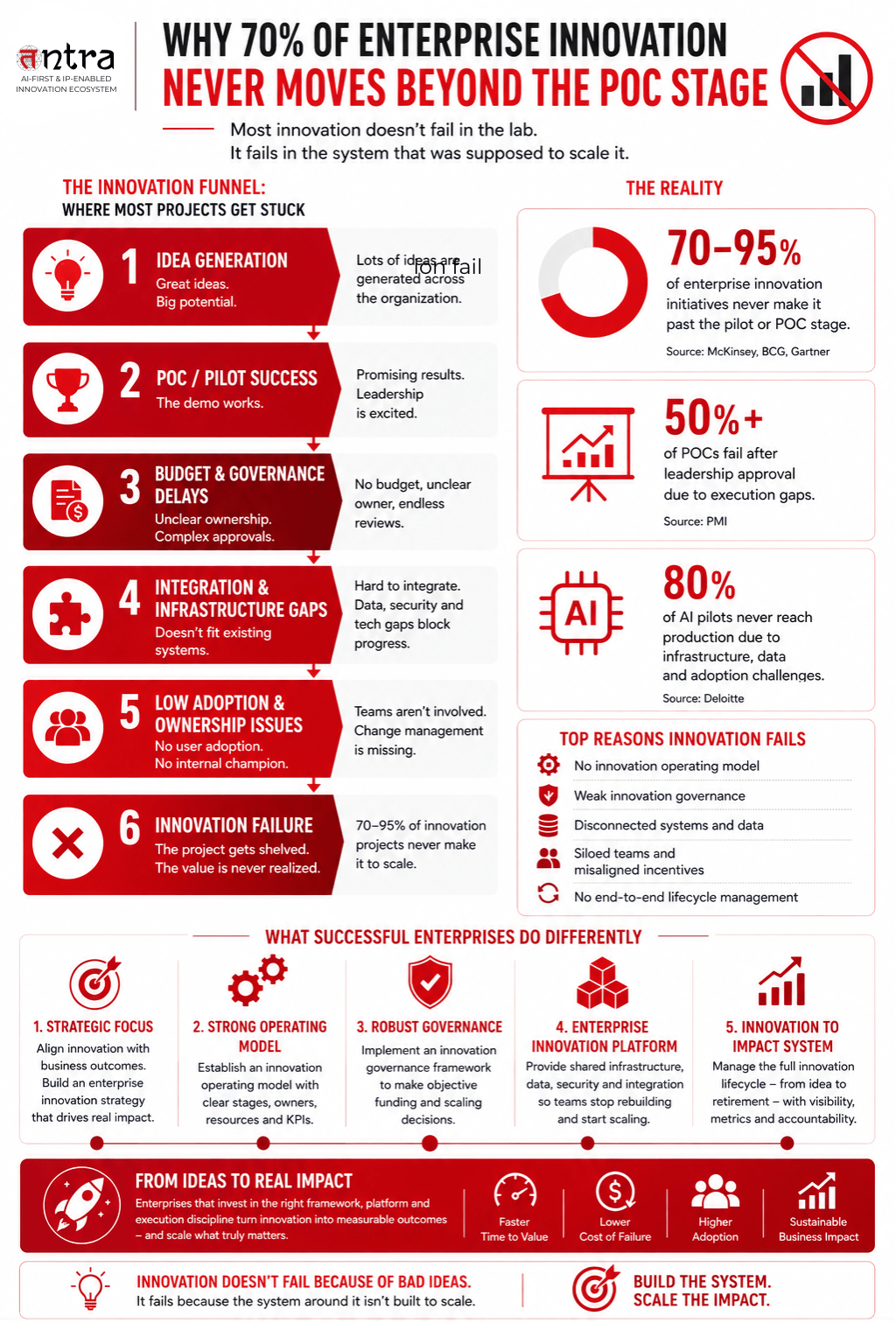
Most enterprise innovation does not fail in the lab. It fails in the system that was supposed to scale it.
There’s a meeting that happens in almost every large organization.
A team has just finished a proof of concept. The demo looks polished. The numbers are promising. Leadership nods. Someone says “this is exciting.”
And then, nothing.
The project quietly disappears into a backlog, a committee review, or a budget cycle that never quite arrives.
This is enterprise innovation failure in its most common form. Quiet. Anticlimactic. And completely avoidable.
The 70% statistic is not an exaggeration. Studies across industries consistently show that the vast majority of innovation initiatives stall after the POC phase.
They get built, demonstrated, celebrated, and shelved.
Most organizations are not running innovation. They are running innovation theatre—optimized for visibility, not outcomes.
And the painful truth is that most organizations have no idea why it keeps happening to them.
The Innovation Lab Problem Nobody Talks About
When the Lab Becomes a Trophy Case
Companies spend millions building dedicated innovation labs. They hire design thinkers, bring in futurists, run hackathons, and create physical spaces meant to spark creativity. For a while, it genuinely feels like progress.
But why innovation labs fail to deliver business impact comes down to one core problem: they are designed to generate ideas, while the organization around them is designed to run operations. These are two fundamentally different systems. Without a bridge between them, innovation stays in the lab forever.
The lab produces a POC. The core business asks, “Great, but who owns this? What’s the budget? What team runs it? How does it fit into our existing systems?”
The lab has no good answers. Innovation dies on the bridge between exploration and execution.
The Idea Was Never the Problem
Innovation POC failure is rarely about the quality of the idea. The idea is usually fine.
The failure lives in the gap between what the lab is rewarded for—generating and showcasing ideas—and what the business actually needs: scalable, profitable, real-world solutions.
This is not a talent problem. It is a system design failure.
You can have brilliant people producing brilliant POCs and still have nothing to show for it two years later. That is exactly what most enterprises are experiencing.
Why Innovation Keeps Dying after the Exciting Part?
Here is something most consultants underplay:
Why innovation projects fail often has nothing to do with technology, talent, or timing.
It has everything to do with organizational design. When a POC succeeds, most enterprises celebrate—and then push it into systems that were never designed for it.
- Procurement expects predictability
- Finance expects proven ROI
- HR expects stable roles
Innovation is none of these things. Forcing innovation through these systems is not governance. It is structural rejection.
What Happens After Launch
Why innovation fails after launch is a particularly frustrating phenomenon because the organization genuinely tried. A product gets built, goes live, and within six months, adoption is low, the team has been reassigned, and leadership has moved on to the next exciting initiative.
The product exists, but the ecosystem needed to sustain and grow it was never created.This happens because organizations treat innovation as a project with a start and end date, rather than as a capability that requires its own innovation operating model. Once the project phase ends, the innovation is essentially orphaned.
The Hidden Forces that Kill Scale
The hidden reasons 90% of innovation never scales are less about technology and more about organizational behavior. Budget cycles that reset annually. Leaders incentivized on short-term performance. Middle managers who see new tools as threats to their current workflows. Procurement teams that add months of delay to any new vendor relationship.
These are not edge cases. They are the default operating conditions of most enterprises. And they kill more innovation than technology ever will.
What a Real Innovation Operating Model Actually Looks Like
Three Layers That Must Work Together
The organizations that consistently move from idea to impact share one common trait: they treat innovation as a discipline, not an event. They build an enterprise innovation framework that governs how ideas are discovered, tested, resourced, scaled, and retired.
A functional innovation operating model connects three layers that most organizations keep completely separate:
- Strategy layer: Where is the organization going, and which problems are worth solving to get there? This is where enterprise innovation strategy lives. It must be set by leadership, communicated clearly, and revisited regularly.
- Execution layer: How do ideas move from concept to product? This is the innovation execution model, defining the stages, gates, owners, and resources for every initiative. Without this, every team reinvents the wheel.
- Governance layer: Who decides what gets funded, what gets killed, and what gets scaled? A strong innovation governance framework means those decisions are made on merit and strategic alignment, not on politics or whoever shouted loudest in the last leadership meeting.
Most enterprises have pieces of this. Very few have all three layers working together. That gap is where billions of dollars in innovation investment quietly disappear every year.
AI and the New Frontier of Innovation Execution
Why Early AI Pilots Failed the Same Way?
AI innovation framework thinking has matured significantly over the past few years. Early AI initiatives in enterprises suffered from the exact same POC problem: lots of pilots, very few products. A model would get trained on clean data in a sandbox, perform beautifully in a demo, and then collapse when exposed to messy real-world data, fragmented systems, and confused users.
The shift happening now is that leading organizations are building their enterprise AI transformation framework around outcomes, not algorithms. The question is no longer “what can this model do?”
The question is “what decision or process does this model improve, and how do we measure that?”
Sequencing Matters More than Most Teams Realize
An AI-driven innovation methodology that actually works starts with the business problem, works backward to the solution, and builds the data infrastructure, change management plan, and governance model before writing a single line of code.
Scaling innovation in enterprises with AI requires treating AI as infrastructure rather than a feature. When AI is bolted onto existing processes, it creates friction and gets abandoned. When it is woven into how work actually happens, it becomes indispensable. That distinction sounds simple. Getting it right in practice is where most organizations need help.
Scaling AI is not about better models. It is about better integration into how work actually happens.
Innovation Lifecycle Management: The Piece Everyone Skips
Why the Back Half of the Journey Gets Ignored?
Most organizations focus on:
- Ideation
- POCs
- Pilots
And ignore everything after. That is where value is lost.
A complete lifecycle includes:
- Discovery
- POC
- Pilot
- Scaling
- Performance management
- Retirement
If you don’t manage the back half, you don’t have innovation. You have experimentation.
From POC to Platform: The Infrastructure Shift
Why Starting from Scratch Every Time is Killing You?
Enterprise innovation at scale does not fail because of a lack of ideas. It fails because every new idea starts from scratch.
Most enterprises build disconnected point solutions—each with its own data pipelines, security layers, integrations, and deployment logic. Over time, this creates fragmentation that slows execution, increases cost, and makes scaling nearly impossible.
This is not an execution gap. It is an infrastructure problem.
The shift required is simple to understand, but difficult to implement:
Build the platform once. Let innovation plug into it.
An enterprise-grade innovation platform provides a shared foundation across:
- Data access and orchestration
- Security and compliance
- Integration with core systems
- Deployment and scalability
- User and access management
When these are solved at the platform level, innovation teams stop rebuilding plumbing and start solving real business problems.
Without this foundation, every POC is a one-off—and most will never survive beyond the demo stage.
Where the Innovation to Impact Framework Becomes Real
This is where the innovation to impact framework stops being conceptual and becomes operational.
The platform acts as the connective layer between innovation activity and measurable business outcomes. It enables visibility across the entire innovation lifecycle—from idea to deployment to performance.
Leaders are no longer forced to rely on narratives or isolated success stories.
They can see, in real time, how innovation investments translate into adoption, efficiency, and revenue impact.
The conversation shifts from:
- “Are we innovating enough?”
To: “What is our innovation actually producing—and how do we scale it further?”
Choosing the Right Innovation Partner
What Good Consulting Actually Looks Like
The enterprise innovation consulting ecosystem has grown rapidly—and for good reason. Most organizations benefit from external perspective, structured thinking, and access to capabilities they cannot build internally at speed.
At its best, the right partner can compress years of trial and error into a focused, outcome-driven journey.
The problem is that most consulting engagements are not designed for outcomes. They are designed for deliverables.
- Strategy decks
- Frameworks
- Presentations
And then nothing changes.
A strategy gets approved. A roadmap is defined. The engagement ends.
But the system required to execute that strategy was never built—and the internal team was never equipped to carry it forward.
This is where most innovation consulting fails.
Not because the thinking was wrong—but because the capability was never transferred.
What Real Partners do Differently
The difference is not in insight. It is in execution.
Real innovation partners do not operate as advisors on the outside. They embed within the system and help build it from within.
They:
- Work alongside internal teams, not parallel to them
- Build execution capability, not just strategic clarity
- Stay accountable for outcomes, not just outputs
They are measured the same way the business is—by what gets shipped, adopted, and scaled.
The Questions Worth Asking ebfore you Sign Anything
Choosing the right innovation partner is not about capability on paper. It is about what actually gets built, adopted, and scaled inside your organization.
The better model is to work with a partner that embeds alongside internal teams, builds capability as part of the engagement, and stays accountable for outcomes—not just outputs.
A genuine enterprise innovation partner measures success the same way the business does: in revenue impact, cost reduction, time saved, and decisions improved.
Before engaging any consulting partner, the questions worth asking are simple:
- Can you show us POCs that became production systems in organizations like ours?
- What does your framework look like in execution—not just in presentation?
- How do you ensure our team is stronger after the engagement than before it?
If the answers focus on deliverables rather than outcomes, the result will be predictable.
The Path Forward
The organizations moving from innovation theater to genuine innovation capability share a few behaviors worth naming clearly:
- They fund innovation as a portfolio with different time horizons and risk profiles, not as a single project with a fixed deadline
- They build innovation pipeline management systems that give leadership real visibility into what is moving and what is stuck
- They treat innovation lifecycle management as a core operational discipline alongside finance, HR, and supply chain
- They invest in an enterprise innovation platform that gives teams a shared foundation rather than a blank slate every time
- They measure the innovation operating model itself, not just the outputs, so they can improve how they innovate over time
The organizations that figure this out will move faster, waste less, and build things that actually get used. The ones that keep running POCs without the infrastructure to scale them will keep wondering why their enterprise innovation strategy is not producing the results they expected.
The gap between a great demo and a real product is a system problem. And systems can be designed, built, and improved with the right thinking and the right partners.
Ready to Innovate?
Tntra helps enterprises close this gap. As a purpose-built enterprise AI solutions provider and innovation ecosystem builder, Tntra combines deep engineering capability with a structured innovation to impact framework that takes ideas from concept through to scaled, production-ready products. Whether you are trying to rescue a stalled POC, redesign your innovation operating model, or find a true AI innovation partner that stays accountable for real outcomes, Tntra is built for exactly this kind of work.
See how Tntra helps enterprises build what actually ships → tntra.io
FAQs
What is the Main Reason Projects Fail to Move Past POC?
Most POCs fail to scale because the organization lacks an innovation execution model to carry ideas forward. The gap between a successful demo and a production-ready product is almost always a system problem, not a technology problem.
Why Do 95% of Enterprise AI Projects Fail?
They are built around algorithms rather than outcomes. Without a clear enterprise AI transformation framework that connects AI capability to real business decisions, even technically impressive models get abandoned after the pilot phase.
What is a Major Challenge Faced by AI Proof of Concepts?
POCs are typically tested on clean, controlled data but deployed into messy, fragmented real-world systems. Without proper innovation lifecycle management, this transition breaks the solution before it ever reaches scale.
How Many AI Projects Fail?
Research consistently shows that between 70% and 95% of enterprise AI initiatives never move beyond the pilot or POC stage, making innovation POC failure one of the most expensive and underreported problems in large organizations today.
Why Do Most Innovation Projects Fail in Enterprises?
Because enterprises treat innovation as a project rather than a capability. Without a functioning innovation operating model and innovation governance framework, ideas get orphaned the moment the initial excitement fades.
What is the Best Way to Scale AI in Enterprises?
Treat AI as infrastructure, not a feature. Building an enterprise innovation platform as a shared foundation, paired with an AI-driven innovation methodology rooted in business outcomes, is the most reliable path to sustainable scale.
How to Reduce Innovation Failure in Enterprises?
Invest in a complete innovation lifecycle framework that governs ideas from discovery through retirement. Pair that with strong innovation pipeline management and a leadership culture that funds innovation as a portfolio, not a one-time bet.