Why Innovation Labs Fail to Deliver Business Impact (And What’s Missing)?
Innovation labs fail not because of bad ideas but because of broken structure. This article examines why enterprise innovation consistently stalls between prototype and business impact, tracing the root causes to missing operating models, vague strategy, weak governance, and lifecycle frameworks that were never built in the first place. It makes the case that closing the innovation to impact gap requires building innovation as a deliberate organizational system, and explains why AI makes getting this right more urgent than it has ever been.
Most corporate innovation labs share the same origin story. Leadership gets inspired at a conference, a consultant presents a compelling case, a budget gets approved, and suddenly there is a shiny new lab with a catchy name, exposed brick walls, and a mandate to “disrupt from within.”
Eighteen months later, the question nobody wants to ask out loud starts circulating in the corridors: why has none of this made it into the actual business?
Understanding why innovation labs fail starts with being willing to look at the uncomfortable truth. The problem is almost never the people. The ideas are usually solid. The energy, at least in the beginning, is genuine. What breaks down is everything around the ideas. The structure, the governance, the connection to the business that was supposed to benefit from all this creative energy in the first place.
The Gap Nobody Planned for
There is a specific moment that kills most innovation programs, and it happens long before anyone realizes it is happening.
An idea gets validated. A prototype gets built. The demo goes well. Leadership is impressed. And then the idea needs to move into the real business, and suddenly there is no clear path forward. No business unit has ownership. No budget has been allocated for the next stage. Nobody has the authority, or frankly the incentive, to shepherd something unproven through a system that was built to execute known things reliably.
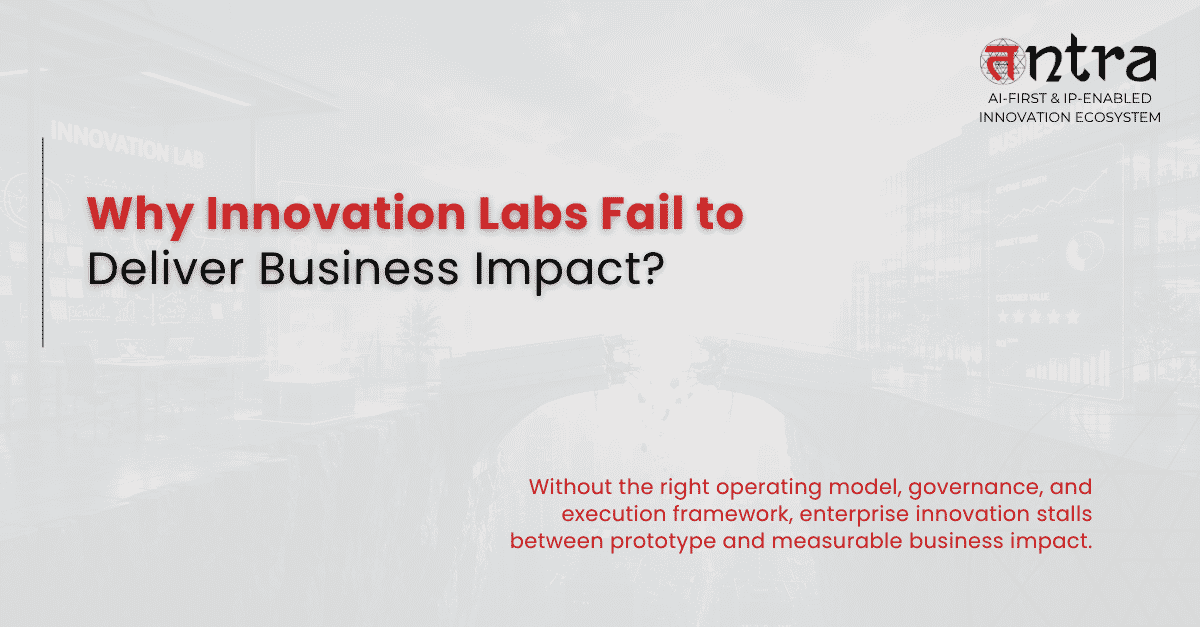
This is the innovation to impact gap, and it is far more common than most organizations want to admit. The lab was set up to generate ideas. Nobody set up the infrastructure to land them.
Innovation not delivering business impact is almost always a symptom of this structural failure. The core business runs on efficiency, predictability, and risk management. The innovation lab runs on exploration, experimentation, and learning fast. These two operating rhythms are almost perfectly opposed, and when nobody builds a bridge between them, the chasm swallows everything.
Enterprise innovation failure does not usually happen because an idea was bad. It happens at the crossing point, where a promising concept meets an organization that was never prepared to receive it.
The Reason Innovation Stays Stuck
Here is what most post-mortems on failed innovation programs get wrong. They attribute the failure to culture. The business was too risk-averse. Leadership did not walk the talk. The teams were not empowered enough.
Culture matters. But culture is downstream of structure. And the deepest innovation labs failure reasons are structural every single time.
The missing piece is almost always a functioning innovation operating model, the connective tissue between a great idea and a business result. Without it, every innovation initiative is essentially improvising its way through a process that requires precision. Teams spend enormous energy figuring out how decisions get made, who controls the next stage of funding, what success even means at each milestone. That energy should be going into building something worth scaling.
A real innovation execution model answers the questions that most organizations leave dangerously open. Who has the authority to move a project from prototype to pilot? What does a business unit need to see before it adopts something new? How does the organization learn from the bets that do not work out, so the same money does not get lost twice? These are not creative questions. They are operational ones, and answering them is what separates organizations that consistently deliver enterprise innovation from those that consistently talk about it.
Innovation execution failure is predictable when these questions go unanswered. And the frustrating part is that it is entirely preventable with the right upfront design.
Strategy that is Specific enough to be Useful
There is a level above the operating model that deserves its own honest look, and that is innovation strategy failure at the top of the house.
Ask most enterprises to show you their innovation strategy. What you will usually get is either a deck full of aspirational language with no real choices embedded in it, or a list of current projects dressed up to look like strategy. Real enterprise innovation strategy makes specific commitments about where the organization will compete, what it will build, and what it will deliberately walk away from. Most innovation strategies carefully avoid making those choices.
Without that specificity, labs drift. They chase whatever felt most exciting at the last leadership offsite. The portfolio ends up scattered across problems that share no common thread, and nothing accumulates into real competitive advantage.
Managing enterprise innovation with genuine discipline means treating it the way a serious business treats capital allocation. Every bet should connect back to a specific strategic intent. Every investment should be evaluated against a clear thesis. The enterprise innovation framework that supports this operates across several layers working together: strategy at the top, portfolio management in the middle, execution infrastructure underneath, and an ecosystem layer connecting the organization to external talent, technology, and ideas. Pull any one of these out and the system weakens.
The innovation governance framework is where most organizations stumble hardest. Governance sounds bureaucratic, and in many companies it is. But thoughtful governance does the opposite of what people fear. It makes decisions faster by making the criteria clearer. It gives teams confidence because the goalposts stop moving. And it creates the accountability structures that turn innovation from a series of interesting experiments into a managed portfolio of strategic bets.
The innovation lifecycle framework companions this closely. Every idea needs a mapped journey, from early problem validation through concept development, prototyping, piloting, and into scale. When that map does not exist, every stage transition becomes a negotiation, momentum dies, and good ideas arrive at organizational bureaucracy without the stamina to survive it.
Why AI Makes this More Urgent, not More Complex?
Everything described so far has been true for decades. What has changed is how fast the window is closing.
AI is compressing the pace of competitive change in ways that make enterprise innovation challenges more expensive to ignore than they have ever been. The organizations building genuine advantage right now are treating AI as infrastructure, not as a collection of pilots.
Building a serious AI innovation framework means rethinking how the entire organization discovers, evaluates, and integrates new capabilities, not just running experiments with the latest models. An AI-first innovation ecosystem is built through deliberate investment in data infrastructure, governance, talent, and partnership networks. It is built by leaders who understand that the innovation ecosystem platform layer connecting them to startups, research institutions, and technology partners is a strategic asset, not a nice-to-have.
The concept of an enterprise innovation OS captures this well. Just as an operating system gives every application a reliable foundation to run on, an innovation operating system gives every initiative shared infrastructure, shared governance, and shared learning to build on. An AI-powered innovation platform embedded within this accelerates everything from market research to prototype iteration to scaling decisions, and creates institutional memory that compounds over time.
Innovation ecosystem development at this level takes years to build and creates the kind of competitive moats that are genuinely hard to replicate. The organizations investing in it seriously right now will look back on this period as the one where the real distance between themselves and their competitors was established.
What Closing the Gap Takes?
The organizations that consistently deliver on enterprise innovation strategy share a few behaviors worth naming directly:
- They get specific about strategy before they greenlight a single project, clarity on what problems are worth solving and which ones are out of scope.
- They build the innovation operating model before they build the portfolio, governance and lifecycle infrastructure come first, not as an afterthought when things go sideways.
- They measure outcomes rather than activities, how many innovations entered the business, what impact did they generate, not how many hackathons were run.
- They treat AI innovation framework development as foundational infrastructure, not as one initiative sitting alongside others.
These are operational commitments, not cultural ones. And they require senior leadership to make them with real conviction, because the system that exists inside every large organization will resist them, not out of malice, but because established systems protect themselves.
The innovation to impact the gap is a solvable problem. It closes when organizations decide to build innovation as a system rather than run it as a program. That decision is harder than it sounds, and more valuable than most leaders realize until they are on the other side of it.
This is exactly the work Tntra does with enterprise leadership teams.
As a strategic AI innovation partner, digital transformation partner, and innovation consulting firm enterprise organizations trust when the stakes are real, Tntra helps build the operating models, governance frameworks, and enterprise innovation platform infrastructure that turn innovation from a recurring cost into a compounding advantage.
If your organization is ready to close the gap between innovation activity and business impact, the conversation starts at www.tntra.io.
FAQs
Why do Innovation Labs Fail in Enterprises?
Innovation labs fail because the structure around the ideas breaks down, not the ideas themselves. Without a defined pathway from prototype to business adoption, clear ownership, and governance that connects the lab to the core business, even the most promising concepts stall between innovation and implementation.
Why do Most Innovation Projects Not Scale?
Most innovation projects fail to scale because organizations build labs but never build the infrastructure needed to operationalize outcomes. Without a deliberate innovation operating model, promising projects get trapped inside enterprise bureaucracy.
What Prevents Innovation from Delivering ROI?
Innovation fails to deliver ROI when strategy lacks specificity, governance is inconsistent, and no scalable innovation lifecycle framework exists to move projects from experimentation to deployment.
How can Companies Turn Innovation Into Business Impact?
Companies create measurable impact by building innovation as an operational system with governance, ownership, lifecycle frameworks, and measurable execution models.
What is an Innovation Operating Model?
An innovation operating model defines how innovation initiatives move through funding, governance, validation, scaling, and adoption inside the enterprise.
How do You Scale Innovation Beyond POC?
Scaling innovation beyond proof-of-concept requires clear ownership, predefined scale budgets, governance checkpoints, and business units prepared to operationalize successful pilots.
What is the Biggest Challenge in Enterprise Innovation?
The biggest challenge is bridging the gap between experimentation and operational adoption. Most enterprises generate ideas successfully but fail to build the systems required to scale them into measurable business outcomes.